Can electric cars win over the mass market?
August 26, 2011 by Mira Oberman
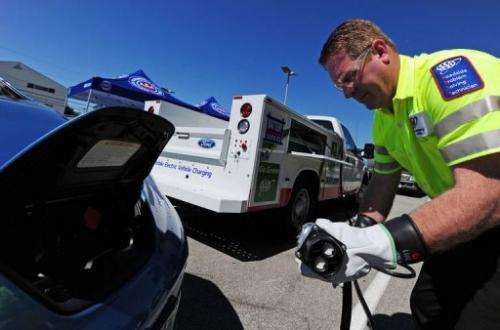
John Nielsen of the American Automobile Association demonstrates charging a Nissan Leaf electric car, at the unveiling of North America's first roadside assistance trucks capable of charging electric vehicles in Los Angeles, California.
It's not every day that a US governor accepts an invitation to the launch of a Japanese-built car, but Nissan's all-electric Leaf offers environmental credentials that top any nationalistic concerns.
"Illinois is laying the groundwork for electric vehicles and a more green economy, and our efforts are paying off," Governor Pat Quinn said Thursday, as he thanked Nissan for bringing the Leaf to his state months earlier than originally planned.
"By investing in electric vehicle technology, both the state of Illinois and Nissan are making transportation in our state more efficient, sustainable and affordable."
The first mass-market electric vehicle has won some high-profile fans since it was launched in Japan and a handful of US markets in December, and in Europe earlier this year.
The Leaf emits none of the tailpipe pollutants that have covered city skies in smog and is touted as a step forward from gas-electric hybrids produced by the likes of Toyota, which makes the best-selling Prius.
Eager early adopters are waiting months to get their hands on one and 350,000 Americans have asked Nissan to send them information about the Leaf.
Yet it's not yet clear how successful the Leaf will be at winning over what Nissan's US marketing director calls the "pragmatic majority". Or what kind of an impact it will have ultimately have on greenhouse gas emissions.
Unlike plug-in hybrids such as GM's Volt which also offer zero-emission driving -- though at a far more limited range -- Leaf drivers can't just stop at a gas station if they run low on battery power.
While most Americans drive just a fraction of the Leaf's maximum range of 100 miles (160 kilometers) on their daily commutes, there simply aren't yet enough public charging stations to allow for road trips or fully eliminate 'range anxiety' - the fear of getting stuck on the side of the road when the battery runs dry.
"It's a big shift," Leaf marketing director Brian Marangno told AFP after the Chicago launch, which will include a highly-publicized three day 'Drive Electric' fair where prospective buyers can learn about the Leaf and take it for a spin outside the Field Museum.
"Our car is not for everyone, there's no doubt of that, but it's for a lot of people."
JD Powers forecasts that 12,000 electric vehicles will be sold in the United States this year -- a tiny fraction of the 12 to 13 million vehicle market.
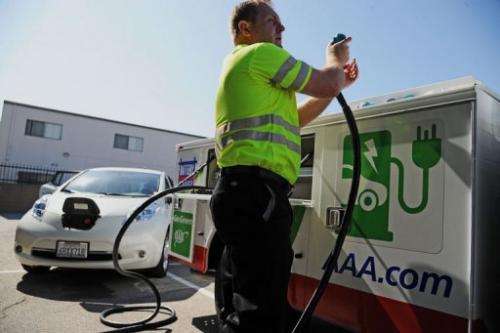
John Nielsen of the American Automobile Association demonstrates charging a Nissan Leaf electric car in Los Angeles, at the unveiling of North America's first roadside assistance trucks capable of charging electric vehicles.
That number should rise to 100,000 vehicles in the US and 800,000 worldwide in 2016 as more automakers enter the electric market and more consumers are drawn to the product, said JD Powers auto industry analyst Mike Omotoso.While those numbers look impressive, electric cars are forecast to make up just 0.6 percent of the US market and 1.3 percent of global auto sales by 2016.
More flexible hybrids are expected to take a bigger chunk as automakers expand their offerings to meet stringent fuel economy and emissions standards.
JD Powers forecasts hybrid sales will reach 1.1 million units in the United States and 3.1 million worldwide in 2016, which is around seven and five percent of the markets.
"One of the things that's slowing down the growth of hybrids and electric vehicles is that we're seeing a big improvement in fuel economy with gasoline-powered vehicles," Omotoso said in a telephone interview.
There are a wide variety of vehicles that offer efficiencies of around 40 miles per gallon but only cost $15,000 to $20,000, compared with around $40,000 for the Volt and $33,000 for the Leaf.
"With the economy still weak, people are going to look for the cheap solution," Omotoso said.
That's why it's so important for automakers to improve the fuel efficiency of their entire lineup, said Luke Tonachel, a transportation analyst with the National Resource Defense Council.
"Electric cars are one of a suite of technologies that are making vehicles cleaner and more fuel efficient," he said.
Tough new standards announced last month by President Barack Obama will help cut US oil consumption by three million barrels per day and slash carbon emissions by 550 million metric tons per year by 2030.
(c) 2011 AFP
-
From lemons to lemonade: Reaction uses carbon dioxide to make carbon-based semiconductor,
32 comments
-
Thioridazine kills cancer stem cells in human while avoiding toxic side-effects of conventional cancer treatments,
3 comments
-
SpaceX private rocket blasts off for space station (Update),
42 comments
-
Climate scientists say they have solved riddle of rising sea,
31 comments
-
SpaceX capsule has 'new car' smell, astronauts say (Update),
2 comments
-
Need a rigid insulation material???
14 hours ago
-
magnets or EMF in car bumpers to protect from fender bender
May 26, 2012
-
length of wire in a coil of known dimensions?
May 25, 2012
-
India Engineering Powerhouse
May 25, 2012
-
electromagnet core dereference between hard and soft iron
May 25, 2012
-
Measuring water pressure in an open tank
May 24, 2012
- More from Physics Forums - General Engineering
More news stories
Browser wars flare in mobile space
The browser wars are heating up again, but this time the fight is for dominance of the mobile Internet.
7 hours ago |
5 / 5 (1) |
3
Probability of contamination from severe nuclear reactor accidents is higher than expected: study
Catastrophic nuclear accidents such as the core meltdowns in Chernobyl and Fukushima are more likely to happen than previously assumed. Based on the operating hours of all civil nuclear reactors and the number ...
Technology / Energy & Green Tech
May 22, 2012 |
3.6 / 5 (22) |
56
|
SpotterRF debuts Radar Backpack Kit (w/ Video)
(Phys.org) -- SpotterRF has announced a special radar backpack kit designed to enhance situational awareness for soldiers on the ground. The company says its special radar is designed for warfighters as part ...
HyperSolar shows dirty water no barrier to power world
(Phys.org) -- The Santa Barbara, California, company, HyperSolar, is set to transparently share the ups and downs of its research experiences toward the companys ultimate vision, successfully producing ...
Tesla to launch electric sedan in US on June 22
Tesla Motors said Tuesday it would begin deliveries of "the world's first premium electric sedan" on June 22, slightly ahead of schedule.
Technology / Energy & Green Tech
May 22, 2012 |
4.5 / 5 (12) |
18
Nvidia trumpets Tegra 3 phone design wins for 2012
(Phys.org) -- Nvidias competitive war paint has a name, Tegra 3. On the heels of Nvidia announcements about lowering costs of its Tegra 3 processors and Nvidia-enabled tablets running Android Ice Cream ...
Scientist: Evolution debate will soon be history
(AP) -- Richard Leakey predicts skepticism over evolution will soon be history. Not that the avowed atheist has any doubts himself.
Dell tablet leak: 10.1-inch display, two-battery choice
(Phys.org) -- Headline after headline talks about vendors tablets in the wings as likely number-one contenders for the iPad. Such claims have justifiably been taken with a grain of salt, considering ...
Keep food safety in mind this memorial day weekend
(HealthDay) -- Picnics, parades and cookouts are as much a part of Memorial Day weekend as tributes to the United States' war veterans.
Social welfare cuts ultimately come with heavy price, researchers say
(Phys.org) -- Slashing government funding for Medicaid, food stamps and other programs that serve the poor while politically popular with some lawmakers and many conservatives may do more harm ...
Is a classical electrodynamics law incompatible with special relativity?
(Phys.org) -- The laws of classical electromagnetism that were developed in the 19th century are the same laws that scientists use today. They include Maxwell’s four equations along with the Lorentz la ...

Aug 26, 2011
Rank: 3.5 / 5 (4)
Also, who is the idiot who wrote this article. they said ...President Obama WILL help cut... Unless they know something we don't it should state, ...SHOULD help...
Aug 26, 2011
Rank: 3.7 / 5 (3)
Aug 26, 2011
Rank: 4 / 5 (8)
It is the perpetual failure of non-thinkers to believe that there must be a singular solution to every problem.
Electric vehicles are one type of solution to the problem of CO2 production in the transportation sector,
Aug 26, 2011
Rank: 2 / 5 (14)
The energy to charge the battery comes from Coal. The nissan leaf is essentially a coal powered car.
If we get the electricity from renewable sources, then were stuck with the fact that batteries have extremely low energy density. This is fundamental to the battery design, as it carries its fuel and its waist products with it all time.
Fuel cells and hydrogen are the only real solution. Investments should be made in that direction. This is why every major car company has a hydrogen fuel cell program. Electric cars are just a stopgap, way to get a foothold in the "green" market, while the bugs are worked out in the FCVs. Which, btw, are doing well and should be on the market soon.
Aug 26, 2011
Rank: 4 / 5 (5)
Aug 26, 2011
Rank: 4.3 / 5 (4)
Aug 26, 2011
Rank: 4.4 / 5 (7)
Sorry, but no. Hydrogen production remains grossly inefficient and even in theory can't work. You can't distribute hydrogen in the existing pipelines, so either an entirely new infrastructure has to be built or you truck it around. The hydrogen vehicle has been a great way for the automobile industry to avoid improving other technologies. Even the grandson of the inventor of fuel cells has abandoned them in favor of battery power.
Aug 26, 2011
Rank: 4.5 / 5 (2)
If our various national administrations in concert with the banking industry would include viable technologies for home generation, conversion and storage of electric energy into home mortgages and sweeten the deal with lower interest rates it would do several things: 1) Reduce the strain on the national and local power infrastructure, 2) Stimulate the home building market, and 3) Infuse capital into the off-grid energy generation, energy conversion and storage markets.
Of course, I'm being a bit self serving here... I plan to retire to some land I bought some years ago in NW Nevada. As I'll need to generate, convert and store my own power I'd like to see the energy production, conversion and storage methods mature some, and for the prices to come down. The only way the prices will come down significantly is if there is a mature and active market.
Aug 26, 2011
Rank: 3.7 / 5 (3)
Aug 26, 2011
Rank: 5 / 5 (10)
Where does the energy to produce hydrogen come from, pixie dust?
Aug 26, 2011
Rank: 4.5 / 5 (2)
Aug 26, 2011
Rank: 5 / 5 (4)
The energy to charge the battery come from the grid. That means that, as more environmentally friendly technologies are added to the grid and replace the more polluting ones, the technology to charge and power the cars locally can/will remain the same.
Saves a lot of expensive infrastructure changes in the future (except of course for the initial infrastructure change of providing quick charge stations/etc when/if that tech becomes available).
Aug 26, 2011
Rank: not rated yet
Yes, indeed..... The two most profitable ventures in our nation's glorious history!
Aug 26, 2011
Rank: 5 / 5 (2)
Its called inertia. You can much more easily send a few dozen people to the moon a dozen or so times than move millions of people around, safely, reliably, and do it year after year. Look at the transition from using horses as the primary mode of transport to using cars. In that case there was a HUGE environmental driver, much more so than moving from gas to electric cars.
And it still took at least 25 years.
Aug 26, 2011
Rank: 4 / 5 (1)
The charging of electric cars will also be a safety issue. Looking at the top picture you can see the guy wearing arc flash protecting gloves, but not the NFPA 70E required helmet and face sheild. He's also wearing clothing with reflective material, which is not allowed in arc flash protective clothing. Until I see the numbers indicating the voltage and amperage I won't be able to tell what NFPA 70E risk/hazard catagory is involved and subsequently the required personal protective equipment. Charging electric cars at a public location will either have to be hands-free or will have to be performed by a trained operator with the proper equipment. There is simply too much energy involved in a rapid charge process to let the driver do it.
Aug 26, 2011
Rank: 4.7 / 5 (3)
Yes, and how long do you think it will take before that shift happens?
Here's a tip: it's going to take longer than the lifetime of an electric car bough in the next 5-10 years.
There will be at least two generations of electric cars that will be powered predominantly on coal if we start buying them in the near future.
Aug 26, 2011
Rank: 5 / 5 (2)
Come on, don't forget CO2-free nuclear energy. Doesn't it sout better 'nuclear-powered car'?
Open your mind. Currently used batteries are extremely primitive as well as fuel cells. But recently discovered graphene-lithium solution sounds very interesting. Nano-tube supercapacitors might be a good solution too. Both cabon based capacitors and batteries can work together with fuel cells giving great power some day.
Remember taht hydrogen doesn't exist in pure form on earth. We can easily produce it from water, but with use of energy. So, hydrogen cars would be coal-powered too :)
Aug 26, 2011
Rank: 3.3 / 5 (6)
It basically takes a decade to build a nuclear powerplant these days because of all the red tape, and with no plans to build new plants, we'll soon run out of nuclear power - unless you want to risk running the old ones till they eventually blow up.
You can thank the hippies for that.
Aug 26, 2011
Rank: 3.4 / 5 (5)
Sure.
Not right away. Batteries need to improve. But we've seen a number of articles right here at PhysOrg that suggest that better batteries are coming. Much better.
Want to make a bet? I think that by the year 2050, you'll be able to drive an electric car from Washington, D.C. to LA on a single charge - and charge it up in a few hours. Energy densities like that for batteries aren't prohibited by any of the laws of physics. Electrons are light; it's just figuring out how to store them that needs work.
Once batteries achieve energy densities approaching that of gasoline, the reduced maintenance costs and cheaper fuel for electric cars will be irresistible. Meantime, there will be early adopters to motivate manufacturers to work out the bugs.
Aug 26, 2011
Rank: 2.6 / 5 (5)
Did you buy one yet or are you waiting for more govt subsidies?
Aug 26, 2011
Rank: 3.7 / 5 (3)
Except that you aren't storing electrons.
Electrons are like the chain of a bicycle while the battery is like a big spiral spring with a sprocket. Electron move the metal ions inside the battery to "wind" them up to a higher energy potential by chemically combining them to the electrode materials.
You aren't putting anything in a battery, just moving the parts inside, and it's those parts that weigh a lot.
Aug 27, 2011
Rank: 4.5 / 5 (2)
Until the grid is largely powered by clean energy I think the effects of these cars on the environment will be negligible. And we all have seen how easy it is to build clean power plants: http://www.physor...lif.html
From a mechanical and engineering stand points there is a lot to like about electric vehicles. I think they are pretty cool; as long as they dont look like golf carts.
But I do have a question. What is the effect of cold weather on the range?
Say it was -10°F
Im not up on the new battery tech and not sure how susceptible they are to the cold.
Aug 27, 2011
Rank: not rated yet
Until the grid is largely powered by clean energy I think the effects of these cars on the environment will be negligible. And we all have seen how easy it is to build clean power plants: http://www.physor...lif.html
From a mechanical and engineering stand points there is a lot to like about electric vehicles. I think they are pretty cool; as long as they dont look like golf carts.
But I do have a question. What is the effect of cold weather on the range?
Say it was -10 F
Im not up on the new battery tech and not sure how susceptible they are to the cold.
Aug 27, 2011
Rank: not rated yet
Until the grid is largely powered by clean energy I think the effects of these cars on the environment will be negligible. And we all have seen how easy it is to build clean power plants: remember the article about the solar farm some three weeks ago. Some environmentalist sued to stop it and the case was going before the judge?
From a mechanical and engineering stand points there is a lot to like about electric vehicles. I think they are pretty cool; as long as they dont look like golf carts.
But I do have a question. What is the effect of cold weather on the range?
Say it was -10 F
Im not up on the new battery tech and not sure how susceptible they are to the cold.
Aug 27, 2011
Rank: 4 / 5 (4)
Not as if they're taking away your gas car. Keep that around for longer trips.
Now, when will the industry (forget Detroit) come out with an electric commuter car like the Leaf for $8 thousand dollars?
Aug 27, 2011
Rank: 1 / 5 (1)
Obviously another SOCAL voice.
Aug 27, 2011
Rank: 4 / 5 (1)
Probably would cost 1/3 of it's range.Maybe Nissan will offer a battery heater for northern climates,similar to a block heater.
Aug 27, 2011
Rank: 4 / 5 (1)
I am not paying insurance premiums and upkeep on two cars.The better alternative for now is a series hybrid car like the Volt.It's 40 mile electric range covers most commuting needs,and the range extending gas engine only kicks in on extended drives.
The problem with the current crop of electric cars is the cost of the li-ion battery.Industry and Detroit are both eager to see a cheaper battery system developed along with greater energy density and faster charging time.
Aug 27, 2011
Rank: 5 / 5 (1)
the batteries need to be better .....and eventually they will, and there won't be any more 'discussion' . once you build the perfect battery, the charging infrastructure will virtually build itself.
think about this. petroleum was amazingly powerful when it was first discovered, and it took decades of various cracking and catalytic conversion research to create the high tech fuels we burn today. gasoline and diesel are extremely energy dense and easy to burn in a modern ICE.
batteries are pretty much the sticking point with the change to electric vehicles. when they are perfected and finally prove they are capable of delivering the power density and quick chargeablity that is required of them, ...everyone will be clamoring for electric vehicles.
also, the existing electric vehicles out there....golfcarts, electric trollies, and other battery powered machinery will piggy back.
Aug 28, 2011
Rank: 5 / 5 (1)
I see a day where everyone (except truck drivers) drives electric cars that get about 300 miles range and we make most of our electricity from renewable sources. The oil companies will fight this to the nail, but good will prevail.
Aug 28, 2011
Rank: 5 / 5 (1)
Butanol is probably the best bet for fuelling long range vehicles like semis,as it can be grown by genetically modified bacteria:http://www.redorb...actories ,and requires no engine modifications,and has almost the energy density of gasoline.
Aug 28, 2011
Rank: 5 / 5 (1)
Aug 28, 2011
Rank: 5 / 5 (1)
If you are referring to the Volt,do you know how it works? Up to 40 miles,the car runs on batteries.After 40 miles,an on-board engine kicks in automatically to recharge the batteries.The car therefore has the same range as an ICE auto.
Aug 28, 2011
Rank: 1 / 5 (1)
Prius: $24K
Versa: $21K
http://www.automo...e10.html
Aug 28, 2011
Rank: 4 / 5 (1)
Does the $40k figure take into account the govt rebate? Anyway,my point was that,environmentally speaking, a series hybrid car like the Volt is currently the best of both worlds.It doesn't burn an ounce of gas if your daily driving is under 40 miles.
Parallel hybrid cars like Prius and Insight,on the other hand, employ an ICE assisting the electric motor for propulsion.Even the 2012 Prius plug-in hybrid has an all-electric range of only 13 miles.
Aug 28, 2011
Rank: 1 / 5 (2)
How much coal does it burn?
If it is such a good deal, are you one of the few who have purchased one?
Aug 28, 2011
Rank: 4 / 5 (1)
Aug 28, 2011
Rank: 4 / 5 (1)
I would have considered buying it,but having lost my Saturn in a head-on,and needing a car,got a Civic instead.Besides,the Volt won't be available where I live till next year.
I don't think the Volt would burn much coal-most people would charge them in off-peak hours.
Aug 28, 2011
Rank: 4 / 5 (1)
Yes,or how long could it heat the interior at -40 in Alaska? Yet another reason pure electrics won't be replacing ICE vehicles anytime soon.
Aug 28, 2011
Rank: 1 / 5 (4)
Aug 28, 2011
Rank: 5 / 5 (5)
Rossi is a long running con,similar to Black Light Power Inc. I would stay well away from both.
Aug 29, 2011
Rank: 5 / 5 (1)
Before Rossi there was this:
http://www.lenr-c...xces.pdf
It just has taken some time to find out what does work reliably.
Aug 30, 2011
Rank: not rated yet
Before Rossi there was this:
http://www.lenr-c...xces.pdf
It just has taken some time to find out what does work reliably.
Aug 30, 2011
Rank: not rated yet
Back in the early days of the car I wonder if the same argument was made about petrol?
The early cars were electric prior to the advent of the ICE, I'm willing to bet that there was the same 'there's no infrastructure and it'll go bang' arguments that we currently see for hydrogen.
Technology will get there eventually, one step at a time. There will never be an instant leap to an EV that can perform in the same way as an ICE vehicle.
Aug 30, 2011
Rank: 5 / 5 (3)
http://www.thenew...gen-hoax
Hydrogen is NOT an energy source. It is only an energy CARRIER. And a rather poor one..
Aug 30, 2011
Rank: not rated yet
Please, do some serious research on what you said. It is well-known that electric, even as it exists today, is significantly more efficient than gasoline. I won't bother to refute the rest of these fallacies; it is not worth it.
Aug 30, 2011
Rank: not rated yet
There was a story on Physorg not too long ago that detailed the reduction of carbon nanoparticles to less than 1nm. This significantly increases surface area and charge storage to the range of Li batteries, and is supposed to be simple to make. Now all that is needed is for the technology to be commercialized. From past experience, I'm not expecting that anytime soon; however, one can hope.
Aug 30, 2011
Rank: 5 / 5 (1)
The problem with these claims is that they are never replicated by independent labs.If they were,it would be the biggest scientific story of the last 100 years.Rossi in particular is one slippery customer.Read: http://www.popsci...kthrough
Sep 01, 2011
Rank: 1 / 5 (1)
http://www.theglo...2149465/
Sep 02, 2011
Rank: not rated yet
The only reason organizations like OSHA, NFPA, EPA and a slew of others exist is because people died or were injured or poisoned more often before they were created. In the vast majority of cases the failure was that profit was more important than safety or health.
Sep 02, 2011
Rank: 1 / 5 (1)
That will lead to an economy that does not have the resources to dispose of wastes safely.
This is why all the communists countries have significant toxic waste issues.
Sep 02, 2011
Rank: not rated yet
Sep 02, 2011
Rank: not rated yet
That doesn't make sense. By your logic, the illegal dumping would continue to go on unknown without the EPA (or similar agency involvement) since the illegal dumping is cheaper and more economically viable without regulation.
The countries would still have toxic waste issues, they just wouldn't know about them.
Sep 02, 2011
Rank: not rated yet
Obama overruled the Environmental Protection Agency and the unanimous opinion of its independent panel of scientific advisers and directed administrator Lisa Jackson to withdraw the proposed regulation to reduce concentrations of ground-level ozone, smog's main ingredient. The decision rests in part on reducing regulatory burdens and uncertainty for businesses at a time of rampant uncertainty about an unsteady economy."
http://news.yahoo...156.html
Finally, some sense from the regime.