East vs. West quakes: Way different creatures
August 24, 2011 By SETH BORENSTEIN and ALICIA CHANG , AP Science Writers
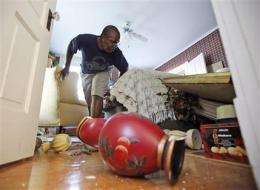
Tony Williams surveys damage at his Mineral, Va. home after an earthquake struck Tuesday, Aug. 23, 2011. Items in his home were knocked over and displaced, and the home suffered some structural damage after the most powerful earthquake to strike the East Coast in 67 years shook buildings and rattled nerves from South Carolina to New England. The quake was centered near Mineral, a small town northwest of Richmond. (AP Photo/Steve Helber)
(AP) -- The East Coast doesn't get earthquakes often but when they do strike, there's a whole lot more shaking going on. The ground in the East is older, colder and more intact than the West Coast or the famous Pacific Ring of Fire. So East Coast quakes rattle an area up to 10 times larger than a similar-sized West Coast temblor.
"They tend to be more bang for the buck as far as shaking goes," said Virginia Tech geology professor James Spotila.
Tuesday's 5.8-magnitude quake was centered in Virginia and was felt up and down the Eastern seaboard for more than 1,000 miles. There hasn't been a quake that large on the East Coast since 1944 in New York.
While this was a rarity for the East, a 5.8 quake isn't unusual for California, Oregon, Washington and Alaska, where one occurs about once a year. Those states have had 103 quakes 5.8 or bigger since 1900, compared to now two in the East.
The tiny island of Trinidad is more quake-prone than the East Coast, said U.S. Geological Survey seismologist Paul Earle.
"In all the years I was at FEMA, there didn't seem to be a concern for earthquakes on the East Coast," former Federal Emergency Management Agency chief James Lee Witt said.
Because of geology, earthquakes on the coasts have different triggers and act differently in some ways. And they definitely are felt differently.
One glaring East versus West disparity: When a quake happens in California, geologists usually know what fault ruptured. Tuesday's quake happened on an unknown fault, and it is likely to remain a mystery.
Because the quake didn't break the surface "we may never actually map this fault from this earthquake," Earle said.
The only thing that will help scientists figure out where the break truly occurred are the aftershocks which could help highlight or outline the fault line, said Cornell University seismologist Rowena Lohman.
Most of the times, quakes occur when Earth's floating giant plates shift, rub against or slip past each other. That's what happens along California's San Andreas fault when quakes happen there.
Tuesday's thrust earthquake was far from the edge of a plate - the nearest are thousands of miles away in the mid-Atlantic or California, said seismologist David Applegate, associate director of natural hazards for the USGS in Reston, Va.
The stresses that cause these kinds of quakes come from far away and mount ever so slowly over time, even building up from the retreat of glaciers at the end of the Ice Age, he said.
Another East versus West contrast: The ground is different in the East in a way that makes the shaking travel much further, allowing people to feel the quake several states and hundreds of miles away.
The rocks in the Earth's crust in the East are colder, older and harder, which means seismic waves travel more efficiently and over greater distances. Rocks on the West Coast are relatively young and broken up by faults.
"An intact bell rings more loudly than a cracked bell and that's essentially what the crust is on the East Coast," USGS seismologist Lucy Jones told a news conference in Pasadena, Calif.
In the East, hurricanes are the worry far more than quakes. Former FEMA chief Witt said people on the West Coast know what to do in an earthquake: drop to the floor, cover their heads and hold on to something sturdy until the shaking stops.
That's what USGS's Applegate did in Virginia.
"It's seared in our heads," said USGS seismologist Susan Hough in Pasadena. "People back East don't get that kind of preparedness message."
More information: USGS: http://earthquake.usgs.gov/earthquakes/
©2011 The Associated Press. All rights reserved. This material may not be published, broadcast, rewritten or redistributed.
-
From lemons to lemonade: Reaction uses carbon dioxide to make carbon-based semiconductor,
32 comments
-
Thioridazine kills cancer stem cells in human while avoiding toxic side-effects of conventional cancer treatments,
3 comments
-
SpaceX private rocket blasts off for space station (Update),
42 comments
-
Climate scientists say they have solved riddle of rising sea,
31 comments
-
SpaceX capsule has 'new car' smell, astronauts say (Update),
2 comments
-
Hypothetical desert earth
14 hours ago
-
More human population = greater mass?
May 25, 2012
-
Conversion from aircraft bearing to normal degrees
May 23, 2012
-
Interpretation/Analysis of the Lab results(HEPA filter)
May 22, 2012
-
Has anyone here attended the The Urbino Summer School in Paleoclimatology?
May 22, 2012
-
Earthquakes: Mag 6 N. Italy and Mag 5.6 W. Bulgaria
May 21, 2012
- More from Physics Forums - Earth
More news stories
Sophisticated simulations predict future warming
The chances of our planet being hit by a global warming of 3 degrees Celsius by 2050 is as likely as it being hit by an increase of 1.4 degrees, new research shows. Presented in the journal Nature Geoscience, the British study ...
Space & Earth / Earth Sciences
May 22, 2012 |
4.4 / 5 (9) |
51
Kyoto Protocol architect 'frustrated' by climate dialogue
UN climate talks are going nowhere, as politicians dither or bicker while the pace of warming dangerously speeds up, one of the architects of the Kyoto Protocol told AFP.
May 23, 2012 |
3.7 / 5 (7) |
39
Aliens don't want to eat us, says former SETI director
Alien life probably isnt interested in having us for dinner, enslaving us or laying eggs in our bellies, according to a recent statement by former SETI director Jill Tarter.
Space & Earth / Space Exploration
May 25, 2012 |
4.4 / 5 (13) |
38
Dragon arrives at space station in historic 1st (Update 2)
The privately bankrolled Dragon capsule made a historic arrival at the International Space Station on Friday, triumphantly captured by astronauts wielding a giant robot arm.
Space & Earth / Space Exploration
May 25, 2012 |
5 / 5 (10) |
19
What's the big deal about private space launches?
(AP) -- The first private spaceship is headed to the International Space Station. Some questions and answers about the cargo mission by Space Exploration Technologies, known as SpaceX:
Space & Earth / Space Exploration
May 22, 2012 |
5 / 5 (6) |
35
Nvidia trumpets Tegra 3 phone design wins for 2012
(Phys.org) -- Nvidias competitive war paint has a name, Tegra 3. On the heels of Nvidia announcements about lowering costs of its Tegra 3 processors and Nvidia-enabled tablets running Android Ice Cream ...
Browser wars flare in mobile space
The browser wars are heating up again, but this time the fight is for dominance of the mobile Internet.
Scientist: Evolution debate will soon be history
(AP) -- Richard Leakey predicts skepticism over evolution will soon be history. Not that the avowed atheist has any doubts himself.
Dell tablet leak: 10.1-inch display, two-battery choice
(Phys.org) -- Headline after headline talks about vendors tablets in the wings as likely number-one contenders for the iPad. Such claims have justifiably been taken with a grain of salt, considering ...
Keep food safety in mind this memorial day weekend
(HealthDay) -- Picnics, parades and cookouts are as much a part of Memorial Day weekend as tributes to the United States' war veterans.
Social welfare cuts ultimately come with heavy price, researchers say
(Phys.org) -- Slashing government funding for Medicaid, food stamps and other programs that serve the poor while politically popular with some lawmakers and many conservatives may do more harm ...