Deforestation in Brazil's Amazon up 15%
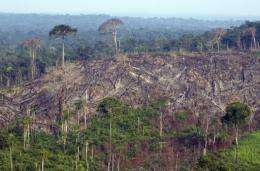
Aerial view of a burnt out sector of the Jamanxim National Forest in the Amazon state of Para, nothern Brazil. Deforestation in Brazil's Amazon increased by 15 percent during the past 12 months, the National Institute for Space Research (INPE) said.
Deforestation in Brazil's Amazon increased by 15 percent during the past 12 months, the National Institute for Space Research (INPE) said.
From July 2010 to July 2011 the vast South American rainforest lost 2,654 square kilometers (1,649 square miles) of vegetation in the states of Mato Grosso and Para, according to a preliminary analysis of satellite photos.
The year before, 2,295 square kilometers (1,426 square miles) were destroyed over that time period.
This July, 225 square kilometers (139 square miles) were lost to deforestation, though this was significantly less than the 485 square kilometers (301 square miles) destroyed in July 2010.
In April 477 square kilometers (296 square miles) were destroyed, with more than 95 percent of the devastation taking place in Mato Grosso, which is a major agricultural frontier used for cattle ranches and soybean farming.
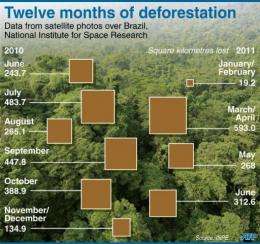
Graphic showing monthly deforestation in the Brazilian Amazon, based on satellite analysis by the National
Wednesday's figures were calculated from a satellite system known as DETER, which detects in real time when an area larger than 61 acres is destroyed, though its results are not always exact due to cloud cover.Brazil, the world's fifth largest country by area, has 5.3 million square kilometers of jungle and forests -- mostly in the Amazon river basin -- of which only 1.7 million are under state protection.
The rest is in private hands, or its ownership is undefined.
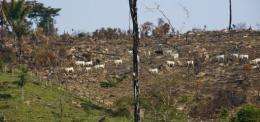
Cattle walks in a burnt area of the Amazon rain forest in 2009. Deforestation in Brazil's Amazon increased by 15 percent during the past 12 months, the National Institute for Space Research (INPE) said Wednesday.
Deforestation has made Brazil one of the world's top greenhouse gas emitters, and the pace of deforestation peaked in 2004 at 27,000 square kilometers (10,000 square miles) a year.The rate of deforestation has declined since then, in part because of DETER, and at the 2009 UN climate change summit in Copenhagen, Brazil committed itself to reducing Amazon deforestation by 80 percent by 2020.
(c) 2011 AFP
-
From lemons to lemonade: Reaction uses carbon dioxide to make carbon-based semiconductor,
32 comments
-
Thioridazine kills cancer stem cells in human while avoiding toxic side-effects of conventional cancer treatments,
3 comments
-
SpaceX private rocket blasts off for space station (Update),
42 comments
-
Climate scientists say they have solved riddle of rising sea,
31 comments
-
SpaceX capsule has 'new car' smell, astronauts say (Update),
2 comments
-
Hypothetical desert earth
14 hours ago
-
More human population = greater mass?
May 25, 2012
-
Conversion from aircraft bearing to normal degrees
May 23, 2012
-
Interpretation/Analysis of the Lab results(HEPA filter)
May 22, 2012
-
Has anyone here attended the The Urbino Summer School in Paleoclimatology?
May 22, 2012
-
Earthquakes: Mag 6 N. Italy and Mag 5.6 W. Bulgaria
May 21, 2012
- More from Physics Forums - Earth
More news stories
Sophisticated simulations predict future warming
The chances of our planet being hit by a global warming of 3 degrees Celsius by 2050 is as likely as it being hit by an increase of 1.4 degrees, new research shows. Presented in the journal Nature Geoscience, the British study ...
Space & Earth / Earth Sciences
May 22, 2012 |
4.4 / 5 (9) |
51
Kyoto Protocol architect 'frustrated' by climate dialogue
UN climate talks are going nowhere, as politicians dither or bicker while the pace of warming dangerously speeds up, one of the architects of the Kyoto Protocol told AFP.
May 23, 2012 |
3.7 / 5 (7) |
39
Aliens don't want to eat us, says former SETI director
Alien life probably isnt interested in having us for dinner, enslaving us or laying eggs in our bellies, according to a recent statement by former SETI director Jill Tarter.
Space & Earth / Space Exploration
May 25, 2012 |
4.4 / 5 (13) |
38
Dragon arrives at space station in historic 1st (Update 2)
The privately bankrolled Dragon capsule made a historic arrival at the International Space Station on Friday, triumphantly captured by astronauts wielding a giant robot arm.
Space & Earth / Space Exploration
May 25, 2012 |
5 / 5 (10) |
19
What's the big deal about private space launches?
(AP) -- The first private spaceship is headed to the International Space Station. Some questions and answers about the cargo mission by Space Exploration Technologies, known as SpaceX:
Space & Earth / Space Exploration
May 22, 2012 |
5 / 5 (6) |
35
Nvidia trumpets Tegra 3 phone design wins for 2012
(Phys.org) -- Nvidias competitive war paint has a name, Tegra 3. On the heels of Nvidia announcements about lowering costs of its Tegra 3 processors and Nvidia-enabled tablets running Android Ice Cream ...
Browser wars flare in mobile space
The browser wars are heating up again, but this time the fight is for dominance of the mobile Internet.
Scientist: Evolution debate will soon be history
(AP) -- Richard Leakey predicts skepticism over evolution will soon be history. Not that the avowed atheist has any doubts himself.
Dell tablet leak: 10.1-inch display, two-battery choice
(Phys.org) -- Headline after headline talks about vendors tablets in the wings as likely number-one contenders for the iPad. Such claims have justifiably been taken with a grain of salt, considering ...
Keep food safety in mind this memorial day weekend
(HealthDay) -- Picnics, parades and cookouts are as much a part of Memorial Day weekend as tributes to the United States' war veterans.
Social welfare cuts ultimately come with heavy price, researchers say
(Phys.org) -- Slashing government funding for Medicaid, food stamps and other programs that serve the poor while politically popular with some lawmakers and many conservatives may do more harm ...


Aug 18, 2011
Rank: 1 / 5 (2)
http://www.conbio...acts.pdf
In fact, if natural forest fires were allowed to burn, the Keeling Curve would be around twice as high as it currently is.
50 million acres of forest for 1910...You got any idea how much CO2 that is if burned to completion, which it very likely was burned to near-completion in a the era before modern firefighting techniques?
Let's say 500 trees per acre, not counting shrubs, and 1 ton per tree, and 50 million acres. That's 25 trillion kilograms of wood. Now burn the wood and you get 47.5 trillion kg CO2 from just U.S. Forest fire in 1910 alone.
That is up to 9.5, NINE POINT FIVE, parts per million equivalent worth of CO2 made by NATURE in 1910, ONE YEAR, from forest fires in the U.S. alone.
Human deforestation is insignificant compared to what nature does.
Aug 18, 2011
Rank: 1 / 5 (1)
Which is damn near half of the Keeling Curve's net average slope of 2.1...just from the U.S. forest fires alone...
If we weren't fighting NATURE MADE forest fires, the Keeling Curve would have a slope of around 10 (TEN) or more, just from U.S. forest fires!!!
Imagine that! Due to fighting forest fires in the U.S. alone, human beings actually have a net NEGATIVE carbon footprint, and by nearly a damn order of magnitude...
Aug 18, 2011
Rank: 1 / 5 (1)
I even found some material on hardwood stands, which suggested 100 to 125 for pole sized, or 50 to 75 for saw timber. However, this is the target for harvestable crop trees, which need to be more idealisticly shaped individually. The actual biomass on the land is and would be more in a 100% natural forest.
Additionally, hardwood trees grow wider crowns, whereas pine trees tend to grow much taller, so you can fit more pines in the same area.
http://www.stockm...i?id=457
This site recommends planting pine trees for LUMBER in 300 per acre, which is not too much different than my guesstimate of 500 per acre. Additionally, some seem to plant them even higher.
The point is, in nature where the trees are not growing to a target lumber value per individual tree, they may be denser than this.
Good guess...
Aug 18, 2011
Rank: 5 / 5 (1)
What they are speaking of here -specifically- is primarily HUMAN INTERVENTION(though why this is not made explicit in the article is a mystery), which you propose as the great and noble defender of the Forest, when, in fact, it is usually just the opposite, and has been -both historically AND prehistorically -during the aricultural and industrial phases of human development- overwhelmingly the direct cause of steady forest loss, the whole world over.
It's interesting to see you tinkering with some of the numbers involved, but alas -you fail to see "the Forest for the trees" as they say.
I hope that this isn't intentional.