Bragg reflectivity of X-rays: At the limit of the possible
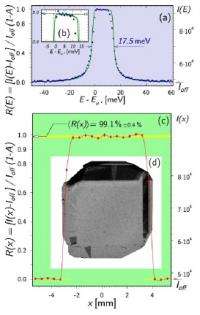
(PhysOrg.com) -- Researchers utilizing high-brightness x-rays at the U.S. Department of Energy Office of Science’s Advanced Photon Source at Argonne National Laboratory have demonstrated that synthetic, nearly defect-free diamond crystals can reflect more than 99% of hard x-ray photons backward in Bragg diffraction, with a remarkably small variation in the magnitude of reflectivity across the sample. Their results, which are published in Nature Photonics, represent a quantum leap to the largest reflectivity measured, at the limit of what is theoretically possible. It was attained under the most challenging conditions of normal incidence and with extremely high-energy x-ray photons.
Ultra-high-reflectance mirrors are essential components of the most sophisticated optical instruments, which are designed to cover the entire frequency spectrum and find use in a wide range of applications, from telescopes for astronomy to high-energy x-ray facilities such as the APS. In the x-ray regime, super-polished mirrors with close to 100% reflectivity are routinely used at grazing angles of incidence. However, at large angles of incidence, and especially at normal incidence, such high reflectivity had not been achieved.
The research in this study was conducted by a team comprising investigators from Argonne National Laboratory and the Technological Institute for Superhard and Novel Carbon Materials (TISNCM) in Russia. This investigation was motivated by the need for high-reflectivity x-ray mirrors at close-to-normal incidence for use in x-ray free electron laser oscillators (XFELO).
XFELOs are x-ray light sources of the future that will provide scientists with fully coherent x-rays with record high spectral purity and average brightness, qualities that are highly desirable for experiments. Unlike high-gain x-ray lasers, XFELOs are designed to be low-gain machines, requiring a low-loss optical cavity with high-reflectivity x-ray mirrors close to backscattering, similar to conventional table-top lasers.
The feasibility of XFELOs was questioned by many experts because of the high-reflectivity x-ray mirror limitations. These limitations are now removed by the demonstration of very high (more than 99%) reflectivity of hard x-rays in Bragg backscattering from diamond crystals. Theoretical analysis presented in the Nature Photonics paper establishes that diamond has the highest (higher than any other crystal) Bragg reflectivity due to the uniquely small ratio of the extinction length in Bragg diffraction to the absorption length. Even in backscattering, where the reflectivity is lowest, it was thought to be more than 99%, and this has now been demonstrated.
Synthetic diamond crystals of sufficient size and crystalline perfection for use as high-reflectivity x-ray mirrors can be grown using modern techniques. In this experiment, synthetic diamond single crystals of very high crystal quality were grown at the TISNCM via the temperature gradient method under high-pressure and high-temperature conditions. The reflectivity measurements were performed at the X-ray Science Division beamlines 30-ID and 7-ID at the APS utilizing 23.7-keV and 13.9-keV photons, respectively.
Systematic observations of the more than 99% reflectivity show that high-reflectivity mirror limitations in the regime of hard x-rays have been eliminated. This is an important step toward realization of x-ray cavities for XFELOs. Also, the results in this study support a broad range of potential applications of diamond crystals for high-reflectance, coherence-preserving, and resilient x-ray optics, such as x-ray monochromators, beam splitters, delay lines, high-finesse Fabry-Perot resonators, etc.
More information: Kwang-Je Kim, Yuri Shvyd’ko, and Sven Reiche “A Proposal for an X-Ray Free-Electron Laser Oscillator with an Energy-Recovery Linac”, Phys. Rev. Lett. 100, 244802 (2008).
Yuri Shvyd’ko, et al., “Near-100% Bragg reflectivity of X-rays”, Nature Photonics, (published online August 2011). DOI:10.1038/nphoton.2011.197
Provided by Argonne National Laboratory


