Risk assessments to block invasive wildlife pay off, study shows
August 29, 2011

Risk assessments to block invasive wildlife pay off, study shows

Enlarge

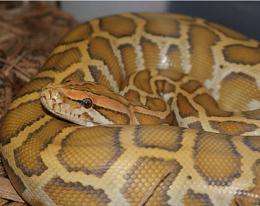
The Burmese python is an example of an invasive species introduced in the U.S. that now must be controlled at great expense.

(PhysOrg.com) -- A University of California, Davis, environmental and resource economist collaborated on a study that was the first to estimate the net benefits of screening potentially invasive wild animals, to prevent them from being introduced to the United States.

The researchers noted that federal, state and local governments are spending tens of millions of dollars annually on efforts aimed at controlling recent invasions by such animals as the , the and the red .

The study, based on the introduction of non-native reptiles and amphibians through typical importation routes, estimated that a nationwide risk-screening system would yield net benefits ranging from approximately $54,000 to $141,000 per species, assuming mid-range impacts of establishing species.

The study findings have been posted online and are scheduled for publication in the Sept. 15 edition of the journal .

“Managing the introduction of non-indigenous species is becoming a major goal of policy makers,” said the study’s lead author, Michael Springborn, an assistant professor in UC Davis’ Department of Environmental Science and Policy. “This study integrated biology and economics to tackle the question of how we as a nation balance the benefits of trade against the risk of invasive species becoming established.”

One result of globalization in recent decades has been a dramatic increase in trade and travel, which has resulted in both intentional and accidental transport of species beyond their native areas. The researchers noted that the United States receives hundreds of millions of non-native animals each year, representing thousands of different wildlife species.

Once established, introduced species can multiply to levels that can be harmful to economies, agriculture, the environment, and animal and human health. Because of that, policymakers are increasingly concerned about better managing the introduction and establishment of non-native species.

For several years, Congress has considered mandating stricter risk-assessment procedures, but legislation has stalled. Proposed legislation in the Senate would broaden the scope of the 111-year-old Lacey Act, the wildlife trade law that at this time restricts the importation of 25 “injurious species.”

More information about the study and the authors is available online at:
http://www.science … 262X#FCANote

Provided by UC Davis search and more info website


Rank 5 /5 (1 vote)
Relevant PhysicsForums posts

More news stories

Scientist: Evolution debate will soon be history

(AP) -- Richard Leakey predicts skepticism over evolution will soon be history. Not that the avowed atheist has any doubts himself.

Biology / Evolution

created 18 hours ago | popularity 3.3 / 5 (18) | comments 56

More plant species responding to global warming than previously thought

(Phys.org) -- Far more wild plant species may be responding to global warming than previous large-scale estimates have suggested.

Biology / Ecology

created May 22, 2012 | popularity 4.6 / 5 (14) | comments 18 | with audio podcast

Thousands of shellfish found dead in Peru

Thousands of crustaceans were found dead off the coast of Lima following the mystery mass death of dolphins and pelicans, the Peruvian Navy said Friday.

Biology / Ecology

created May 26, 2012 | popularity 4.8 / 5 (4) | comments 7

For monogamous sparrows, it doesn't pay to stray (but they do it anyway)

It's quite common for a female song sparrow to stray from her breeding partner and mate with the male next door, but a new study shows that sleeping around can be costly.

Biology / Plants & Animals

created May 22, 2012 | popularity 5 / 5 (2) | comments 7 | with audio podcast

Study uncovers secret to speedy burrowing by razor clams

(Phys.org) -- If you look at a razor burrowing clam sitting in a bucket, you’d never guess that it could burrow itself down into the soil, much less do it with any speed. Razor clams look like fat straws, ...

Biology / Plants & Animals

created May 25, 2012 | popularity 1 / 5 (1) | comments 3 | with audio podcast report


Nvidia trumpets Tegra 3 phone design wins for 2012

(Phys.org) -- Nvidia’s competitive war paint has a name, Tegra 3. On the heels of Nvidia announcements about lowering costs of its Tegra 3 processors and Nvidia-enabled tablets running Android Ice Cream ...

Browser wars flare in mobile space

The browser wars are heating up again, but this time the fight is for dominance of the mobile Internet.

Dell tablet leak: 10.1-inch display, two-battery choice

(Phys.org) -- Headline after headline talks about vendors’ tablets in the wings as likely number-one contenders for the iPad. Such claims have justifiably been taken with a grain of salt, considering ...

Keep food safety in mind this memorial day weekend

(HealthDay) -- Picnics, parades and cookouts are as much a part of Memorial Day weekend as tributes to the United States' war veterans.

Social welfare cuts ultimately come with heavy price, researchers say

(Phys.org) -- Slashing government funding for Medicaid, food stamps and other programs that serve the poor – while politically popular with some lawmakers and many conservatives – may do more harm ...

Is a classical electrodynamics law incompatible with special relativity?

(Phys.org) -- The laws of classical electromagnetism that were developed in the 19th century are the same laws that scientists use today. They include Maxwell’s four equations along with the Lorentz la ...