Biology, materials science get a boost from robust imaging tool
August 8, 2011

Biology, materials science get a boost from robust imaging tool

Enlarge

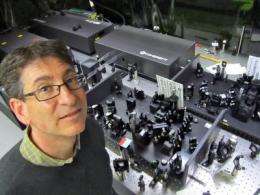
Andrew H. Marcus is a professor of chemistry at the University of Oregon. Credit: University of Oregon

Shape and alignment are everything. How nanometer-sized pieces fit together into a whole structure determines how well a living cell or an artificially fabricated device performs. A new method to help understand and predict such structure has arrived with the successful use a new imaging tool.

Coupling laser-driven, two-dimensional fluorescence imaging and high-performance computer modeling, a six-member team -- led by University of Oregon chemist Andrew H. Marcus and Harvard University chemist Alan Aspuru-Guzik -- solved the conformation of self-assembled porphyrin molecules in a biological membrane.

Porphyrins are that are ubiquitous in living things. They carry mobile electrical charges that can hop from molecule-to-molecule and allow for nanoscale communications and energy transfer. They are also building blocks in nanodevices.

The new technique -- phase-modulation 2D -- is detailed in a paper scheduled to appear online this week ahead of regular publication in the . The breakthrough skirts the often-needed step of obtaining crystals of molecules that are being studied, said Marcus, a member of the Oregon Center for Optics, Materials Science Institute and Institute of Molecular Biology. Most functional don't easily form crystals.

"Our technique is a workable way to determine how macromolecular objects assemble and form the structures they will in biological environments," Marcus said. "It's robust and will provide a means to study biological protein-nucleic acid interactions."

Work already is underway to modify the experimental instrumentation in the UO's stable and temperature-controlled High Stability Optics Lab to apply the research on machinery -- one category of the best-known macromolecular complexes, which consist of and proteins that must be properly aligned to function correctly. "It's a strategy that will allow us to do two things: Look at these complexes one molecule at a time, and perform experiments at short ultraviolet wavelengths to look at DNA problems," he said.

In addition, the approach should be useful to materials scientists striving to understand and harness the necessary conformation of polymers used in the production of nanoscale devices. "In biology, large molecules assemble to form very complex structures that all work together like a machine," Marcus said. "The way these nanoscale structures form and become functional is an actively pursued question."

The technique builds on earlier versions of two-dimensional (2D) optical spectroscopy that emerged in efforts to get around limitations involved in applying X-ray crystallography and nuclear magnetic resonance to such research. The previous 2D approaches depended on the detection of transmitted signals but lacked the desired sensitivity.

The new approach can be combined with single-molecule fluorescence microscopy to allow for research at the tiniest of scales to date, Marcus said. "With fluorescence, you can see and measure what happens one molecule at time. We expect this approach will allow us to look at individual molecular assemblies."

Provided by University of Oregon search and more info website

Filter


Move the slider to adjust rank threshold, so that you can hide some of the comments.


Display comments: newest first

Techno1
Aug 08, 2011

Rank: 5 / 5 (1)
Nanotechnology is nearly unlimited.

I can't wait till we have protein paste that tastes exactly like Chicken (or beef,) but without the blood, feathers, poop or other waste products to deal with.

We already use bacteria and molds in other food industry standards: Bread/yeast, Cheeses, yogurts, Vinegar, Pepperonis, and Salamis, etc.

Imagine a cultured, edible bacteria with the taste of your favorite meats, but with perfect sanitation and perfect nutritional value, which would be grown in huge tanks, the same way acetobacter is used in Vinegar.

One can imagine something like this might one day be possible, given these advances in nanotechnologies and genetics research.
Rank 5 /5 (2 votes)
Relevant PhysicsForums posts

More news stories

In nanorod crystal growth, nanoparticles seen as artificial atoms

In the growth of crystals, do nanoparticles act as "artificial atoms" forming molecular-type building blocks that can assemble into complex structures? This is the contention of a major but controversial theory ...

Nanotechnology / Nanophysics

created May 24, 2012 | popularity 4.8 / 5 (6) | comments 0 | with audio podcast

First direct observation of oriented attachment in nanocrystal growth

Berkeley Lab researchers have reported the first direct observation of nanoparticles undergoing oriented attachment, the critical step in biomineralization and the growth of nanocrystals. A better understanding ...

Nanotechnology / Nanophysics

created May 24, 2012 | popularity 4.7 / 5 (3) | comments 0 | with audio podcast

Dopant gives graphene solar cells highest efficiency yet

(Phys.org) -- By taking advantage of graphene’s favorable electrical and optical properties, and then adding an organic dopant, researchers have achieved the highest power conversion efficiency yet for ...

Nanotechnology / Nanophysics

created May 21, 2012 | popularity 5 / 5 (10) | comments 14 | with audio podcast feature

Synthetic nano-waste does not disappear

(Phys.org) -- Tiny particles of cerium oxide do not burn or change in the heat of a waste incineration plant. They remain intact on combustion residues or in the incineration system, as a new study by Swiss ...

Nanotechnology / Bio & Medicine

created May 25, 2012 | popularity 5 / 5 (2) | comments 1 | with audio podcast

'Metamaterials,' quantum dots show promise for new technologies

(Phys.org) -- Researchers are edging toward the creation of new optical technologies using "nanostructured metamaterials" capable of ultra-efficient transmission of light, with potential applications including ...

Nanotechnology / Nanophysics

created May 24, 2012 | popularity 5 / 5 (7) | comments 1 | with audio podcast


Nvidia trumpets Tegra 3 phone design wins for 2012

(Phys.org) -- Nvidia’s competitive war paint has a name, Tegra 3. On the heels of Nvidia announcements about lowering costs of its Tegra 3 processors and Nvidia-enabled tablets running Android Ice Cream ...

Browser wars flare in mobile space

The browser wars are heating up again, but this time the fight is for dominance of the mobile Internet.

Scientist: Evolution debate will soon be history

(AP) -- Richard Leakey predicts skepticism over evolution will soon be history. Not that the avowed atheist has any doubts himself.

Dell tablet leak: 10.1-inch display, two-battery choice

(Phys.org) -- Headline after headline talks about vendors’ tablets in the wings as likely number-one contenders for the iPad. Such claims have justifiably been taken with a grain of salt, considering ...

Keep food safety in mind this memorial day weekend

(HealthDay) -- Picnics, parades and cookouts are as much a part of Memorial Day weekend as tributes to the United States' war veterans.

Social welfare cuts ultimately come with heavy price, researchers say

(Phys.org) -- Slashing government funding for Medicaid, food stamps and other programs that serve the poor – while politically popular with some lawmakers and many conservatives – may do more harm ...