Possible biological control discovered for pathogen devastating amphibians
August 26, 2011

Possible biological control discovered for pathogen devastating amphibians

Enlarge

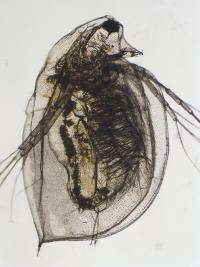
Researchers have confirmed that this zooplankton, Daphni magna, will eat a deadly fungus that is devastating amphibian populations around the world. It may provide a new biocontrol agent to help address this crisis. (Photo courtesy of Oregon State University)

Zoologists at Oregon State University have discovered that a freshwater species of zooplankton will eat a fungal pathogen which is devastating amphibian populations around the world.

This tiny zooplankton, called Daphnia magna, could provide a desperately needed tool for biological control of this , the scientists said, if field studies confirm its efficacy in a natural setting.

The , B. dendrobatidis, is referred to as a "chytrid" fungus, and when it reaches high levels can disrupt balance and lead to death from cardiac arrest in its amphibian hosts. One researcher has called its impact on amphibians "the most spectacular loss of vertebrate biodiversity due to disease in recorded history."

The research, reported today in the journal Biodiversity and Conservation, was supported by the National Science Foundation.

"There was evidence that zooplankton would eat some other types of fungi, so we wanted to find out if Daphnia would consume the chytrid fungus," said Julia Buck, an OSU doctoral student in zoology and lead author on the study. "Our laboratory experiments and confirmed that it would eat the zoospore, the free-swimming stage of the fungus."

"We feel that offers the best chance to control this , and now we have a good candidate for that," she said. "Efforts to eradicate this disease have been unsuccessful, but so far no one has attempted biocontrol of the chytrid fungus. That may be the way to go."

The chytrid fungus, which was only identified in 1998, is not always deadly at low levels of infestation, Buck said. It may not be necessary to completely eliminate it, but rather just reduce its density in order to prevent mortality. Biological controls can work well in that type of situation.

Amphibians have been one of the great survival stories in Earth's history, evolving about 400 million years ago and surviving to the present while many other life forms came and went, including the dinosaurs. But in recent decades the global decline of amphibians has reached crisis proportions, almost certainly from multiple causes that include habitat destruction, pollution, increases in ultraviolet light due to ozone depletion, invasive species and other issues.

High on the list, however, is the that has been documented to be destroying amphibians around the world, through a disease called chytridiomycosis.

Its impact has been severe and defied various attempts to control it, even including use of fungicides on individual amphibians. Chytridiomycosis has been responsible for "unprecedented population declines and extinctions globally," the researchers said in their report.

"About one third of the amphibians in the world are now threatened and many have gone extinct," said Andrew Blaustein, a professor of zoology, co-author on this study and an international leader in the study of amphibian decline.

"It's clear there are multiple threats to amphibians, but disease seems to be a dominant cause," he said.

Although they have survived for hundreds of millions of years, amphibians may be especially vulnerable to rapid environmental changes and new challenges that are both natural and human-caused. They have a permeable skin, and exposure to both terrestrial and aquatic environments.

Because of this, OSU researchers said, other animals such as mammals, birds and fish have so far not experienced such dramatic population declines.

More information: The story this study is based on is available online: http://www.springe … h87052r77p2/

Provided by Oregon State University search and more info website

Filter


Move the slider to adjust rank threshold, so that you can hide some of the comments.


Display comments: newest first

alexford
Aug 27, 2011

Rank: not rated yet
Talking about Amphibians: Fishes do not remain long in waters where their food supply has been destroyed, even though the fishes may not be affected directly. For these reasons daphnids should prove satisfactory for testing waters for toxic materials.

We can also research in this way too. Totally agree with the scientist "if field studies confirm its efficacy in a natural setting."

regards
Alex F (B. Pharma)
canadiandrugsaver.com
Rank 5 /5 (2 votes)
Relevant PhysicsForums posts

More news stories

Scientist: Evolution debate will soon be history

(AP) -- Richard Leakey predicts skepticism over evolution will soon be history. Not that the avowed atheist has any doubts himself.

Biology / Evolution

created 18 hours ago | popularity 3.3 / 5 (18) | comments 56

More plant species responding to global warming than previously thought

(Phys.org) -- Far more wild plant species may be responding to global warming than previous large-scale estimates have suggested.

Biology / Ecology

created May 22, 2012 | popularity 4.6 / 5 (14) | comments 18 | with audio podcast

Thousands of shellfish found dead in Peru

Thousands of crustaceans were found dead off the coast of Lima following the mystery mass death of dolphins and pelicans, the Peruvian Navy said Friday.

Biology / Ecology

created May 26, 2012 | popularity 4.8 / 5 (4) | comments 7

For monogamous sparrows, it doesn't pay to stray (but they do it anyway)

It's quite common for a female song sparrow to stray from her breeding partner and mate with the male next door, but a new study shows that sleeping around can be costly.

Biology / Plants & Animals

created May 22, 2012 | popularity 5 / 5 (2) | comments 7 | with audio podcast

Study uncovers secret to speedy burrowing by razor clams

(Phys.org) -- If you look at a razor burrowing clam sitting in a bucket, you’d never guess that it could burrow itself down into the soil, much less do it with any speed. Razor clams look like fat straws, ...

Biology / Plants & Animals

created May 25, 2012 | popularity 1 / 5 (1) | comments 3 | with audio podcast report


Nvidia trumpets Tegra 3 phone design wins for 2012

(Phys.org) -- Nvidia’s competitive war paint has a name, Tegra 3. On the heels of Nvidia announcements about lowering costs of its Tegra 3 processors and Nvidia-enabled tablets running Android Ice Cream ...

Browser wars flare in mobile space

The browser wars are heating up again, but this time the fight is for dominance of the mobile Internet.

Dell tablet leak: 10.1-inch display, two-battery choice

(Phys.org) -- Headline after headline talks about vendors’ tablets in the wings as likely number-one contenders for the iPad. Such claims have justifiably been taken with a grain of salt, considering ...

Keep food safety in mind this memorial day weekend

(HealthDay) -- Picnics, parades and cookouts are as much a part of Memorial Day weekend as tributes to the United States' war veterans.

Social welfare cuts ultimately come with heavy price, researchers say

(Phys.org) -- Slashing government funding for Medicaid, food stamps and other programs that serve the poor – while politically popular with some lawmakers and many conservatives – may do more harm ...

Is a classical electrodynamics law incompatible with special relativity?

(Phys.org) -- The laws of classical electromagnetism that were developed in the 19th century are the same laws that scientists use today. They include Maxwell’s four equations along with the Lorentz la ...