Better batteries through nanoscale 3D chemical imaging
August 9, 2011

Better batteries through nanoscale 3D chemical imaging

Enlarge

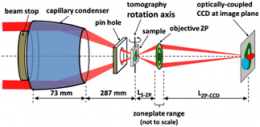
TXM setup. Monochromatic x-rays are focused onto the sample using a capillary condenser. The sample stage is capable of three-axis translation, and rotation for tomography. For XANES imaging the focal length of the zoneplate objective lens is varied over the investigated energy range. Images are captured using a high resolution charge-coupled device (CCD) system. Credit: Nelson et al. 2011

Concerns over the finite availability of oil and the effect of greenhouse gases on climate have spurred intense efforts to develop electric-drive vehicles; the major barrier to successful commercialization being battery technology. Although Li-ion batteries, crucial in the boom of portable electronics, stand as the technology of choice in soon-to-be marketed models, further improvements in their energy density, cost, cycle life and safety are still necessary.

Observation of the movement of chemical phase transition fronts and changes to the electrode , which allows effective wetting of the particles by the electrolyte and transport of lithium ions, could direct new strategies for design of next generation high devices. Hence, monitoring changes in electrodes during battery operation (i.e., insertion/extraction of Li ions) requires imaging of morphological as well as . XANES microscopy holds the promise of adding a new dimension, 3D nanoscale chemical and architectural visualization, to the diagnostics of Li-ion battery electrodes.

This work describes two recent publications in which X-ray absorption near edge structure (XANES) microscopy, a revolutionary technique based on the combination of full-field transmission X-ray microscopy (TXM; see Figure 1) with XANES, was used to obtain nanotomography on materials found in Li-ion battery electrodes (Nelson et al. 2011) and on the battery electrodes themselves (Meirer et al. 2011). The full-field transmission X-ray microscope on SSRL 6-2 is capable of imaging from 4 to 14 keV, a range suitable for spectroscopic imaging of many metals used in battery electrodes and other materials.

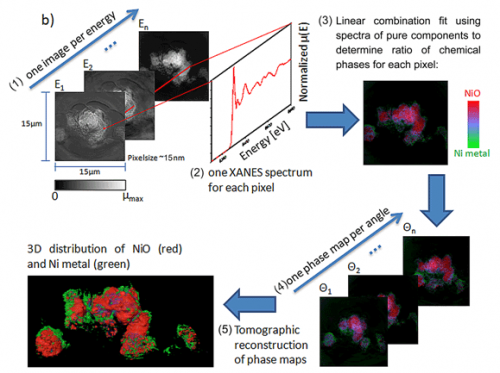
With a field of view of 30 microns, extendable to millimeter rage with mosaic imaging, the microscope can be used to obtain single-pixel (15-30 nanometers) XANES spectra, resulting inapproximatelyone million XANES spectra per energy stack. Fitting of the XANES results in a chemical phase map at 30-nanometer resolution (see Figure 2 for schematic of the technique). Because this method combines high resolution with relatively large field of view and deep hard X-ray penetration of materials, it can provide 2D and 3D chemical information over relatively large areas relevant to hierarchical structures found in energy materials such as battery electrodes, fuel cells, and catalytic systems.
Better batteries through nanoscale 3D chemical imaging
Enlarge

Principles of data processing for 3D XANES microscopy. (1) One image is acquired in absorption contrast at each energy in the XANES scan. (2) XANES are constructed from each pixel plotting normalized absorption vs. energy. (3) XANES from each pixel is fit to create a chemical phase map. (4) One phase map is generated at each angle in the tomographic scan. (5) The set of phase maps is used for tomographic reconstruction to retrieve 3D chemical speciation. Credit: Meirer et al. 2011

The potential impact of this technique is illustrated with the study of the changes taking place in NiO while cycled in a Li battery.  NiO is considered an alternative anode material because of its very high charge storage capability3. The use of XANES microscopy to analyze Li-ion NiO battery electrodes at different states of charge results in a series of images in which the presence of NiO and Ni, the phase produced upon reduction, can be resolved and correlated with changes in morphology and porosity.

Within the framework of energy storage, this work adds a completely new dimension to the diagnostics of Li-ion battery electrodes, which are devices of great technological relevance because of their implementation in electric-drive vehicles. More generally speaking, 3D XANES microscopy is a unique technique that combines unprecedented spatial and energy resolution with large fields of view and fast acquisition (images can be obtained in minutes to a few hours) whose capabilities and high throughput lead to an overarching impact in a variety of fields as diverse as energy storage, archaeological objects, and biomaterials. Preliminary work on NiO/Ni imaging was published in Applied Physics Letters and the 3D XANES work on Li ion battery has been published in the Journal of Synchrotron Radiation

More information: F Meirer, et al. “3D imaging of chemical phase transformations at the nanoscale with full field transmission X-ray microscopy”J Synchrotron Rad 18 (2011).

GJ Nelson, et al. "Three Dimensional Mapping of Nickel Oxidation States using Full Field X-ray Absorption Near Edge Structure Nanotomography" Appl Phys Lett 98: 173109 (2011). doi:10.1063/1.3574774

Provided by SLAC National Accelerator Laboratory search and more info website


Rank 5 /5 (2 votes)
Relevant PhysicsForums posts
  • microstructure of titanium
    created20 hours ago
  • Steam in My Espresso Machine
    createdMay 26, 2012
  • Density question
    createdMay 24, 2012
  • Mass transport originating from a point source at a solid gas interface
    createdMay 22, 2012
  • Ammonia dispersion in Air
    createdMay 22, 2012
  • Multi Choice Help
    createdMay 21, 2012
  • More from Physics Forums - Materials & Chemical Engineering

More news stories

In nanorod crystal growth, nanoparticles seen as artificial atoms

In the growth of crystals, do nanoparticles act as "artificial atoms" forming molecular-type building blocks that can assemble into complex structures? This is the contention of a major but controversial theory ...

Nanotechnology / Nanophysics

created May 24, 2012 | popularity 4.8 / 5 (6) | comments 0 | with audio podcast

First direct observation of oriented attachment in nanocrystal growth

Berkeley Lab researchers have reported the first direct observation of nanoparticles undergoing oriented attachment, the critical step in biomineralization and the growth of nanocrystals. A better understanding ...

Nanotechnology / Nanophysics

created May 24, 2012 | popularity 4.7 / 5 (3) | comments 0 | with audio podcast

Dopant gives graphene solar cells highest efficiency yet

(Phys.org) -- By taking advantage of graphene’s favorable electrical and optical properties, and then adding an organic dopant, researchers have achieved the highest power conversion efficiency yet for ...

Nanotechnology / Nanophysics

created May 21, 2012 | popularity 5 / 5 (10) | comments 14 | with audio podcast feature

Synthetic nano-waste does not disappear

(Phys.org) -- Tiny particles of cerium oxide do not burn or change in the heat of a waste incineration plant. They remain intact on combustion residues or in the incineration system, as a new study by Swiss ...

Nanotechnology / Bio & Medicine

created May 25, 2012 | popularity 5 / 5 (2) | comments 1 | with audio podcast

'Metamaterials,' quantum dots show promise for new technologies

(Phys.org) -- Researchers are edging toward the creation of new optical technologies using "nanostructured metamaterials" capable of ultra-efficient transmission of light, with potential applications including ...

Nanotechnology / Nanophysics

created May 24, 2012 | popularity 5 / 5 (7) | comments 1 | with audio podcast


Nvidia trumpets Tegra 3 phone design wins for 2012

(Phys.org) -- Nvidia’s competitive war paint has a name, Tegra 3. On the heels of Nvidia announcements about lowering costs of its Tegra 3 processors and Nvidia-enabled tablets running Android Ice Cream ...

Browser wars flare in mobile space

The browser wars are heating up again, but this time the fight is for dominance of the mobile Internet.

Scientist: Evolution debate will soon be history

(AP) -- Richard Leakey predicts skepticism over evolution will soon be history. Not that the avowed atheist has any doubts himself.

Dell tablet leak: 10.1-inch display, two-battery choice

(Phys.org) -- Headline after headline talks about vendors’ tablets in the wings as likely number-one contenders for the iPad. Such claims have justifiably been taken with a grain of salt, considering ...

Keep food safety in mind this memorial day weekend

(HealthDay) -- Picnics, parades and cookouts are as much a part of Memorial Day weekend as tributes to the United States' war veterans.

Social welfare cuts ultimately come with heavy price, researchers say

(Phys.org) -- Slashing government funding for Medicaid, food stamps and other programs that serve the poor – while politically popular with some lawmakers and many conservatives – may do more harm ...