Widespread flood threat to continue through summer: NOAA
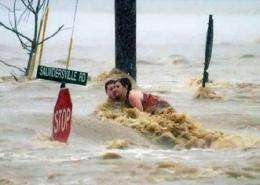
(PhysOrg.com) -- Many rivers in the upper Midwest and northern Plains remain above flood stage, and the threat for more flooding will continue through the summer, forecasters at NOAA’s National Weather Service said today.
With rivers running high and soils completely saturated, just a small amount of rain could trigger more flooding, including areas that have already seen major to record flooding. NOAA’s Climate Prediction Center is forecasting above-normal rain in most of these vulnerable areas in the next two weeks, and above-normal rainfall in much of the region in the one- and three-month outlooks. Adding to the flood threat will be the rising temperatures over the Rockies, which will release the water from the remaining snowpack.
“The sponge is fully saturated – there is nowhere for any additional water to go,” said Jack Hayes, Ph.D., director of NOAA’s National Weather Service. “While unusual for this time of year, all signs point to the flood threat continuing through summer.”
Forecasters say this season could rival the Great Flood of 1993, when the upper Midwest endured persistent, record-breaking floods from April through August, impacting nine states and causing more than $25 billion in damages (adjusted for inflation).
As flood threats continue in these areas, NOAA’s partners at the Federal Emergency Management Agency are continuing to support the response efforts in all of the impacted states. And they continue to urge all residents to take steps now to get ready for severe flooding and other hazards.
“The flooding that many Americans have already experienced this spring is a crucial reminder of just how devastating floods can be,” said FEMA Administrator Craig Fugate. “As this forecast tells us, the response to this year’s flooding is going to be a long effort – but we will be standing with all of the affected states, communities and families every step of the way. And this will continue to be a team effort – with the government working hand in hand with all of our partners, including states, tribal and local governments, non-profits, the private sector and most importantly, the public. If you haven’t already, visit ready.gov to learn more about how you can protect your loved ones, homes and other properties from flooding, including by purchasing flood insurance.”
Throughout the rest of the summer, the highest flood risk areas include:
• North Central U.S. including Souris River (North Dakota) and Red River of the North (border of North Dakota and Minnesota), Minnesota River (Minnesota), Upper Mississippi River (Minnesota and Iowa), and Des Moines River (Iowa)
• Lower Missouri River from Gavin’s Point (Nebraska and South Dakota border) downstream along the border of Nebraska and Iowa, continuing through the borders of Kansas and Missouri then through Missouri to the Mississippi River
• Tributaries to the Lower Missouri including the James and Big Sioux Rivers in North Dakota
Lower Ohio River Valley including the White, Wabash and lower Ohio River
• East of Rockies: North Platte River in Colorado, Wyoming and Nebraska and Yellowstone River in Wyoming and Montana
• West of Rockies: Utah and Colorado
Many factors set the stage for this year’s ongoing flood threat, including persistent rainfall last summer and fall, a large winter snowpack across much of the upper Midwest, an unusually cool and wet spring adding additional snowpack in the higher elevations of the Rockies and further saturated soil in lower elevations and in the northern Plains, and above-normal to record river levels for this time of year in the at-risk areas.
In anticipation of these threats, FEMA has been working proactively with these states for months to prepare for and respond to flooding. Through its regional offices in Colorado, Missouri and Illinois, FEMA is continuing to closely monitor ongoing and potential flooding in these states, and is also working closely with our numerous federal partners, including the U.S. Army Corps of Engineers, the National Weather Service, and the U.S. Department of Agriculture, among others.
To support to states currently dealing with flooding, under the leadership of President Obama, FEMA is providing approved federal disaster assistance for Missouri, North Dakota, Iowa, Kansas, Nebraska, Montana and South Dakota. FEMA also currently has staff embedded in state emergency operations centers in Wyoming, Iowa, Kansas and Missouri to coordinate federal support efforts as needed. In addition, FEMA has field offices set up in North Dakota, South Dakota, Montana, Nebraska, Iowa, and Missouri to respond to ongoing and potential flooding, and has deployed commodities to North and South Dakota, in case they become needed. In preparation for this flooding season, FEMA also pre-staged commodities, including water, meals, and blankets, in strategic locations close to the flooding in Iowa, Kansas, Missouri and Nebraska, that may be requested for use by states. To learn more about FEMA’s efforts, visit blog.fema.gov/search/label/Floods .
NOAA offers the following flood safety tips:
• Determine whether your community is in a flood-risk area and continue monitoring local flood conditions at water.weather.gov.
• Visit www.ready.gov for flood preparedness advice to safeguard your family, home and possessions and for more information about the National Flood Insurance Program.
• Purchase a NOAA Weather Radio receiver with battery power option to stay apprised of quickly changing weather information.
• Study evacuation routes in advance and heed evacuation orders.
• Turn Around, Don’t Drown – never cross flooded roads, no matter how well you know the area or how shallow you believe the water to be.
Provided by NOAA


