Toyota demos 'Window to the World' vehicle back seat smart window technology (w/ video)
July 21, 2011 by Bob Yirka report

Toyota demos 'Window to the World' vehicle back seat smart window technology

Enlarge

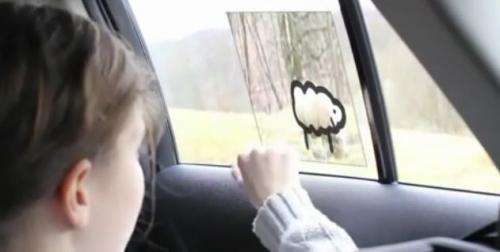
(PhysOrg.com) -- Designers from the Copenhagen Institute of Interaction Design and engineers from Toyota have been working together and have come up with a unique and innovative concept they call the "Window to the Word" where the window of the back seat of an automobile is converted into a see-through touch-screen device capable of allowing people, likely children, to draw images with their finger, magnify objects they see outside the car, learn by having objects they touch converted into another language, get distance for objects seen and be given information about objects they see.

This video is not supported by your browser at this time.

Watching the video the team has created of a child using the is both awe inspiring and head scratching. On the one hand, you have to give the and engineers credit for even thinking of such a thing, and for portraying it in such a beautiful and simplistic way. But, on the other, the practicalities of such a technology soon surpass the feelings of wonder at this new demonstration of the power of applied technology. Would window smudging ruin the effect after awhile, for example, or would a child bother with it if buckled in so tight that turning to use the window would become a strenuous activity; or would kids prefer to just have a on their lap, etc.

Using the new technology, which was demoed at the European ’ Association meeting last month, in Belgium, appears to be straightforward and simple. To zoom in on an object, two fingers are spread outwardly from a single point, as on a tablet device. To draw, a single finger is pressed against the window and moved about, again, similar to any other touch-screen. Menuing is controlled via a designated area in the lower left corner of the window. One truly interesting feature is that objects drawn on the window appear to move out of the framed window at the same rate as the car is moving, giving the illusion that the object drawn was actually part of the outside landscape and is being left behind as the car heads off.

Whether or not the “Window to the World” concept ever makes it to real world vehicles, the ideas behind it demonstrate that car manufacturers are intent on using every bit of available technology to make driving, or riding in cars in the future, a better experience for all of us.

© 2010 PhysOrg.com

Filter


Move the slider to adjust rank threshold, so that you can hide some of the comments.


Display comments: newest first

that_guy
Jul 21, 2011

Rank: 4 / 5 (1)
I like how the article goes into the 'practicality' of this system without mentioning the practicality of installing several thousand dollars of equipment into a car for entertainment purposes only.

A full entertainment system with screens can be factory installed for under $1000 now - but those still are not very common. Something that cost more than twice as much with less than half the use. Right.

But - not to demean their research - I can definitely see practical offshoots from this research in many car and non-car related areas.
TAz00
Jul 21, 2011

Rank: not rated yet
Two words: Mass Production
gopher65
Jul 21, 2011

Rank: 5 / 5 (1)
This would probably be neater on spacecraft windows, and in low flying tourist airplane and helicopter windows. Tour buses in places like Yellowstone National Park too. Neat idea, with potential usefulness in some industries (tourism especially).
Cave_Man
Jul 21, 2011

Rank: 5 / 5 (1)
I sense this may be heavily funded by chiropractors who work exclusively with children.
Sparkygravity
Jul 21, 2011

Rank: 3 / 5 (2)
I like how the article goes into the 'practicality' of this system without mentioning the practicality of installing several thousand dollars of equipment into a car for entertainment purposes only.

A full entertainment system with screens can be factory installed for under $1000 now - but those still are not very common. Something that cost more than twice as much with less than half the use. Right.

But - not to demean their research - I can definitely see practical offshoots from this research in many car and non-car related areas.


To be quite candid, a couple of thousand dollars more for installation of an 'educational entertainment interactive window' is probably a bigger bang for your buck, than what you'll spend on education costs for children's first couple years of elementary school. Especially when updating computer software to be larger in scope and more comprehensive is easier than dealing with teacher unions and school reform.
Vendicar_Decarian
Jul 21, 2011

Rank: 2 / 5 (4)
Feh
BenjaminButton
Jul 22, 2011

Rank: 5 / 5 (3)
The difference as I see it between this and a tablet computer is that it draws the user's focus out of the car to the surrounding and thus provides a connection to the real world. However practical or impractical it may be, I think it's nice to see something like this in the context of frequently voiced concerns that children are being drawn into a virtual world and losing a healthy and vital connection with the real world. Besides...imagine the back seats could pivot...now add 3G internet links to discovery channel and it's practicality expands significantly...Not such a flight of fancy anymore eh?
jscroft
Jul 22, 2011

Rank: 2.6 / 5 (5)
Yah. That's great. Maybe UAW can lobby the Federal government to mandate that ALL vehicles produced in the United States include this technology. Single people with no kids won't mind subsidizing it by paying a few thousand more for a new car... after all, it's all for the common good, right?

Smells like deja vu around here...
ev3rm0r3
Jul 22, 2011

Rank: 3 / 5 (2)
What they didn't add is that when some kid smashes out your passenger windows its not going to be covered by insurance and is going to be 1000's out of pocket to fix it. Yeah, i'll pass on this one. All I can forsee is mass neck strain though from this, terrible idea for a car.
that_guy
Jul 22, 2011

Rank: 2.3 / 5 (3)
I reported js for innappropriate comments. This is not a political article. I suggest everyone else do the same. We are here to discuss the science/technology, not someone's unrelated political view.
jwalkeriii
Jul 22, 2011

Rank: 3 / 5 (2)
Made me smile. Thank you.
gwrede
Jul 24, 2011

Rank: not rated yet
The "easy" part is installing a side-looking camera, a computer, a transparent touch sensitive LCD screen, and writing the software. The harder part is this needs tracking of the kid's eyes.

(The video was a photoshop job through and through. And the kid was a good actress. They still can't make it for real.)

Then we have the problem of utility. Apart from the gee-whizz features that look really good on a demo but are totally worthless (like your drawings sliding away, for chrissake!), the thing needs to serve some useful purpose, even for a kid, or they won't use it after the third day.

But I do agree, it would be a nice technology, if someone developed a killer app for it. And that will probably be for either the military, law enforcement, or something else where there's a real need, and money.
jscroft
Jul 25, 2011

Rank: 4 / 5 (4)
I reported js for innappropriate comments. This is not a political article. I suggest everyone else do the same. We are here to discuss the science/technology, not someone's unrelated political view.


Good Lord, is THAT why there was toilet paper on my lawn this morning?

I was responding in an obviously tongue-in-cheek manner to a discussion on practicality and how this thing gets paid for. If you don't think politics is relevant to that, then you haven't been paying attention for the past few years.

Now downgrade THIS, you humorless tool! [gestures]
Mark A
Aug 08, 2011

Rank: not rated yet
This will reduce the visibility of the driver and is a distraction.
It is also most probelly breaking the law.
Rank 4 /5 (11 votes)
Relevant PhysicsForums posts

More news stories

Browser wars flare in mobile space

The browser wars are heating up again, but this time the fight is for dominance of the mobile Internet.

Technology / Software

created 8 hours ago | popularity 5 / 5 (1) | comments 3

Probability of contamination from severe nuclear reactor accidents is higher than expected: study

Catastrophic nuclear accidents such as the core meltdowns in Chernobyl and Fukushima are more likely to happen than previously assumed. Based on the operating hours of all civil nuclear reactors and the number ...

Technology / Energy & Green Tech

created May 22, 2012 | popularity 3.6 / 5 (22) | comments 56 | with audio podcast

SpotterRF debuts Radar Backpack Kit (w/ Video)

(Phys.org) -- SpotterRF has announced a special radar backpack kit designed to enhance situational awareness for soldiers on the ground. The company says its special radar is designed for warfighters as part ...

Technology / Hi Tech & Innovation

created May 26, 2012 | popularity 5 / 5 (5) | comments 13 | with audio podcast report

HyperSolar shows dirty water no barrier to power world

(Phys.org) -- The Santa Barbara, California, company, HyperSolar, is set to transparently share the ups and downs of its research experiences toward the company’s ultimate vision, successfully producing ...

Technology / Energy & Green Tech

created May 24, 2012 | popularity 4.8 / 5 (16) | comments 17 | with audio podcast report

Tesla to launch electric sedan in US on June 22

Tesla Motors said Tuesday it would begin deliveries of "the world's first premium electric sedan" on June 22, slightly ahead of schedule.

Technology / Energy & Green Tech

created May 22, 2012 | popularity 4.5 / 5 (12) | comments 18


Change in developmental timing was crucial in the evolutionary shift from dinosaurs to birds: study

At first glance, it's hard to see how a common house sparrow and a Tyrannosaurus Rex might have anything in common. After all, one is a bird that weighs less than an ounce, and the other is a dinosaur that ...

Computer model used to pinpoint prime materials for efficient carbon capture

When power plants begin capturing their carbon emissions to reduce greenhouse gases – and to most in the electric power industry, it's a question of when, not if – it will be an expensive undertaking.

'Unzipped' carbon nanotubes could help energize fuel cells, batteries

Multi-walled carbon nanotubes riddled with defects and impurities on the outside could replace some of the expensive platinum catalysts used in fuel cells and metal-air batteries, according to scientists at ...

T cells 'hunt' parasites like animal predators seek prey, study shows

By pairing an intimate knowledge of immune-system function with a deep understanding of statistical physics, a cross-disciplinary team at the University of Pennsylvania has arrived at a surprising finding: T cells use a movement ...

Manufacturing genes to attack flu virus

An international research team has manufactured a new protein that can combat deadly flu epidemics.

Yale study concludes public apathy over climate change unrelated to science literacy

Are members of the public divided about climate change because they don't understand the science behind it? If Americans knew more basic science and were more proficient in technical reasoning, would public consensus match ...