Last shuttle leaves space station, due back Thurs.
(AP) -- The last space shuttle is headed home.
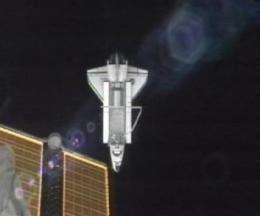
Atlantis left the International Space Station on Tuesday and slipped away after a partial lap around the station. Ten pairs of eyes pressed against the windows, four in the shuttle and six in the station.
All that remains of NASA's final shuttle voyage is the touchdown, targeted for the pre-dawn hours of Thursday back home in Florida. Its return ends the 30-year run of a vessel that kept U.S. astronauts flying to and from orbit longer than any other rocketship
"Get her home safely and enjoy the last couple days in space shuttle Atlantis," the station's Mission Control told commander Christopher Ferguson and his crew.
Replied Ferguson: "It's been an incredible ride."
As a final salute, the space station rotated to provide never-before-seen views of the complex. Atlantis flew halfway around the outpost, cameras whirring aboard both craft to record the historic event.
Flight controllers savored the dual TV images. "It must look pretty spectacular," Ferguson said.
And it did: Atlantis sailing serenely against the black void of space, its payload bay wide open, and the space station, its huge solar wings glowing golden in the sunlight.
As the lead team of flight controllers signed off for the very last time, the voice emanating from the shuttle's Mission Control cracked with emotion. Another team would take over late Tuesday for landing.
To ensure their safe return, the crew conducted one final survey of the shuttle, using the robotic arm and a laser-tipped extension. Experts scrutinized the images for signs of micrometeorite damage.
Atlantis spent 8 1/2 days at the space station and left behind a year's worth of supplies, insurance in the event commercial providers encounter delays in launching their own cargo ships.
It was the 37th shuttle mission, over more than 12 years, dedicated to building and maintaining the space station - the largest structure ever to orbit the planet.
In keeping with tradition, Atlantis' departure was marked by the ringing of the naval ship's bell aboard the space station. The undocking occurred nearly 250 miles above the Pacific.
"Atlantis departing the International Space Station for the last time," space station astronaut Ronald Garan Jr. announced, ringing the bell three times. "We'll miss you guys. Godspeed."
Ferguson thanked the six station residents for their hospitality, then added:
"We'll never forget the role the space shuttle played in its creation. Like a proud parent, we anticipate great things to follow ... Farewell, ISS. Make us proud."
All told, shuttles spent 276 days - or nearly 40 weeks - docked to the station. It's now a sprawling complex with multiple science labs - 13 rooms in all and more than 900,000 pounds of mass, most of that delivered by shuttles.
"So large that some astronauts have even momentarily gotten lost in it - you can take it from me," said Mission Control communicator Daniel Tani, a former station resident. "Of course, the ISS wouldn't be here without the space shuttle so ... we wanted to say thank you and farewell to the magnificent machines that delivered, assembled and staffed our world-class laboratory in space."
NASA and its international partners mean to keep it running until at least 2020. With the retirement of the shuttle fleet, the space station now must rely solely on other countries for restocking, at least until the first privately funded rocket blasts off with a load. That could come by year's end.
Private astronaut launches from U.S. soil, however, are three to five years away - at best. Until then, Americans will continue flying to and from the space station via Russian Soyuz capsules at a hefty price.
The Atlantis crew left behind a small U.S. flag that flew on the inaugural shuttle voyage in 1981. The flag is the prize for the first company that launches astronauts to the station from the U.S. President Barack Obama described it last week as "a capture-the-flag moment here for commercial spaceflight."
Obama wants private companies taking over Earth-to-orbit operations so NASA can concentrate on sending astronauts beyond. The goals: an asteroid by 2025 and Mars by the mid-2030s.
Flight director Kwatsi Alibaruho alluded to the potential difficulties ahead, as he described how he's dealt with his own discomforts regarding the end of the shuttle program and the uncertain future for space exploration.
"I try to look at that as an adventure, rather than focusing too much on the memories," he said Tuesday.
Atlantis will join Discovery and Endeavour in retirement after this 13-day journey, the 135th for the shuttle program. All three will become museum displays.
Tuesday marked the 36th anniversary of the undocking of the Apollo spacecraft from a Soviet Soyuz in the first-of-its-kind joint flight. Nearly six years passed between the end of that 1975 mission and the start of NASA's next: the space shuttle.
Mission Control said that gap - five years and nine months - is the mark to beat this time around. And it said it was starting the clock.
More information:
NASA: http://www.nasa.gov/shuttle
Shuttle-station sightings: http://spaceflight.nasa.gov/realdata/sightings/index.html
©2011 The Associated Press. All rights reserved. This material may not be published, broadcast, rewritten or redistributed.


