Space shuttle's science brought payoffs to Earth
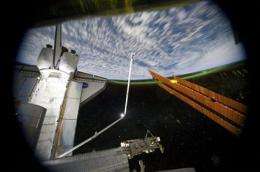
Science from the space shuttle helped open Earth's eyes to the cosmos and sister planets. It created perhaps the most detailed topographical map of Earth. And it even is helping doctors understand, and sometimes fix, what's happening in our aging and ailing bodies.
If you need help getting out of a crashed car, or if you're a soldier maneuvering around an active land mine field, space shuttle-derived technology may have saved your life.
And thanks to the space shuttle, we have healthier baby formula and cooling socks to wear in hot weather.
Most Americans wrongly credit the Apollo moon program with creating Earthly "spinoffs" of new technology that it never did: sticky Velcro, non-sticky Teflon and orange-powdered Tang - all things used by NASA but not invented there.
Yet the space shuttle program often doesn't get recognized for its science and technology, NASA says. And shuttle-based science will come to an end when Atlantis - carrying mouse stem cell and vaccine experiments - comes home on Thursday.
Of course spending nearly $200 billion on any advanced technology will pay off in various unplanned ways. And one scientist, a prominent critic of manned spaceflight, says NASA's claimed benefits are more hype than hope.
Bob Park, a professor of physics at the University of Maryland, debunker of science myths and author of the book "Voodoo Science," said much of NASA's claims of science and earthly technological benefits is advertising hokum that helps companies sell items as being developed in space.
"If you trace them, there's nothing there," Park said. "Teflon, Tang, nothing was invented in space. Space used it."
Park points to a decades-old NASA spinoff report as supporting his skepticism.
But scientists who have worked with and for the space agency say research during the 10 years the shuttle was developed and the 30 years it has flown has paid off.
"There's been a good deal of science learned on the shuttle," said MIT astronautics and health technology professor Laurence Young, who has sent experiments on seven shuttle flights, mostly on how weightlessness affects the body.
Science wasn't the reason the shuttle was built, said Rice University physicist Neal Lane, who was the head of the National Science Foundation and President Bill Clinton's science adviser. However, the shuttle and the International Space Station - which couldn't be constructed without the shuttle - are unprecedented places for important science. He has great hopes for an antimatter physics experiment shuttle Endeavour delivered to the station in May.
People overlook the increased understanding in human biology that the shuttle and station have provided, Lane said. "We've learned some things about the human body that we had no other way to learn except to operate for some period of time - some extended period of time - in space."
Astronauts lose bone strength, have balance problems and weakened immune systems that in many ways are similar to aging. Studying how to combat bone loss on shuttle astronauts with exercise and other activity may help the Earth-bound, they figure.
Still, the most obvious science the shuttle helped generate is with astronomy. Exhibit 1 is the Hubble Space Telescope, which changed Earth's view of the cosmos and even its understanding of the age of the universe. It was launched with the shuttle, fixed with the shuttle and upgraded four other times by spacewalking shuttle astronauts. Without all that, Earth's view of the rest of the universe would have been fuzzy at best.
Former NASA science chief Alan Stern said the shuttle launched three other major space exploration probes: Galileo, which gave close-up views of Jupiter and its moons; Magellan, which mapped hot chaotic Venus; and Ulysses, which examined the sun's larger influence on the edges of the solar system.
But what's taken for granted even more is how the shuttle improved our view of our home planet with one flight in 2000. The spacecraft carried a set of special radar instruments that mapped most of the world, including previously inaccessible areas such as jungles and mountaintops, with the most precise topographical measurements ever. This is important for military planning and aviation.
"It's a gift that is going to keep on giving. It's going to affect science, environment and national security," said University of Tennessee aviation and flight research professor John Muratore, a former NASA flight director. "And that is a really undervalued mission."
Another overlooked item from the space shuttle is the bioreactor, Muratore said. It originally was designed to grow cells and tissue in space for experiments in zero gravity, but it's used on Earth for all sorts of biomedical research, he said. Bioreactors can grow blood and human tissue in a constantly rotating growth medium that simulates the free fall of zero gravity. Then, scientists can direct tissue growth in predetermined shapes using plastic lattices, much like the way ivy climbs walls. It's still a developing technology so who knows where it will lead, said Dan Lockney, NASA's spinoff technology manager.
Each year, NASA puts out a list of shuttle science spinoffs, which are either purposeful or accidental. NASA scientists were trying to design better space food and they looked to algae. They found an algae nutrient that had only been seen in human breast milk and developed it. It is now in 95 percent of infant formula, Lockney said.
"Millions of babies have been fed (by) NASA; that beats Tang," Lockney said. Another common item is a material designed for shuttle spacesuits that controls temperature, cooling astronauts. Phase change materials from Outlast Technologies Inc. are now in socks, outdoor clothing and even some business suits, he said.
Famed heart surgeon Dr. Michael DeBakey helped develop a tiny new artificial heart pump - a bridge for patients needing transplants - based on fluid flow through the space shuttle main engines, the most complicated engines ever built. A few hundred people have had the device implanted.
NASA helped develop a tool for firefighters that rescues people from crashed cars that is lighter and cheaper than the famed Jaws of Life and which doesn't need an outside power source or hoses. Also, shuttle rocket fuel has been used to develop a device that safely sets off buried land mines.
For MIT's Young, science on the space shuttle is ideal. Astronauts would get so familiar with the experiments they had to perform, that they became experts themselves, sometimes adapting the research and making it better. They often were co-authors of Young's published research papers.
This was "the way we thought science should be done," he said.
More information: NASA Spinoffs: http://www.sti.nasa.gov/tto/
©2011 The Associated Press. All rights reserved. This material may not be published, broadcast, rewritten or redistributed.


