Space shuttle's legacy: Soaring in orbit and costs
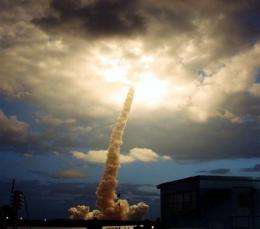
(AP) -- The space shuttle was sold to America as cheap, safe and reliable. It was none of those.
It cost $196 billion over 40 years, ended the lives of 14 astronauts and managed to make less than half the flights promised.
Yet despite all that, there were some big achievements that weren't promised: major scientific advances, stunning photos of the cosmos, a high-flying vehicle of diplomacy that helped bring Cold War enemies closer, and something to brag about.
Former President George H.W. Bush, who oversaw the early flights, said the shuttle program "authored a truly inspiring chapter in the history of human exploration."
NASA's first space shuttle flight was in April 1981. The 135th and final launch is set for July 8. Once Atlantis lands at the end of a 12-day mission, it and the other two remaining shuttles are officially museum pieces - more expensive than any paintings.
America has done far more for far less. The total price tag for the program was more than twice the $90 billion NASA originally calculated.
The nation spent more on the space shuttle than the combined cost of soaring to the moon, creating the atom bomb, and digging the Panama Canal, according to an analysis by The Associated Press using figures from NASA and the Smithsonian Institution and adjusting for inflation.
Even its most ardent supporters concede that the shuttle program never lived up to its initial promise. The selling point when it was conceived four decades ago was that with weekly launches, getting into space would be relatively inexpensive and safe. That wasn't the case.
"But there is no embarrassment in setting the bar impossibly high and then failing to clear it," said former astronaut Duane Carey, who flew in 2002. "What matters is that we strived mightily to do so - and we did strive mightily. The main legacy left by the shuttle program is that of a magnificent failure."
Of the five shuttles built, two were lost in fiery tragedies. The most shuttle flights taken in one year was nine - far from the promised 50.
The program also managed to make blasting into space seem everyday dull by going to the same place over and over again. Shuttles circled the planet 20,830 times, but went nowhere really new.
The shuttle's epitaph is "we tried," said Hans Mark, a former deputy NASA administrator who oversaw most of the first dozen launches.
Six years ago, then-NASA chief Michael Griffin even called the shuttle program a mistake.
But as a mistake it is one that paid off in wildly unexpected ways that weren't about money and reliability.
"The discoveries it enabled, the international cooperation it fostered and the knowledge it gained - often at great human cost - has also contributed in countless, important ways to humanity and our common progress," President Bush wrote The Associated Press in an email. Bush oversaw the program's early days as vice president, a job that has by tradition supervised NASA.
There are the magnificent photos from the Hubble Space Telescope, which helped pinpoint the age of the universe and demonstrated the existence of mysterious dark energy; the ongoing labwork on the International Space Station; a multitude of satellites for everything from spying to climate change; and spacecraft that explore the solar system. All owe their existence to the space shuttle.
The Hubble was not just launched from the shuttle - it was repaired and upgraded five times by shuttle astronauts. They also captured and fixed satellites in orbit.
Earlier this year, shuttle astronauts installed a $2 billion particle physics experiment on the space station that may find evidence of dark matter and better explain aspects of how the universe was formed. Add the intangibles of near continuous American presence in space over three decades and a high-flying venue for both international diplomacy and school science lessons.
Like a real life version of the television show "Star Trek," the shuttle was a United Nations in space, carrying representatives of 16 other countries. The U.S. and Russia became close partners in space and Russian rocket scientists after the breakup of the Soviet Union found new employment. NASA's current boss said all that is not something that should be ignored. The shuttle also diversified space to make it seem more like Earth, sending the first American woman, the first African-American and teachers, lawmakers and even a former migrant farmworker into orbit.
"The space shuttle program reaffirmed, once again, American dominance in space and laid the foundation for the United States to continue its long-standing leadership beyond our home planet," NASA Administrator and former shuttle commander Charles Bolden wrote in an email. "The shuttle program evolved over its lifetime and gave us many firsts and many proud national moments, along with painful lessons."
University of Colorado science policy professor Roger Pielke Jr., who studies shuttle costs and policies, said there are probably other ways the country could have spent several billion dollars a year on a human space program and gotten more.
Launching like a rocket and landing like an airplane, the shuttle was the ultimate hybrid. It acts both as a space taxi, carrying astronauts, and has the muscle of a long-distance trucker, hauling heavy machinery. That versatility translated into higher costs.
When spaceships carry people, extra safety requirements add hefty expenses. Rockets that haul big pieces of equipment - like station segments or a giant telescope - require more power and fuel, which means more cost. The shuttle has both of those problems that escalate the price.
When the shuttle succeeded, it did so in a spectacular way. But its failures were also large and tragic.
Seven astronauts perished when Challenger exploded about a minute after launch in 1986 and seven more died when Columbia burned up as it returned to Earth in 2003. One out of every 67 flights ended in death - a fatality rate that would make the most ardent daredevil cringe.
Based on deaths per million miles traveled, the space shuttle is 138 times riskier than a passenger jet.
Former astronaut and past NASA associate administrator Scott Horowitz said, "While the shuttle is the most magnificent engineering feat, its complexity and the naive belief that it would be as safe as an airliner was its Achilles heel."
One problem is that the shuttle was a compromise from start to finish, said Howard McCurdy, a professor at American University and author of several books on the space agency. The shuttle had to satisfy both NASA and the Department of Defense, which dictated the exact shape of its wings and the size of its payload bay, said Roger Launius, senior curator at the Smithsonian Air and Space Museum.
The concept behind it was based on a three-step space plan, ultimately ending on Mars, said George Mueller, the former top official who is credited as the father of the space shuttle program. To get to Mars, NASA needed a space station circling Earth as a jumping-off point. To get to the space station, NASA wanted a completely reusable space shuttle.
In 1971, President Nixon gave NASA only the shuttle. It had no place to go. The space station wasn't built until 1998.
Worst of all, Mueller said, was that the plan to make every part of the shuttle fully reusable was dropped. Budget cuts ordered by the Nixon White House meant that the fuel tank would be jettisoned with each flight and the boosters would fall into the ocean after launch and have to be retrieved and refurbished extensively.
Those changes made to save upfront money, while they sound small, meant adding incredible expense to every flight, Mueller said in an interview.
The shuttle will likely go down in history as an anomaly of America's space program. The spacecraft before it were disposable capsules, like Apollo. And the designs for machines of the near future are also for the most part disposable capsules. That suggests that the 30 years of reusable shuttles that landed like airplanes were a diversion from the natural evolution of rocketry, said McCurdy.
It may be an anomaly, but astronauts call it an engineering marvel in both versatility and complexity. John Glenn, who flew in a Mercury capsule as well as the shuttle, called it "the perfect vehicle for its time."
He said like any pilot he'd prefer to fly the shuttle and called it a much smoother ride. But he said he understands why the future looks more like his Mercury capsules.
"As far as expense, simplification and cutting costs, the capsule is by far cheaper," the 89-year-old former senator said in a telephone interview from his Columbus, Ohio, office on Friday.
"The shuttle is an amazing piece of machinery," astronaut Stan Love said. "It blows away anything that can fly now or in the next 30 years."
However, when it comes to fulfilling the promise made four decades ago, Love retells a joke heard often around NASA: The space shuttle was supposed to be cheap, safe and turn spaceflight into something so routine it would be boring. One out of three ain't bad.
©2011 The Associated Press. All rights reserved. This material may not be published, broadcast, rewritten or redistributed.


