Solar car Quantum to tour Michigan in the ultimate road test
July 13, 2011

Solar car Quantum to tour Michigan in the ultimate road test

Enlarge

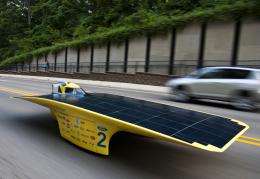
The U-M Solar Car Team is about to take off on a 1,000-mile mock race across the state. Credit: Evan Dougherty

The national champion solar car team will soon put its 2011 car and crew to the toughest test before the October World Solar Challenge. On Saturday, the University of Michigan team will embark on a 1,000-mile, four-day "mock race" that will ring the state's Lower Peninsula.

The Quantum, which is street legal, will cruise along mostly two-lane roads at an expected average of 40-50 mph (past Michigan solar cars can break 100 mph, but the team doesn't test for speed until after the World Solar Challenge). Five stops in St. Joseph, Ludington, Traverse City, Mackinaw City and Tawas City will simulate the mandatory control stops along the Australian race route. At these check points, the team will rest, change drivers and charge up. For details about the dates and times the team will be at each stop, check the website at http://solarcar.en … ich.edu/news .

"Mock race is a major milestone for us," said Rachel Kramer, project manager and senior neuroscience student. "We'll be on the open roads navigating and dealing with other traffic while making real-time race strategy decisions."

You can follow along online. Michigan Engineering will travel with the team, posting videos and updates on and , as well as on Tumblr at http://michiganengineering.tumblr.com . The team will also blog, tweet and post videos at http://solarcar.engin.umich.edu/category/blog.

Beyond practice, the trip will give the team a chance to show Quantum off across the state that many of its biggest fans and supporters call home. The team has more than 300 sponsors. Half are in the auto manufacturing sector and the majority of those are Michigan companies.

"Quantum is a breakthrough car for the U-M team and we couldn't have built it without our sponsors," said Chris Hilger, business manager and junior chemical . "This year we worked with the automotive base around us in unprecedented ways. No team has collaborated with industry on the level that we have."

Whereas in 2009, Michigan-based engineering firm Roush painted the car and donated some machining time and materials, this year the students built Quantum's carbon fiber chassis and body right at Roush's office, getting advice from professional engineers as they worked.

"With their help, we took a process that used to take a month and finished it in a week, and we ended up with a better product," Hilger said.

The team worked with the Detroit office of British engineering firm Ricardo to measure the true forces the car experiences on the road. With this new knowledge, the students were able to design a streamlined car that's 200 pounds lighter than its predecessor. The team ran aerodynamics tests in GE Jacobs' wind tunnel. Atlas Tool Inc. manufactured the wheels.

Provided by University of Michigan search and more info website


Rank not rated yet
Relevant PhysicsForums posts

More news stories

Browser wars flare in mobile space

The browser wars are heating up again, but this time the fight is for dominance of the mobile Internet.

Technology / Software

created 6 hours ago | popularity 5 / 5 (1) | comments 2

Probability of contamination from severe nuclear reactor accidents is higher than expected: study

Catastrophic nuclear accidents such as the core meltdowns in Chernobyl and Fukushima are more likely to happen than previously assumed. Based on the operating hours of all civil nuclear reactors and the number ...

Technology / Energy & Green Tech

created May 22, 2012 | popularity 3.6 / 5 (22) | comments 56 | with audio podcast

SpotterRF debuts Radar Backpack Kit (w/ Video)

(Phys.org) -- SpotterRF has announced a special radar backpack kit designed to enhance situational awareness for soldiers on the ground. The company says its special radar is designed for warfighters as part ...

Technology / Hi Tech & Innovation

created May 26, 2012 | popularity 5 / 5 (5) | comments 13 | with audio podcast report

HyperSolar shows dirty water no barrier to power world

(Phys.org) -- The Santa Barbara, California, company, HyperSolar, is set to transparently share the ups and downs of its research experiences toward the company’s ultimate vision, successfully producing ...

Technology / Energy & Green Tech

created May 24, 2012 | popularity 4.8 / 5 (16) | comments 17 | with audio podcast report

Tesla to launch electric sedan in US on June 22

Tesla Motors said Tuesday it would begin deliveries of "the world's first premium electric sedan" on June 22, slightly ahead of schedule.

Technology / Energy & Green Tech

created May 22, 2012 | popularity 4.5 / 5 (11) | comments 18


Nvidia trumpets Tegra 3 phone design wins for 2012

(Phys.org) -- Nvidia’s competitive war paint has a name, Tegra 3. On the heels of Nvidia announcements about lowering costs of its Tegra 3 processors and Nvidia-enabled tablets running Android Ice Cream ...

Scientist: Evolution debate will soon be history

(AP) -- Richard Leakey predicts skepticism over evolution will soon be history. Not that the avowed atheist has any doubts himself.

Dell tablet leak: 10.1-inch display, two-battery choice

(Phys.org) -- Headline after headline talks about vendors’ tablets in the wings as likely number-one contenders for the iPad. Such claims have justifiably been taken with a grain of salt, considering ...

Keep food safety in mind this memorial day weekend

(HealthDay) -- Picnics, parades and cookouts are as much a part of Memorial Day weekend as tributes to the United States' war veterans.

Social welfare cuts ultimately come with heavy price, researchers say

(Phys.org) -- Slashing government funding for Medicaid, food stamps and other programs that serve the poor – while politically popular with some lawmakers and many conservatives – may do more harm ...

Is a classical electrodynamics law incompatible with special relativity?

(Phys.org) -- The laws of classical electromagnetism that were developed in the 19th century are the same laws that scientists use today. They include Maxwell’s four equations along with the Lorentz la ...