Scientists model physics of a key dark-energy probe
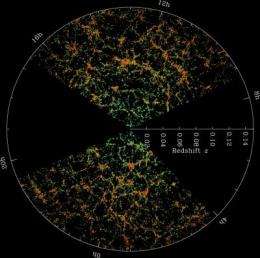
Produced by the Sloan Digital Sky Survey, this three-dimensional map of the distribution of galaxies shows Earth at the center, and represents each galaxy with a single point. Large astronomical surveys, such as SDSS, rely upon a model of Baryon Acoustic Oscillations to provide a cosmological "standard ruler" for determining length scale. Ohio State University's Chris Orban and David Weinberg, Ph.D., have employed Ohio Supercomputer Center resources to simplify and better characterize that BAO model. Credit: M. Blanton and SDSS
Ohio State University researchers are leveraging powerful supercomputers to investigate one of the key observational probes of "dark energy," the mysterious energy form that is causing the expansion of the universe to accelerate over time.
The OSU project, led by Chris Orban, a graduate research fellow in physics at Ohio State's Center for Cosmology and Astro-Particle Physics, focuses on simulations created on Ohio Supercomputer Center (OSC) systems to simplify and better characterize a subtle dark matter clustering feature. The new model allows cosmologists to gain a more accurate understanding of certain aspects of large-scale structure, such as the effect of the expansion of the universe on the growth of density fluctuations.
"Knowing how the dark matter 'reacts' to the expansion of the universe is crucial for learning the most about dark energy and dark matter from large astronomical surveys like the Sloan Digital Sky Survey, of which OSU is a collaborating member," said Orban. "In particular, there is a subtle clustering feature seen in this data set called 'Baryon Acoustic Oscillations' (BAO), which turns out to be very useful for constraining cosmological parameters like the equation of state of dark energy."
The oscillations come from fluctuations in the distribution of hot plasma in the early universe; researchers can identify this feature by measuring the cosmic microwave background.
"The BAO signature gets imprinted on the dark matter very early on, but the feature changes over cosmic time, potentially biasing its use as a cosmological tool," Orban explained. "It's a complicated non-linear problem, and physicists are very fond of simplifying complicated problems to gain a more in-depth understanding. This is exactly what we did for the first time, in our paper, using N-body simulations."
"For current state-of-the-art astronomical surveys, the main non-linear effects that we investigate in the paper are negligible compared to other sources of error, but next-generation surveys will need to be far more sophisticated in this regard," said Orban's academic advisor, David Weinberg, Ph.D., who is a professor of astronomy at OSU and the project scientist for the Sloan Survey. "This places the utmost importance on making reliable and precise predictions for these non-linear effects, a task which cosmological N-body simulations are in many ways well-suited to do."
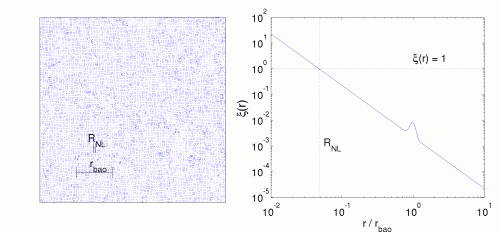
Snapshots from cosmological simulations (left) performed on Ohio Supercomputer Center systems and a plot of the clustering of dark matter on different scales (right). Orban and Weinberg are studying the evolution of the Baryon Acoustic Oscillations standard ruler using a new cosmological model that simplifies the non-linear dynamics that affect the BAO bump feature. Credit: Orban and Weinberg/OSU
Since early 2009, Orban and Weinberg have employed nearly 200,000 processor-hours of computational time on the OSC's flagship Glenn Cluster and eight terabytes of storage space on its Mass Storage Environment. The Glenn Cluster offers researchers more than 9,600 Opteron cores, 24 terabytes of memory and a peak computational capability of 75 teraflops which translates to 75 trillion calculations per second.For software, the researchers employed the state-of-the-art Gadget-2 N-body code to calculate the trajectories of more than a hundred million particles, and set the initial conditions using the 2LPT code developed by their collaborators at New York University.
"This research project represents a fantastic conjunction of people and disciplines," observed Ashok Krishnamurthy, co-executive director of OSC. "It brought together professionals in the fields of physics, astronomy and computational science to produce impressive results that might not otherwise have come together for many years. OSC is proud to have contributed to these achievements."
Orban and Weinberg authored a paper on this research, "Self-similar Bumps and Wiggles: Isolating the Evolution of the BAO Peak with Power-law Initial Conditions," which is slated for publication in the journal Physical Review D.
"We're both pretty proud of the final product, which we've been working on for about two and a half years," Orban said. "Our production runs represent by far the largest set of cosmological simulations ever performed at The Ohio State University."
Provided by Ohio Supercomputer Center
-
From lemons to lemonade: Reaction uses carbon dioxide to make carbon-based semiconductor,
32 comments
-
Thioridazine kills cancer stem cells in human while avoiding toxic side-effects of conventional cancer treatments,
3 comments
-
SpaceX private rocket blasts off for space station (Update),
42 comments
-
Climate scientists say they have solved riddle of rising sea,
31 comments
-
SpaceX capsule has 'new car' smell, astronauts say (Update),
2 comments
-
Water flow question
55 minutes ago
-
[Drift velocity] Factors affecting velocity
3 hours ago
-
does cold gasoline have less energy
4 hours ago
-
distribution of molecules throughout the atmosphere
6 hours ago
-
The Global Positioning System !
7 hours ago
-
A Question relating Power
8 hours ago
- More from Physics Forums - General Physics
More news stories
Is a classical electrodynamics law incompatible with special relativity?
(Phys.org) -- The laws of classical electromagnetism that were developed in the 19th century are the same laws that scientists use today. They include Maxwell’s four equations along with the Lorentz la ...
Landmark calculation clears the way to answering how matter is formed
(Phys.org) -- An international collaboration of scientists, including Thomas Blum, associate professor of physics, is reporting in landmark detail the decay process of a subatomic particle called a kaon ...
May 25, 2012 |
4.2 / 5 (21) |
48
|
Lying in wait for WIMPs: Researchers seek to dramatically increase sensitivity of Large Underground Xenon detector
Although it's invisible, dark matter accounts for at least 80 percent of the matter in the universe. No one knows what it is, but most scientists would bet on weakly interacting massive particles, or WIMPs.
May 23, 2012 |
4 / 5 (7) |
15
|
Hawaii lab turns laser-powered bubbles into microrobots
(Phys.org) -- A team of scientists from the University of Hawaii are working on microrobots created from bubbles of air in a saline solution. The bubbles take on their title of robots as a laser ...
Sound increases the efficiency of boiling
Scientists at the Georgia Institute of Technology achieved a 17-percent increase in boiling efficiency by using an acoustic field to enhance heat transfer. The acoustic field does this by efficiently removing vapor bubbles ...
May 24, 2012 |
5 / 5 (2) |
2
Nvidia trumpets Tegra 3 phone design wins for 2012
(Phys.org) -- Nvidias competitive war paint has a name, Tegra 3. On the heels of Nvidia announcements about lowering costs of its Tegra 3 processors and Nvidia-enabled tablets running Android Ice Cream ...
Browser wars flare in mobile space
The browser wars are heating up again, but this time the fight is for dominance of the mobile Internet.
Scientist: Evolution debate will soon be history
(AP) -- Richard Leakey predicts skepticism over evolution will soon be history. Not that the avowed atheist has any doubts himself.
Dell tablet leak: 10.1-inch display, two-battery choice
(Phys.org) -- Headline after headline talks about vendors tablets in the wings as likely number-one contenders for the iPad. Such claims have justifiably been taken with a grain of salt, considering ...
Keep food safety in mind this memorial day weekend
(HealthDay) -- Picnics, parades and cookouts are as much a part of Memorial Day weekend as tributes to the United States' war veterans.
Social welfare cuts ultimately come with heavy price, researchers say
(Phys.org) -- Slashing government funding for Medicaid, food stamps and other programs that serve the poor while politically popular with some lawmakers and many conservatives may do more harm ...

Jul 20, 2011
Rank: 1 / 5 (2)