New scientific research reveals diamonds aren't forever
Jul 18, 2011
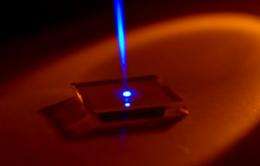
Evaporation of diamond induced by an ultraviolent laser beam. Image courtesy Richard Mildren

(PhysOrg.com) -- In a paper published in the US journal Optical Materials Express this week, Macquarie University researchers show that even the earth's hardest naturally occurring material, the diamond, is not forever.

Associate Professor Richard Mildren and his colleagues from the Macquarie University Photonics Research Centre discovered that diamonds evaporate under exposure to light.

"Although this type of light-induced evaporation has been observed in some materials, this is the first time it's been shown to occur for diamond," Mildren said.

The diamonds were exposed to intense in the UV-C band (the harsh filtered out by the ), and small pits in the diamond surface were visible after only a few seconds. The rate of mass loss in the diamond fell notably for lower light levels but the etching process still continued - albeit at a slower and slower pace, Mildren said.

But before diamond lovers around the world start to panic, he is quick to note that the rate of evaporation is very small and not noticeable under normal conditions. In fact, even under very bright UV conditions, such as intense sunlight or under a UV tanning lamp, it would take approximately the age of the universe - about 10 billion years - to see an observable distance, he said.

The findings not only provide clues about the long-term stability of diamonds, but also have broad implications for future research.

"It's a very practical discovery and we are now looking at how we can exploit this," Mildren said.

"If we can make structures in the diamonds that enable us to control the position of the light within a very narrow filament in the diamond, that's the first step to making smaller and more efficient such as those used in and high performance lasers."

The discovery may also have implications as far reaching as the prospects for finding diamonds on the surface of other planets, Mildren said.

Explore further: Iron-platinum alloys could be new-generation hard drives

More information: Mildren, R. P. et al. Opt. Mater. Express 1, 576-585 (2011).

Provided by Macquarie University

4.3 /5 (10 votes)

Related Stories

Diamonds are a laser's best friend

Sep 18, 2009

(PhysOrg.com) -- Tomorrow's lasers may come with a bit of bling, thanks to a new technology that uses man-made diamonds to enhance the power and capabilities of lasers. Researchers in Australia have now demonstrated the first ...

Researchers to Study Properties of the Hope Diamond

Aug 25, 2005

Since January, scientists from the Naval Research Laboratory's Chemistry Division have been studying the optical properties of the Hope Diamond, at the invitation of the Smithsonian Institution. In collaboration with the ...

Meteorite yields carbon crystals harder than diamond

Feb 03, 2010

(PhysOrg.com) -- Two new types of ultra-hard carbon crystals have been found by researchers investigating the ureilite class Haverö meteorite that crashed to Earth in Finland in 1971. Ureilite meteorites ...

Recommended for you

Promising doped zirconia

May 17, 2013

Materials belonging to the family of dilute magnetic oxides (DMOs)—an oxide-based variant of the dilute magnetic semiconductors—are good candidates for spintronics applications. This is the object of ...

Nanocrystals grow from liquid interface

May 17, 2013

An international collaboration of scientists has discovered a unique crystalizing behavior at the interface between two immiscible liquids that could aid in sustainable energy development.

User comments : 13

Adjust slider to filter visible comments by rank

Display comments: newest first

Grizzled
5 / 5 (20) Jul 18, 2011
"ultraviolent laser beam" - that's a good one. Now for the non-violent beam please.
Shelgeyr
1 / 5 (1) Jul 18, 2011
Heh. Good catch, Grizzled.
tpb
5 / 5 (5) Jul 18, 2011
"to see an observable distance"
I think he means an observable difference.

I believe they've been laser etching serial numbers on diamond for some years now, so light evaporating diamonds is not new.

I would be interested if this was done in the presence of O2(air) or in a vacuum. In air the CC bond might break and become CO.
This may not happen in a vacuum.
Myno
5 / 5 (1) Jul 18, 2011
"the prospects for finding diamonds on the surface of other planets"

Let's see... a common material of moderate intrinsic value only made expensive by monopoly and marketing... yea, I'm excited by the prospects of alien diamonds! Or is there some scientific reason for our interest?
MorituriMax
not rated yet Jul 18, 2011
Seriously? I'm a lot more worried about when those planck-sized mini-black-holes start evaporating and giving me serious gamma-ray burns over 100% of my body.
default_ex
5 / 5 (3) Jul 19, 2011
@Myno

I have to agree with your first sentiment, it is incredibly annoying that the things cost so much due to market hype for their aesthetic purposes. But I must disagree with your last sentiment, they really do hold value for many applications. High purity diamonds have some incredible electrical properties, but such high purity diamonds are often sought after by the wealthy for decorating their fingernails or dog's collar, it's an insult really.
LKD
not rated yet Jul 19, 2011
I believe they've been laser etching serial numbers on diamond for some years now, so light evaporating diamonds is not new.


That was my first thought that this could etch serial numbers for preventing theft or returning stolen jewelry.
bigws
5 / 5 (1) Jul 19, 2011
I believe they've been laser etching serial numbers on diamond for some years now, so light evaporating diamonds is not new.


That was my first thought that this could etch serial numbers for preventing theft or returning stolen jewelry.


The reason they are saying this is new is because they are showing that the diamonds can be changed under normal light conditions and not just a high wattage laser.
Sonhouse
not rated yet Jul 19, 2011
Heh. Good catch, Grizzled.

If it can etch diamond, it sounds pretty violent to me:)
Eikka
3 / 5 (2) Jul 19, 2011
The reason they are saying this is new is because they are showing that the diamonds can be changed under normal light conditions and not just a high wattage laser.


The diamonds were exposed to intense light pulses in the UV-C band


To me that sound much like a high wattage laser, and not normal lighting conditions.
Megadeth312
1 / 5 (1) Jul 19, 2011
The rate of mass loss in the diamond fell notably for lower light levels but the etching process still continued - albeit at a slower and slower pace, Mildren said.


They used the high intensity light pulses to accelerate (and demonstrate) the process, but the point is it still continues under normal lighting conditions, just slower...

But before diamond lovers around the world start to panic, he is quick to note that the rate of evaporation is very small and not noticeable under normal conditions. In fact, even under very bright UV conditions, such as intense sunlight or under a UV tanning lamp, it would take approximately the age of the universe - about 10 billion years - to see an observable distance, he said.

gjbloom
not rated yet Jul 19, 2011
Diamond is not thermodynamically stable. Graphite is a lower-energy configuration. If you heat a zillion-dollar diamond to 1500 C, you'll end up with a very expensive lump of graphite.

Some say that diamond is very slowly decomposing into graphite even at room temperature, assertions by DeBeers notwithstanding. So it should not surprise anyone that application of laser energy might be enough to kick some carbon atoms over the diamond energy barrier.
Wolf358
not rated yet Jul 19, 2011
I have read that diamonds exposed to air and heated to around 1000C simply burn like any other carbon.
Either way, diamonds apparently are not "forever".

More news stories

Making quantum encryption practical

One of the many promising applications of quantum mechanics in the information sciences is quantum key distribution (QKD), in which the counterintuitive behavior of quantum particles guarantees that no one can eavesdrop on ...

Lab sets a new record for creating heralded photons

(Phys.org) —Entanglement, by general consensus of physicists, is the weirdest part of quantum science. To say that two particles, A and B, are entangled means that they are actually two parts of an inseparable ...

New method for producing clean hydrogen

Duke University engineers have developed a novel method for producing clean hydrogen, which could prove essential to weaning society off of fossil fuels and their environmental implications.