Moving data at the speed of science: Berkeley Lab lays foundation for 100 Gbps prototype network
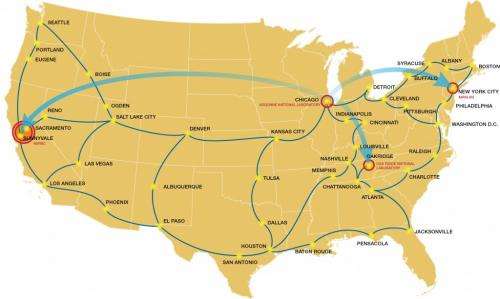
The DOE's Lawrence Berkeley National Laboratory (Berkeley Lab) today announced a major step toward creating one of the world's fastest scientific networks to accelerate research in fields ranging from advanced energy solutions to particle physics. Known as the Advanced Networking Initiative (ANI), the effort represents a $62 million multi-year investment by the DOE Office of Science in next-generation networking technology.
"As science becomes increasingly data-driven and global in scale, it's critical that we create an infrastructure that will enable our scientists to collaborate and compete successfully in the search for solutions to some of the world's biggest challenges in energy," said DOE Office of Science Director William F. Brinkman. "The Advanced Networking Initiative is the kind of investment that will help secure and maintain America's scientific pre-eminence and improve the quality of life for all of us."
Under the subcontracting agreement that Berkeley Lab signed with Internet2, the Department of Energy's Energy Sciences Network (ESnet) staff will work with Internet2 to develop a 100 gigabit- per-second (100 Gbps) prototype network, increasing the information-carrying capacity of DOE's present scientific network by several orders of magnitude.
"Berkeley Lab has long been a key part of the nation's scientific leadership in physics, chemistry, and energy research," said Paul Alivisatos, director of Lawrence Berkeley National Laboratory. "Berkeley Lab has continued this tradition through advanced computation and networking used at the forefront of modern scientific inquiry. It's fitting that, when it came to building the next-generation network, the DOE turned to Berkeley Lab and ESnet to ensure that ANI meets the needs of the U.S. research community to work with the increasingly complex data flows associated with tackling our nation's most urgent challenges and leading the world in collaborative, discovery-class research."
The prototype network is a crucial bridge to a planned nationwide 100 Gbps scientific network that will support thousands of DOE scientists in their research on environmental modeling, developing energy solutions, and exploring the fundamental nature of the universe, as well as in accessing data from one-of-a-kind experimental facilities such as the Large Hadron Collider. A portion of the funding also goes to the development of a national-scale network testbed, made available to researchers and industry for experiments with new network technologies, protocols and applications to help them get up to speed on the new 100 Gbps capability.
To build the national network, Internet2 will use fiber strands on Colorado-based telecommunications firm Level 3 Communications' Tier 1 fiber-optic network, and will provide cutting-edge optical networking equipment from Ciena Corporation, a Maryland-based provider of network infrastructure solutions. By collaborating on complementary projects, ESnet and Internet2 hope to leverage both the ANI investment and Internet2's own investments to maximize the value of both, to deliver unprecedented network capabilities to an increased pool of potential users.
The 100 Gbps prototype network, including hardware and dark fiber, will initially connect three DOE unclassified supercomputing centers: the National Energy Research Scientific Computing Center (NERSC) at Berkeley Lab, Oak Ridge Leadership Computing Facility (OLCF), and Argonne Leadership Computing Facility (ALCF), as well as the Manhattan Landing International Exchange Point (MANLAN).
"Internet2 is excited by the synergies created through this joint project, and how it builds on an already solid relationship with Berkeley Lab to create a flagship scientific network of unrivaled speed and capacity," said Dave Lambert, Internet2 president and CEO. "We believe the new ANI network will not only play a vital role in helping our community fulfill their research, education and service goals, but will create a host of economic opportunities and assure the U.S. a leading role in global science for many years to come."
An Investment in Scientific Competitiveness
This kind of stimulus investment in IT infrastructure is intended to spur U.S. scientific competitiveness by leading to accelerated development and wider deployment of future technologies, speeding the exchange of data and creating new ripples of scientific innovation—and the jobs that come with it. According to Steve Cotter, ESnet Department Head, this ANI funding is enabling Berkeley Lab and Internet2 to advance 100 Gbps technology development, lower its cost, and speed its adoption by the scientific community.
Networks like ESnet are ramping up capacity as the volume of data generated by scientific research rises exponentially. For some scientists, ANI's 100 Gbps capabilities cannot come fast enough.
"We now have many more people wanting to access and then replicate climate data than in previous years," said Dean Williams, climate scientist at Lawrence Livermore National Laboratory.
Long-Range Benefits
As part of the agreement, the Berkeley Lab has negotiated a 20-year lease on dark fiber capacity to be leveraged for so-called "disruptive" research, allowing DOE, industry and university researchers to use the facility to investigate new networking technologies and protocols, and effectively locking in the cost of future network infrastructure needs for the next two decades.
The ANI network will also jump-start ESnet's research in support of "green" energy-efficient networking–a hot priority as data volumes and network and supercomputing center energy demands keep rising. With Berkeley Lab's commitment to lead efforts in carbon reduction and energy efficiency for research, the ANI 100 Gbps prototype will be instrumental in providing measurements of network energy consumption on a real-time basis. ESnet intends to monitor and archive energy usage, making this data available to researchers so they can better understand energy consumption as they develop the next generation of energy-smart networking devices.
More information: www.internet2.edu/
Provided by Lawrence Berkeley National Laboratory


