GOES satellite sees a triple header in the tropics
Jul 20, 2011
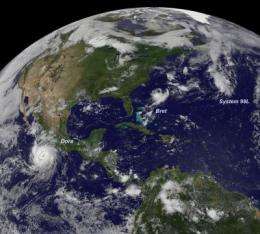
This visible image from the GOES-13 satellite on July 20 at 14:45 UTC (10:45 a.m. EDT) and shows a consolidating System 99L (far right) in the eastern North Atlantic Ocean, Tropical Storm Bret about 255 miles east of Cape Hatteras, N.C., and a large Hurricane Dora off the west coast of Mexico. Credit: NASA/NOAA GOES Project, Dennis Chesters

The GOES-13 satellite captured a triple-header in the tropics today when it captured three tropical cyclones in one image in the Northern Hemisphere.

A visible image taken from the GOES-13 satellite on July 20 at 14:45 UTC (10:45 a.m. EDT) and shows a consolidating low pressure area called System 99L in the eastern , Tropical Storm Bret several hundred miles east of South Carolina, and a large Hurricane Dora off the west coast of Mexico. The image was created by the NASA/NOAA GOES Project at NASA's Goddard Space Flight Center in Greenbelt, Md.

System 99L is a low pressure area that may to reach tropical depression status in the next day or two. It is located about 550 miles east-northeast of Bermuda and is moving to the northeast at 20 mph.

At 2 p.m. EDT on July 20, showed that showers and thunderstorms have become better organized within System 99L. The low-level circulation is also becoming better defined and the storm appears primed to become a tropical depression. If that happens, it would be Tropical Depression 3 (TD3) in the Atlantic Ocean basin. The National Hurricane Center gives it a 90 percent chance of coming together as TD3 in the next 48 hours.

Explore further: Volcanoes cause climate gas concentrations to vary

add to favorites email to friend print save as pdf

Related Stories

GOES-13 sees system 99L organizing tropically

Oct 20, 2010

The GOES-13 satellite keeps a continuous eye over the eastern U.S., the Caribbean Sea, Gulf of Mexico and Atlantic Ocean, and noticed that System 99L is much better organized today, October 20, hinting that ...

Expecting Tropical Depression Alex in the Caribbean

Jun 25, 2010

Forecasters on June 25 had given System 93L in the western Caribbean an 80 percent chance of developing into Tropical Depression Alex, and weekends seem to always birth tropical depressions. The GOES-13 satellite ...

NASA imagery reveals a weaker, stretched out Fiona

Sep 03, 2010

NASA satellite data has noticed that Tropical Storm Fiona is getting "longer." That is, the storm is elongating in almost a north-south direction, indicating that she's weakening and may not make it through ...

Recommended for you

Volcanoes cause climate gas concentrations to vary

1 hour ago

Trace gases and aerosols are major factors influencing the climate. With the help of highly complex installations, such as MIPAS on board of the ENVISAT satellite, researchers try to better understand the ...

Explainer: Why are tornadoes so destructive?

2 hours ago

Tornadoes are a part of life for people living in the Great Plains of the United States. In Oklahoma, a state that averages 62 tornadoes a year, people are prepared as best as they can be and are well warned.

NASA's BARREL mission launches 20 balloons

16 hours ago

(Phys.org) —In Antarctica in January, 2013 – the summer at the South Pole – scientists released 20 balloons, each eight stories tall, into the air to help answer an enduring space weather question: ...

Power of US tornado dwarfs Hiroshima bomb

16 hours ago

Wind, humidity and rainfall combined precisely to create Monday's massive killer tornado in Oklahoma. The awesome amount of energy released dwarfed the power of the atomic bomb that leveled Hiroshima.

User comments : 0

More news stories

Volcanoes cause climate gas concentrations to vary

Trace gases and aerosols are major factors influencing the climate. With the help of highly complex installations, such as MIPAS on board of the ENVISAT satellite, researchers try to better understand the ...