Roving robot to the rescue
July 7, 2011

Roving robot to the rescue

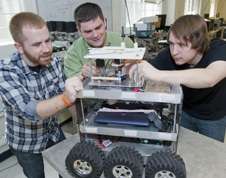
Whelan (left), Williams (center) and Bottiglieri (right) created a robot that can find disaster victims through their mobile phones. Credit: Mary Knox Merrill

(PhysOrg.com) -- Northeastern University student-researchers have created a roving robot named WiLU that may be able to locate and rescue victims of natural disasters or participate in military missions that are too dangerous for soldiers.

The was developed for a senior capstone project under the direction of electrical and professor Charles DiMarzio and associate professor in the College of Computer and , Guevara Noubir. The team members included electrical and computer Tom Bottiglieri, Spiros Mantzavinos, Travis Taylor, Ryan Whelan and Eric Williams.

WiLU—which looks like a Tonka truck—could help save the lives of victims of catastrophic disasters, such as the massive 9.0 earthquake that rocked Japan in March, said Whelan.

As he put it, “You could send this into a search and rescue scenario where you don’t want humans to go.”

Noubir sponsored the students and funded the project with a portion of the National Science Foundation (NSF) Major Research Instrumentation grant awarded to him and an interdisciplinary team of professors from Northeastern to develop wireless sensor networks that support key applications such as search and rescue by swarms of robots.

He praised the student’s innovative robot. “It’s a great example of an effective research platform that integrates multi-disciplinary expertise spanning mechanical engineering, RF communications, embedded software development, and algorithms designs."

Students created a complex algorithm that would enable the robot to locate people—or even bombs that are detonated through mobile phones.

Here’s how it works: a smart antenna mounted atop WiLU measures the signal strength of a mobile phone that is connected to a wireless network. Then, the robot autonomously determines the location of the object by adaptively forming beams to pinpoint the direction and location of the wireless signal source.

Students, who say humans could also control the robot from remote locations, hope to create a subscription service whereby mobile phone users could automatically join the WiFi network.

“Incorporating so many different creative and technical skills on a single project is the goal of our Capstone Design course,” DiMarzio said.

Provided by Northeastern University search and more info website


Rank 5 /5 (1 vote)
Relevant PhysicsForums posts

More news stories

Browser wars flare in mobile space

The browser wars are heating up again, but this time the fight is for dominance of the mobile Internet.

Technology / Software

created 6 hours ago | popularity 5 / 5 (1) | comments 2

Probability of contamination from severe nuclear reactor accidents is higher than expected: study

Catastrophic nuclear accidents such as the core meltdowns in Chernobyl and Fukushima are more likely to happen than previously assumed. Based on the operating hours of all civil nuclear reactors and the number ...

Technology / Energy & Green Tech

created May 22, 2012 | popularity 3.6 / 5 (22) | comments 56 | with audio podcast

SpotterRF debuts Radar Backpack Kit (w/ Video)

(Phys.org) -- SpotterRF has announced a special radar backpack kit designed to enhance situational awareness for soldiers on the ground. The company says its special radar is designed for warfighters as part ...

Technology / Hi Tech & Innovation

created May 26, 2012 | popularity 5 / 5 (5) | comments 13 | with audio podcast report

HyperSolar shows dirty water no barrier to power world

(Phys.org) -- The Santa Barbara, California, company, HyperSolar, is set to transparently share the ups and downs of its research experiences toward the company’s ultimate vision, successfully producing ...

Technology / Energy & Green Tech

created May 24, 2012 | popularity 4.8 / 5 (16) | comments 17 | with audio podcast report

Tesla to launch electric sedan in US on June 22

Tesla Motors said Tuesday it would begin deliveries of "the world's first premium electric sedan" on June 22, slightly ahead of schedule.

Technology / Energy & Green Tech

created May 22, 2012 | popularity 4.5 / 5 (11) | comments 18


Nvidia trumpets Tegra 3 phone design wins for 2012

(Phys.org) -- Nvidia’s competitive war paint has a name, Tegra 3. On the heels of Nvidia announcements about lowering costs of its Tegra 3 processors and Nvidia-enabled tablets running Android Ice Cream ...

Scientist: Evolution debate will soon be history

(AP) -- Richard Leakey predicts skepticism over evolution will soon be history. Not that the avowed atheist has any doubts himself.

Dell tablet leak: 10.1-inch display, two-battery choice

(Phys.org) -- Headline after headline talks about vendors’ tablets in the wings as likely number-one contenders for the iPad. Such claims have justifiably been taken with a grain of salt, considering ...

Keep food safety in mind this memorial day weekend

(HealthDay) -- Picnics, parades and cookouts are as much a part of Memorial Day weekend as tributes to the United States' war veterans.

Social welfare cuts ultimately come with heavy price, researchers say

(Phys.org) -- Slashing government funding for Medicaid, food stamps and other programs that serve the poor – while politically popular with some lawmakers and many conservatives – may do more harm ...

Is a classical electrodynamics law incompatible with special relativity?

(Phys.org) -- The laws of classical electromagnetism that were developed in the 19th century are the same laws that scientists use today. They include Maxwell’s four equations along with the Lorentz la ...