Riding the design wave
Jul 28, 2011
Riding the design wave
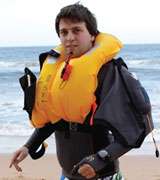
Chris Fox wears his 9th Life design

Chris Fox’s first-hand experience of the risks associated with water sports led him to design a self-inflating life jacket, which has just won a coveted James Dyson Award.

The ‘9th Life’ wetsuit jacket monitors oxygen levels and automatically inflates when the user is at risk of drowning, bringing them into a safe upright position and signally for help via GPS, explained Chris, 23, who graduated last year with a Bachelor of Industrial Design with first-class honors.

It was the drowning tragedy of fellow Queenscliff surf club member Saxon Bird, who was knocked unconscious in a surf-ski accident on the Gold Coast, that highlighted the need for such a design, Chris said.

“My personal experience is through kiteboarding kilometers off shore in windy conditions – I realised that I'm vulnerable if knocked unconscious with no help close by.

“9th Life is unlike any other life jackets on the market today. It provides users with a high level of safety without restricting their mobility and fits in with the sporting style and beach culture,” Chris told The Sun Herald.
Riding the design wave
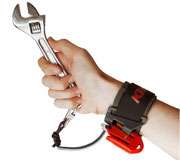
Craig Burke's Klinch tool tether

Chris’s innovation won the silver prize in the student awards, presented recently in Melbourne as part of the 2011 Australian Design Awards.

“I like the challenge of solving problems and looking for solutions that will make a difference to people’s lives. I also enjoy the hands on experience of designing, testing and building products.”

Chris was one of four finalists from UNSW’s Faculty of Built Environment vying for the Dyson Awards.

Dr. Miles Park, Director of the Industrial Design Program, said, “This year’s entries continued a very strong run of student design work – the innovative thinking and attention to detail has been outstanding.”

It follows the outstanding success of Samuel Adeloju, who last year won the international James Dyson Award for his 'Longreach' flotation device launcher.

Other UNSW design alumni to be recognized in the Australian Design Awards were Craig Burke, who won the Housing and Building category for his recently launched product, Klinch tool tether, which allows the user to carry and use multiple tools safely without the risk of being dropped from heights.

“The significance of Craig's win is that it demonstrates how a design that he first worked on as a student can be successfully commercialized and be award-winning,” said Dr. Park.

Explore further: PNNL-developed injection molding process recognized with emerging technologies award

add to favorites email to friend print save as pdf

Related Stories

King of the (lunar) road

Mar 30, 2011

The University of Alabama in Huntsville’s moon buggy may not go from 0 to 60 in five seconds, but it can handle the lunar regolith like nobody’s business. And that’s no small feat, says mechanical ...

LG Electronics LCD monitors sweep top design awards

May 09, 2005

LG Electronics announced its line-up of premium LCD monitors that swept world-class designs awards, namely, Reddot Design Awards 2005 and iF Material Design Awards 2005. CNN and CBS introduced LG’s premium ...

Portable solar device creates potable water

Mar 22, 2011

(PhysOrg.com) -- By harnessing the power of the sun, a Monash University graduate has designed a simple, sustainable and affordable water-purification device, which has the potential to help eradicate disease ...

Designer’s play mat a touching story

May 17, 2011

A Monash industrial design student has developed an interactive play set which helps visually impaired children learn the basics of Braille and develop their motor skills.

Making every drop count

Jan 26, 2011

A sustainable “rain garden” designed to capture every drop of water that falls onto it has been unveiled as one of the leading attractions at the 2011 Chelsea Flower Show.

Modern society made up of all types

Nov 04, 2010

Modern society has an intense interest in classifying people into ‘types’, according to a University of Melbourne Cultural Historian, leading to potentially catastrophic life-changing outcomes for those typed – ...

Recommended for you

How soon could car seats enter the 3-D comfort zone?

17 hours ago

New 3D textiles made of recyclable polyester fibres could contribute help cars be easier to recycle. But recycling technology has yet to progress in separating seat material from other car components.

NASA: Austin, calling Austin. 3-D pizzas to go

May 22, 2013

(Phys.org) —The idea of living with 3-D printed food is neither unthinkable nor new; designers and futurists have been looking to 3-D printing as food's next frontier. In 2012, there was news that the Thiel ...

User comments : 0

More news stories

Solar Kettle allows for boiling water off the grid

(Phys.org) —A company called Contemporary Energy has unveiled a new device it calls the Solar Kettle. It looks very much like a normal coffee thermos, but has flaps on one side that open to allow for collecting ...

Google Drive sports new view and scan enhancements

(Phys.org) —Google Drive has a new look and functions. The makeover in Google Drive features scanning and interface enhancements that put the user into "card" mode. The enhancements make it easy for the ...

Review: Google music plan solid, serendipitous

Google's new music service offers a lot of eye candy to go with the tunes. The song selection of around 18 million tracks is comparable to popular services such as Spotify and Rhapsody, and a myriad of playlists ...

Controlling mood through the motions of mitochondria

(Medical Xpress)—Regulating the distribution of power in neurons is done by a system that makes the national electric grid look simple by comparison. Each neuron has several thousand mitochondria confined ...

A quantum simulator for magnetic materials

Physicists understand perfectly well why a fridge magnet sticks to certain metallic surfaces. But there are more exotic forms of magnetism whose properties remain unclear, despite decades of intense research. ...