Rare white bird lifts hopes for N.Z. kiwis
Jul 15, 2011 by Erica Berenstein
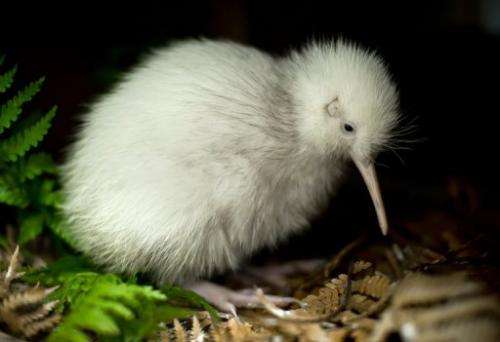
This photo, received from New Zealand's Department of Conservation, shows a young white kiwi bird. Resembling a fluffy white tennis ball with an elongated beak and stout, three-toed feet, the white kiwi has become a symbol of New Zealand's efforts to prevent its emblematic national bird from becoming extinct.

An expectant silence hangs over the Pukaha bird sanctuary as hundreds of spectators await a glimpse of a rare white kiwi, a bird held sacred by New Zealand's indigenous Maori people.

A collective sigh follows his unveiling to the crowd, although this appears to be prompted more by the chick's cute appearance than any mystical qualities.

Resembling a fluffy white tennis ball with an elongated beak and stout, three-toed feet, the white kiwi has become a symbol of New Zealand's efforts to prevent its emblematic national bird from becoming extinct.

The male chick, named Manukura -- meaning "of chiefly status" in Maori -- hatched on May 1 at the sanctuary north of Wellington, becoming the first white kiwi ever born in captivity.

Pukaha's field centre manager Kathy Houkamau said the chick had sparked unprecedented interest in the programme to save the flightless , which is threatened by introduced predators such as stoats, rats and .

"Manukura is proving to be a strong advocate for kiwi because he's so rare and people are really interested in him, he's drawing people to Pukaha and also to the species generally," she said.

"People are learning more about kiwi and threats to kiwi."

The Department of Conservation, which runs the sanctuary, estimates there are fewer than 70,000 left in New Zealand, and several sub-species are listed as critically endangered.

Kiwis are normally brown but birds in the that Manukura came from have white flecks in their plumage, giving rise to the occasional all-white specimen.

"He's not albino, he's got a recessive gene that makes him completely white," sanctuary ranger Tom Studholme said.

"We don't know when they're going to appear, we could get another next year or there might not be another white kiwi for 50, 100 years."

Studholme said Manukura's apearance was a cause for celebration among Maori, who traditionally see a white kiwi as a symbol of new beginnings and renewal.

"Culturally, it meant a lot for the local iwi (tribe)," he said, explaining that tribal elders held a ceremony to bless the bird shortly after its birth.

The blessing, along with a rigorous scientific breeding programme, appears to be paying dividends for Pukaha, which has hatched 14 kiwi chicks, compared with an average of two a year between 2005 and 2010.

The sanctuary, established in 2001, is a forest where wildlife officers have laid traps and baits to minimise predator numbers.

The adult birds roam free and any eggs that are produced are collected and brought to a kiwi nursery, where the chicks are cared for until they are big enough to be released into the forest.

Studholme admitted that his heart was in his mouth when he set birds free, knowing that attempts to eliminate all predators from the forest could never be 100 percent effective.

"You can't dwell on it, you've got to be confident in the work you've done," he said, but added: "It only takes one ferret to get past your defences and they can wipe out five kiwi nests in no time.

"They're nasty little killing machines."

Overall though, the Pukaha sanctuary and similar protected wildlife areas have succeeded in arresting the decline in kiwi numbers, a massive improvement from the 1980s, when populations were falling alarmingly. Manukura's sub-species, though, the north island brown kiwi, is still considered to be in serious decline.

There are doubts about whether Manukura will ever be released into the wild because of fears his white plumage marks him as an easy target.

"If you're white and you're in the bush at night, you could be at greater risk," says captive breeding ranger Darren Page.
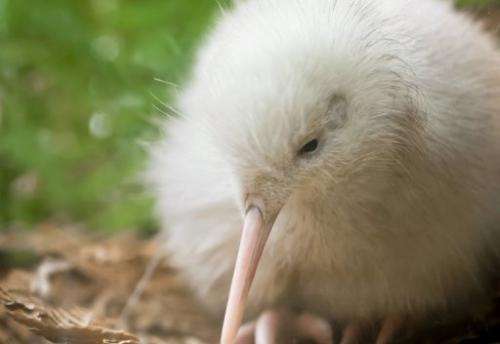
This photo, received from New Zealand's Department of Conservation, shows a young white kiwi bird. Kiwis are normally brown but birds in the gene pool that Manukura (pictured) came from have white flecks in their plumage, giving rise to the occasional all-white specimen.

But that would be the case mostly with kiwi's natural predators, like laughing owls, he says. "Of course, those predators are gone now. We've got your introduced predators like your stoats and your ferrets, which hunt by smell."

Still, Manukura may face a lifetime in Pukaha's nursery, where Houkamau says visitor numbers have doubled in the past two months on those days where he is made available for viewing.

"I do think of the world in terms of before Manukura and after Manukura," Houkamau said.

"I guess the arrival of a white chick changed everything here, we suddenly had an international celebrity on our hands and everyone wanted to see him."

Explore further: Front-row seats to climate change

add to favorites email to friend print save as pdf

Related Stories

Expectations high for next Xbox

30 minutes ago

It's almost time for a new Xbox. Eight years have passed since Microsoft unveiled the Xbox 360, double the amount of time between the original Xbox debut in 2001 and its high-definition successor's launch ...

Bacteria use hydrogen, carbon dioxide to produce electricity

2 hours ago

Researchers have engineered a strain of electricity-producing bacteria that can grow using hydrogen gas as its sole electron donor and carbon dioxide as its sole source of carbon. Researchers at the University of Massachusetts, ...

Why we need to put the fish back into fisheries

2 hours ago

Overfishing has reduced fish populations and biodiversity across much of the world's oceans. In response, fisheries are increasingly reliant on a handful of highly valuable shellfish. However, new research by the University ...

Engineered microbes grow in the dark

2 hours ago

Scientists at the University of California, Davis have engineered a strain of photosynthetic cyanobacteria to grow without the need for light. They report their findings today at the 113th General Meeting of the American ...

Lovelorn frogs bag closest crooner

2 hours ago

What lures a lady frog to her lover? Good looks, the sound of his voice, the size of his pad or none of the above? After weighing up their options, female strawberry poison frogs (Oophaga pumilio) bag th ...

Recommended for you

Honeybees trained in Croatia to find land mines

20 hours ago

(AP)—Mirjana Filipovic is still haunted by the land mine blast that killed her boyfriend and blew off her left leg while on a fishing trip nearly a decade ago. It happened in a field that was supposedly ...

Front-row seats to climate change

May 17, 2013

By day, insects provide the white noise of the South, but the night belongs to the amphibians. In a typical year, the Southern air hangs heavy from the humidity and the sounds of wildlife.

Captured in silken netting and sticky hairs

May 16, 2013

The great ecological success of spiders is often substantiated by the evolution of silk and webs. Biologists of the Kiel University and the University of Bern now found an alternative adaptation to hunting ...

User comments : 1

Adjust slider to filter visible comments by rank

Display comments: newest first

gunslingor1
not rated yet Jul 15, 2011
"Culturally, it meant a lot for the local iwi (tribe)," he said, explaining that tribal elders held a ceremony to bless the bird shortly after its birth.


Why is that every time we hear a story written in the USA about a foreign people, they always refer to them as "Tribes"? The only people immune to this treatment seems to by the Brits; I've even heard modern German groups called tribes, even the Japanese! You never hear people in the US referred to as the Georgia Tribe, or the Los Angeles tribe, nor the Republican or Democrat Tribe, not even the Amish are referred to as a tribe for god sake...so why only international groups? Is this an attempt to make Americans think the rest of the world is primitive? I wouldn't doubt it, half the people I meet think Brazil is a rain forest with Indians wearing loin cloths.

More news stories

Lovelorn frogs bag closest crooner

What lures a lady frog to her lover? Good looks, the sound of his voice, the size of his pad or none of the above? After weighing up their options, female strawberry poison frogs (Oophaga pumilio) bag th ...

Why we need to put the fish back into fisheries

Overfishing has reduced fish populations and biodiversity across much of the world's oceans. In response, fisheries are increasingly reliant on a handful of highly valuable shellfish. However, new research by the University ...

Engineered microbes grow in the dark

Scientists at the University of California, Davis have engineered a strain of photosynthetic cyanobacteria to grow without the need for light. They report their findings today at the 113th General Meeting of the American ...

Honeybees trained in Croatia to find land mines

(AP)—Mirjana Filipovic is still haunted by the land mine blast that killed her boyfriend and blew off her left leg while on a fishing trip nearly a decade ago. It happened in a field that was supposedly ...

Expectations high for next Xbox

It's almost time for a new Xbox. Eight years have passed since Microsoft unveiled the Xbox 360, double the amount of time between the original Xbox debut in 2001 and its high-definition successor's launch ...

US adviser on board of firm that sold anthrax drug

(AP)—Former Navy Secretary Richard J. Danzig, who has served as a bio-warfare adviser to the president, the Pentagon, and the Department of Homeland Security, urged the government to stockpile an anti-anthrax drug while ...