Rare coupling of magnetic and electric properties in a single material
July 25, 2011

Rare coupling of magnetic and electric properties in a single material

Enlarge

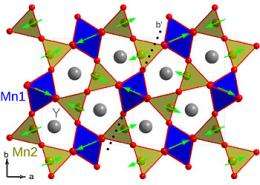
The crystal structure of YMn2O5, which is made of yttrium, manganese, and oxygen. The oxygen atoms are shown in red and the yttrium atoms are gray. The magnetic moments on the manganese are shown as arrows. Ferroelectric polarization occurs between the oxygen and manganese atoms.

Researchers at the U.S. Department of Energy's Brookhaven National Laboratory have observed a new way that magnetic and electric properties — which have a long history of ignoring and counteracting each other — can coexist in a special class of metals. These materials, known as multiferroics, could serve as the basis for the next generation of faster and energy-efficient logic, memory, and sensing technology.

The researchers, who worked with colleagues at the Leibniz Institute for Solid State and Research in Germany, published their findings in the July 25, 2011, edition of .

Ferromagnets are materials that display a permanent magnetic moment, or magnetic direction, similar to how a compass needle always points north. They assist in a variety of daily tasks, from sticking a reminder to the fridge door to storing information on a computer's hard drive. Ferroelectrics are materials that display a permanent electric polarization — a set direction of charge — and respond to the application of an by switching this direction. They are commonly used in applications like sonar, medical imaging, and sensors.

"In principle, the coupling of an ordered magnetic material with an ordered electric material could lead to very useful devices," said Brookhaven physicist Stuart Wilkins, one of the paper's authors. "For instance, one could imagine a device in which information is written by application of an electric field and read by detecting its magnetic state. This would make a faster and much more energy-efficient data storage device than is available today."

But multiferroics — magnetic materials with north and south poles that can be reversed with an electric field — are rare in nature. Ferroelectricity and magnetism tend to be mutually exclusive and interact weakly with each other when they coexist.

Most models used by physicists to describe this coupling are based on the idea of distorting the atomic arrangement, or crystal lattice, of a magnetic material, which can result in an electric polarization.

Now, scientists have found a new way that electric and magnetic properties can be coupled in a material. The group used extremely bright beams of x-rays at Brookhaven's National Synchrotron Light Source (NSLS) to examine the electronic structure of a particular metal oxide made of yttrium, manganese, and oxygen. They determined that the magnetic-electric coupling is caused by the outer cloud of electrons surrounding the atom.

"Previously, this mechanism had only been predicted theoretically and its existence was hotly debated," Wilkins said.

In this particular material, the manganese and oxygen electrons mix atomic orbitals in a process that creates atomic bonds and keeps the material together. The researchers' measurements show that this process is dependent upon the magnetic structure of the material, which in this case, causes the material to become ferroelectric, i.e. have an electric polarization. In other words, any change in the material's magnetic structure will result in a change in direction of its ferroelectric state. By definition, that makes the material a multiferroic.

"What is especially exciting is that this result proves the existence of a new coupling mechanism and provides a tool to study it," Wilkins said.

The researchers used a new instrument at NSLS designed to answer key questions about many intriguing classes of materials such as multiferroics and high-temperature superconductors, which conduct electricity without resistance. The instrument, developed by Wilkins and Brookhaven engineers D. Scott Coburn, William Leonhardt, and William Schoenig, will ultimately be moved to the National Synchrotron Light Source II (NSLS-II), a state-of-the-art machine currently under construction. NSLS-II will produce x-rays 10,000 times brighter than at NSLS, enabling studies of materials' properties at even higher resolution.

More information: Scientific paper: Observation of Electronic Ferroelectric Polarization in Multiferroic YMn2O5 - http://prl.aps.org … 7/i5/e057201

Provided by Brookhaven National Laboratory search and more info website

4.7 /5 (15 votes)  

Filter


Move the slider to adjust rank threshold, so that you can hide some of the comments.


Display comments: newest first

Telekinetic
Jul 25, 2011

Rank: not rated yet
If this new material takes off, you can find me in my lead boots and diver's helmet on the ocean bottom digging up the yttrium where I've staked a claim. Yahoo.
MRyan
Jul 26, 2011

Rank: 5 / 5 (1)
The applications of this material are going to alter the very ideas that we hold today. A skin of this material linked with an electronic Pulse fluctuation computer, you could cover aircraft and make them invisible to electronic tracking. You could also use it to create a fluctuating EM field around a space craft protecting from high levels of Solar radiation.
Rank 4.7 /5 (15 votes)
Relevant PhysicsForums posts
  • Transparency of molten substances?
    createdMay 25, 2012
  • saturated paramagnetic and ferromagnetic
    createdMay 24, 2012
  • How to calculate the bandstructure of Twisted Bilayer Graphene
    createdMay 23, 2012
  • vast computational richness from swapping one proton
    createdMay 22, 2012
  • Oscillator strength of mixed LH- and HH-excitons
    createdMay 22, 2012
  • 2D Quantum Well and k-values
    createdMay 21, 2012
  • More from Physics Forums - Atomic, Solid State, Comp. Physics

More news stories

Is a classical electrodynamics law incompatible with special relativity?

(Phys.org) -- The laws of classical electromagnetism that were developed in the 19th century are the same laws that scientists use today. They include Maxwell’s four equations along with the Lorentz la ...

Physics / General Physics

created May 24, 2012 | popularity 4.7 / 5 (17) | comments 42 | with audio podcast feature

Landmark calculation clears the way to answering how matter is formed

(Phys.org) -- An international collaboration of scientists, including Thomas Blum, associate professor of physics, is reporting in landmark detail the decay process of a subatomic particle called a kaon – ...

Physics / General Physics

created May 25, 2012 | popularity 4.2 / 5 (21) | comments 47 | with audio podcast

Lying in wait for WIMPs: Researchers seek to dramatically increase sensitivity of Large Underground Xenon detector

Although it's invisible, dark matter accounts for at least 80 percent of the matter in the universe. No one knows what it is, but most scientists would bet on weakly interacting massive particles, or WIMPs.

Physics / General Physics

created May 23, 2012 | popularity 4 / 5 (7) | comments 15 | with audio podcast

Hawaii lab turns laser-powered bubbles into microrobots

(Phys.org) -- A team of scientists from the University of Hawaii are working on microrobots created from bubbles of air in a saline solution. The bubbles take on their title of “robots” as a laser ...

Physics / General Physics

created May 23, 2012 | popularity 5 / 5 (4) | comments 2 | with audio podcast weblog

Sound increases the efficiency of boiling

Scientists at the Georgia Institute of Technology achieved a 17-percent increase in boiling efficiency by using an acoustic field to enhance heat transfer. The acoustic field does this by efficiently removing vapor bubbles ...

Physics / Soft Matter

created May 24, 2012 | popularity 5 / 5 (2) | comments 2


Nvidia trumpets Tegra 3 phone design wins for 2012

(Phys.org) -- Nvidia’s competitive war paint has a name, Tegra 3. On the heels of Nvidia announcements about lowering costs of its Tegra 3 processors and Nvidia-enabled tablets running Android Ice Cream ...

Browser wars flare in mobile space

The browser wars are heating up again, but this time the fight is for dominance of the mobile Internet.

Scientist: Evolution debate will soon be history

(AP) -- Richard Leakey predicts skepticism over evolution will soon be history. Not that the avowed atheist has any doubts himself.

Dell tablet leak: 10.1-inch display, two-battery choice

(Phys.org) -- Headline after headline talks about vendors’ tablets in the wings as likely number-one contenders for the iPad. Such claims have justifiably been taken with a grain of salt, considering ...

Keep food safety in mind this memorial day weekend

(HealthDay) -- Picnics, parades and cookouts are as much a part of Memorial Day weekend as tributes to the United States' war veterans.

Social welfare cuts ultimately come with heavy price, researchers say

(Phys.org) -- Slashing government funding for Medicaid, food stamps and other programs that serve the poor – while politically popular with some lawmakers and many conservatives – may do more harm ...