Pseudomonas deploys a toxin delivery machine to breach cell walls of rivals without hurting itself
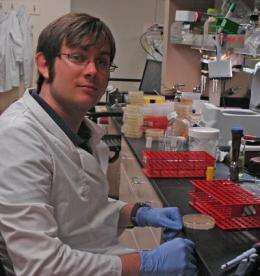
Microbiologists have uncovered a sneaky trick by the bacterium Pseudomonas aeruginosa to oust rivals. It deploys a toxin delivery machine to breach cell walls of competitors without hurting itself.
Its means of attack helps it survive in the outside environment and may even help it cause infection.
P. aeruginosa is a common bacterium that lives in soil, and also an opportunistic pathogen best known for infecting the lungs of cystic fibrosis patients.
The scientists discovered that P. aeruginosa injects toxins into rival bacteria with a needle-like puncturing device called the type VI secretion system (T6SS). The toxins degrade competitors' protective barricades – their cell walls. The research report also delineates the complex defensive mechanisms by which P. aeruginosa protects itself from its own artillery.
The journal Nature will publish the findings July 21.
While generally harmless to healthy people, this versatile bacterium takes advantage of those with weakened immune defenses, explained lead author Alistair Russell, a National Science Foundation fellow in the laboratory of Joseph Mougous, assistant professor of microbiology at the University of Washington (UW) and the study's senior author.
P. aeruginosa's ability to thrive in the thick airway mucous of cystic fibrosis patients and in burned or otherwise severely damaged skin makes it a major public health concern. All of these environments have one thing in common: other bacteria.
According to Russell, "Competition among bacteria is brutal and fierce."
By killing off competitors, P. aeruginosa widens its territory, leading to its overall success. Moreover, the better able it is to outlast other bacteria in the environment, the better chance it has of coming in contact with, and colonizing, people.
"Pseudomonas is never going to encounter an infection site if it can't survive in the outside world," Russell added.
The researchers have detailed the mechanism of the T6SS, which breaches a protective layer present in bacteria and delivers toxic proteins that degrade the cell wall. After the cell wall is compromised, the cell bursts like an overfilled water balloon.
The T6SS mechanism transports toxins so that they never enter P. aeruginosa's cell wall space. To thwart an attack from other members of its species, each P. aeruginosa cell also has specific immunity proteins that inactivate toxins injected by neighboring cells.
Bacterial species that lack these immunity proteins are susceptible.
The study also confirms previous observations of the evolutionary similarity between the T6SS needlelike delivery mechanism and bacteriophage – viruses that infect bacteria.
Interestingly, in a technique called "phage therapy," scientists have long sought to exploit the antibacterial properties of these viruses in order to treat bacterial infections.
One limitation is that bacteriophage are relatively unstable and require a host bacterium to increase their numbers. Mougous and his colleagues are excited by the potential of the antibacterial properties of the T6SS to be used in an analogous way.
Russell explained, "We might be able to take helpful bacteria, give them this system genetically, and increase their ability to clear out professional pathogens – those bacteria that make their living causing disease."
Knowledge of this complex bacterial antimicrobial mechanism also might help in the design of more sophisticated drugs.
"If scientists could inhibit this secretion system in Pseudomonas through a new type of antibiotic, this opportunistic pathogen would not be able to break through the normal, healthy barrier of bacteria in the human body," Russell said.
More information: "Type VI secretion delivers bacteriolytic effectors to target cells," Nature (2011).
Provided by University of Washington


