Pigeons never forget a face
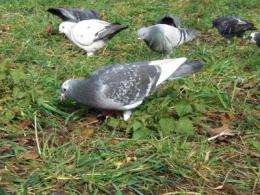
Untrained feral pigeons have special skills enabling them to recognize individuals, and are not fooled by people changing clothes. Credit: Ahmed Belguermi
New research has shown that feral, untrained pigeons can recognise individual people and are not fooled by a change of clothes.
Researchers, who will be presenting their work at the Society for Experimental Biology Annual Conference in Glasgow on Sunday the 3rd of July, have shown that urban pigeons that have never been caught or handled can recognise individuals, probably by using facial characteristics.
Although pigeons have shown remarkable feats of perception when given training in the lab this is the first research showing similar abilities in untrained feral pigeons.
In a park in Paris city centre, pigeons were fed by two researchers, of similar build and skin colour, wearing different coloured lab coats. One individual simply ignored the pigeons, allowing them to feed while the other was hostile, and chased them away. This was followed by a second session when neither chased away the pigeons.
The experiment, which was repeated several times, showed that pigeons were able to recognise the individuals and continued to avoid the researcher who had chased them away even when they no longer did so. Swapping lab coats during the experiments did not confuse the pigeons and they continued shun the researcher who had been initially hostile.
"It is very likely that the pigeons recognised the researchers by their faces, since the individuals were both female and of a similar age, build and skin colour," says Dr. Dalila Bovet a co-author of this work from the University of Paris Ouest Nanterre La Défense. "Interestingly, the pigeons, without training, spontaneously used the most relevant characteristics of the individuals (probably facial traits), instead of the lab coats that covered 90% of the body."
The fact that the pigeons appeared to know that clothing colour was not a good way of telling humans apart suggests that the birds have developed abilities to discriminate between humans in particular. This specialised ability may have come about over the long period of association with humans, from early domestication to many years of living in cities.
Future work will focus on identifying whether pigeons learn that humans often change clothes and so use more stable characteristics for recognition, or if there is a genetic basis for this ability, linked to domestication or to having evolved in an urban environment.
Provided by Society for Experimental Biology
-
From lemons to lemonade: Reaction uses carbon dioxide to make carbon-based semiconductor,
32 comments
-
Thioridazine kills cancer stem cells in human while avoiding toxic side-effects of conventional cancer treatments,
3 comments
-
SpaceX private rocket blasts off for space station (Update),
42 comments
-
Climate scientists say they have solved riddle of rising sea,
31 comments
-
SpaceX capsule has 'new car' smell, astronauts say (Update),
2 comments
-
What would stain as translucent on light-coloured fabric?
17 hours ago
-
How do I identify different bacteria on culture plates?
May 26, 2012
-
Why Do Dogs do Strange things...
May 25, 2012
-
What does exophillic and endophillic mean in terms of mosquito and their control?
May 24, 2012
-
Semen stains glows under black lights (uv light)?
May 23, 2012
-
Question on Human Chromosome 2
May 23, 2012
- More from Physics Forums - Biology
More news stories
Scientist: Evolution debate will soon be history
(AP) -- Richard Leakey predicts skepticism over evolution will soon be history. Not that the avowed atheist has any doubts himself.
16 hours ago |
3.3 / 5 (17) |
51
More plant species responding to global warming than previously thought
(Phys.org) -- Far more wild plant species may be responding to global warming than previous large-scale estimates have suggested.
May 22, 2012 |
4.6 / 5 (14) |
18
|
Thousands of shellfish found dead in Peru
Thousands of crustaceans were found dead off the coast of Lima following the mystery mass death of dolphins and pelicans, the Peruvian Navy said Friday.
May 26, 2012 |
4.8 / 5 (4) |
7
For monogamous sparrows, it doesn't pay to stray (but they do it anyway)
It's quite common for a female song sparrow to stray from her breeding partner and mate with the male next door, but a new study shows that sleeping around can be costly.
May 22, 2012 |
5 / 5 (2) |
7
|
Study uncovers secret to speedy burrowing by razor clams
(Phys.org) -- If you look at a razor burrowing clam sitting in a bucket, youd never guess that it could burrow itself down into the soil, much less do it with any speed. Razor clams look like fat straws, ...
Nvidia trumpets Tegra 3 phone design wins for 2012
(Phys.org) -- Nvidias competitive war paint has a name, Tegra 3. On the heels of Nvidia announcements about lowering costs of its Tegra 3 processors and Nvidia-enabled tablets running Android Ice Cream ...
Browser wars flare in mobile space
The browser wars are heating up again, but this time the fight is for dominance of the mobile Internet.
Dell tablet leak: 10.1-inch display, two-battery choice
(Phys.org) -- Headline after headline talks about vendors tablets in the wings as likely number-one contenders for the iPad. Such claims have justifiably been taken with a grain of salt, considering ...
Keep food safety in mind this memorial day weekend
(HealthDay) -- Picnics, parades and cookouts are as much a part of Memorial Day weekend as tributes to the United States' war veterans.
Social welfare cuts ultimately come with heavy price, researchers say
(Phys.org) -- Slashing government funding for Medicaid, food stamps and other programs that serve the poor while politically popular with some lawmakers and many conservatives may do more harm ...
Is a classical electrodynamics law incompatible with special relativity?
(Phys.org) -- The laws of classical electromagnetism that were developed in the 19th century are the same laws that scientists use today. They include Maxwell’s four equations along with the Lorentz la ...
Jul 03, 2011
Rank: 2 / 5 (2)
Jul 03, 2011
Rank: not rated yet
Or just simple makeup, could be mimes, trannies or clowns ( for the brave ) That would be interesting.
My own experience with birds is that they are very adept at reading your intentions through your eyes, at least in terms of discerning a staring predator from an interested human. My own experiments last summer confirmed this, at least with other wild birds, doves, cardinals, etc. Having grown up with many birds and parrots in my house this was just an observation I made over the years, but I was able to figure out some simple eye movements that calms them enough to allow you to get right up close, it takes a matter of minutes to do with many wild birds. They can probably discern body language, height, etc of individuals as well.
Jul 04, 2011
Rank: not rated yet
Jul 04, 2011
Rank: 1 / 5 (1)
Jul 04, 2011
Rank: not rated yet
I've had very interesting encounters with pigeons. Here's one.
A coffee shop I used to go to always had pigeons that would walk into the business. I observed them, observing people, to see if people were looking at them, if not, they scuttled inbetween the feet of the people that were waiting in line, which usually extends out the door, onto the sidewalk. But only if they weren't being watched.
Jul 04, 2011
Rank: not rated yet
Same coffee shop, one day a pigeon showed up with a piece of old mop string tangled on it's foot. We all sat around observing the bird, talking about how annoying it must be to have a string tangled around your foot. So I got down on my knees , held out my hand, and said to the bird " Would you like me to get that piece of string off your foot ?"
......the bird walked over to me, held up it's foot, and let me take the string off. Left us all with open mouths, myself included.
What does this mean ?
I truly can't say anything except that talking to the birds might not be all that bad afterall. :)
Jul 04, 2011
Rank: not rated yet
That's a great story. I don't want to ruffle any feathers, but could the pigeon have telepathically known of your empathetic history with your own birds, and based on your non-verbal transmission, deemed your intentions worthy of its trust? My dog would lift her paw for me to clear the ice and salt from her paw. Not as amazing as your pigeon, but reinforces the idea of trans-species communication.
Jul 04, 2011
Rank: not rated yet
I don't know. Telepathy, to me, is just an ambiguous term to name a perceptual mechanism/s that we haven't yet identified, like telecognition.
I do know that it's not just birds that I can interact with like this, it almost seems like they can all sense it somehow ( my intention ), I just don't know how else to describe it.
I had a birdfeeder in my window next to my desk, little by little I got them used to eating while my face was inches away. I noticed that after the intial establishment of my non-threatening status through eye contact, they would stand face to face with me, inches away, studying my face while I studied theirs, sometimes for 5 or more minutes. Where they thinking about it ? Idk. Did they recognize me ? Yes, they wouldn't come close to the feeder when friends were over. When I stopped getting up in the window up close, I noticed they would come up to the window and stare inside at me, looking around at things on my desk, etc
Jul 04, 2011
Rank: not rated yet
But their perceptions of what comprises a threat vs a benign encounter I think is deeper than just visual, it's probably quite a few things. Being a chef, and having cooked and handled a lot of dead birds :(, I think that were it " telepathy ' in the normally thought-of sense, they wouldn't come close to me.
Jul 04, 2011
Rank: not rated yet
Jul 05, 2011
Rank: not rated yet
Yeah, things like sensory dep tanks and OBE's beg the question too, don't they ?
Jul 05, 2011
Rank: not rated yet
Jul 05, 2011
Rank: 5 / 5 (1)
Apparently they are good art critics too :)
True about OBE's. Sense dep tanks, I am going to try one soon, got a friend who has one in his basement. Looking forward to it.