Parrots learn their 'names' from their parents
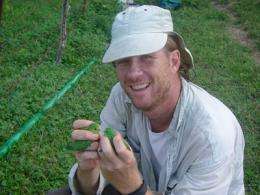
(PhysOrg.com) -- Parrots, which have long amused us for their ability to imitate our vocal patterns, actually learn to caw their "names" from their parents, says a new Cornell study. The research offers the first evidence that parrots learn their unique signature calls from their parents and shows that vocal signaling in wild parrots is a socially acquired rather than a genetically wired trait.
Karl Berg, a doctoral student in the Department of Neurobiology and Behavior in Cornell's College of Agriculture and Life Sciences, led the research team whose findings were published July 13 in the Proceedings of the Royal Society B.
Previous research had shown that all wild parrots use unique "contact calls" that not only distinguish each bird individually, but also communicate their gender, and the mate and larger group they belong to.
Building on this knowledge, Berg's team set out to discover whether the contact calls of wild parrots are something they learn from their parents in their early formative weeks or whether they are genetically determined in each nestling and then taught to their parrot family and community.
Video by Karl Berg of parrot communication
The team set up inconspicuous video cameras and audio recorders inside and outside 17 nests of newly hatched green-rumped parrots (Forpus passerinus) at a wild parrot research center in Venezuela created by Tomas Blohm '51 for several months in 2007-08. To determine whether the individual contact calls were innate or socially acquired, the researchers "cross-fostered" nine of the nests, switching eggs between them so that "foster parents" would raise hatchlings genetically unrelated to them.
Once they had analyzed the similarities and differences in the digital recordings of just under 5,000 individual parrot calls, the results indicated that the signature calls were socially acquired -- the parents gave the chicks their own call, which the chicks chirped back at the parents and would continue to use though with some tweaking.
Indeed, the nestlings all adopted contact calls markedly similar to those their parents (whether biological or foster) vocalized to them for the first weeks of their lives.
The findings "can also have implications for understanding why vocal learning evolved -- or did not evolve -- in other vertebrate groups like humans," Berg said.
To that end, he noted that parrots have two noteworthy characteristics: a large brain relative to their body mass, and a lengthy nesting time during which nestlings are dependent on their parents.
"Parrots can have extremely long periods [leading up] to independence, and this is thought to be related to their large brains," explained Berg. The same goes for primates, he said, with humans in particular being "off the charts" when it comes to a lengthy stage of child dependence.
More research is required, to better understand the evolution of and interaction between these physical and behavioral traits, he said. "We still don't have good explanations of how these behaviors help wild individuals survive and reproduce in nature," he said.
The paper offers some possible explanations: Perhaps the parrots' far-ranging journeys to "communal foraging sights" are what impress upon each parent the need to have their fledglings' names sorted out -- not unlike human parents' need to call for their children by name at a crowded fair.
What is clear, however, is that parrots' evolved vocal skills fulfill a natural purpose beyond squawking that they want a cracker.
Co-authors of the study are biologist Soraya Delgado, visiting scholar Kathryn Cortopassi, and Jack W. Bradbury, professor emeritus, all of the Cornell Laboratory of Ornithology, and Steven Beissinger from the University of California-Berkeley. The research was funded, in part, by the National Science Foundation and the Cornell Laboratory of Ornithology.
More information: The research paper: rspb.royalsocietypublishing.or … 07/07/rspb.2011.0932
Provided by Cornell University


