Onstott's discovery of worms in Earth's depths raises questions about life in space
July 12, 2011 By Nick DiUlio

Onstott's discovery of worms in Earth's depths raises questions about life in space

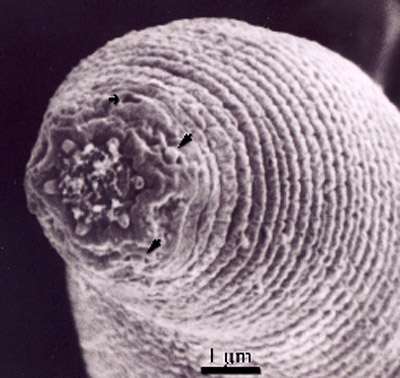
The species of nematode discovered by Onstott's research team can tolerate very high temperatures, reproduce asexually and feed on bacteria from the subsurface. It's a degree of unprecedented complexity that has prompted Onstott to say that finding these nematodes at such depths was akin to "finding Moby Dick in Lake Ontario." Credit: Gaetan Borgonie

After digging holes in the Earth's crust for nearly two decades, Princeton University geoscientist Tullis Onstott is now making headlines for unearthing "worms from hell."

Onstott's research team, which he led with Gaetan Borgonie of the University of Ghent in Belgium, recently made a startling discovery: microscopic roundworms known as nematodes living nearly two-and-a-half miles beneath the Earth's surface in several South African . The worms are roughly a quarter of the diameter of the head of a pin. Although have been known to live as far as 20 feet below the surface, scientists generally assumed there was no reason to believe the organisms would be found anywhere near the depths of those found by Onstott's team, he noted.

The discovery, which was published in the June 2 issue of the journal Nature in an article titled "Nematoda From the Terrestrial Deep Subsurface of South Africa," has attracted the attention of national media outlets such as The Washington Post, National Geographic and Time. Moreover, it has raised questions about not only the possibility of even more complex organisms miles below the Earth's surface, but also the likelihood of far into space.

"The potential to look for alien exists, in a way, right here on Earth," said Onstott, a professor of geosciences who joined the Princeton faculty in 1985. "What we're looking for are 'extremophiles' deep within the Earth, living in an environment that could also occur on other planets."

This particular extremophile -- a word used to describe forms of found in habitats previously thought uninhabitable -- is remarkable not only for the depth at which it was found, but also for its .

A wide range of previously has been known to thrive as far down as these worms. It was thought, however, that the constraints of temperature, energy, oxygen and space would make it impossible for a multicellular organism to live in such a place. These half-millimeter-long worms can apparently tolerate very high temperatures, prompting the researchers to nickname them "worms from hell." The worms also reproduce asexually and feed on bacteria from the subsurface. Given their size, Onstott said that finding these nematodes at such depths was akin to "finding Moby Dick in Lake Ontario."

Immersed in explorations below the Earth

An explorer at heart, Onstott has been searching for this type of biological revelation ever since he was "bitten badly by the subsurface bug" as an associate professor of geosciences at Princeton in 1994. That year he was first introduced to the strange world of deep, subsurface bacteria, and less than two years later he found himself thoroughly immersed in microbiology, plunging far beneath the Earth's surface on what he likes to call "underground safaris."

It's ironic that Onstott developed such passion for the underground world, considering that since he was a boy growing up in New Mexico he only ever wanted to go into space. In high school, shortly after watching Apollo 8 launch from the Kennedy Space Center on television in 1968, Onstott read Carl Sagan's "Intelligent Life in the Universe." The book had a significant impact on him, and he was convinced he'd become an interstellar expert once he graduated.
Onstott's discovery of worms in Earth's depths raises questions about life in space

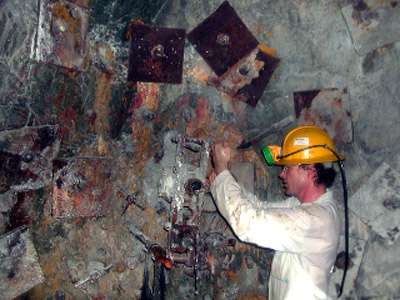
Enduring 90-plus degree temperatures, Onstott turns a valve while working at a depth of more than three kilometers in a South African gold mine where he found the subterranean roundworms. Credit: Lisa Pratt

While earning his bachelor's degree at the California Institute of Technology in the mid-1970s, however, Onstott's interests veered away from planetary science and toward geophysics. By the time he started working on his Ph.D. at Princeton, which he completed in 1980, Onstott no longer saw space -- or Mars in particular -- as a viable avenue of research.

"I was very much interested in traveling to other countries," Onstott recalled. "I couldn't very well travel to Mars, could I?"

However, what fueled Onstott's passion for the deepest of subsurface extremophiles was, more or less, the same question that fueled his fascination with space: He wanted to know how it's possible for life to exist in conditions so radically different from those on the surface of the Earth.

"Finding any life form in a strange place where normal people don't go and you would never expect to find it? That's always going to be something that appeals to the imagination," Onstott said. "It's almost science fiction in that regard. The search for life in these strange environments itself is something that broadens human perspective on life, and that's very important in helping us better understand how life evolves and how bizarre life can be."

Digging for further answers

The last 15 years of Onstott's subterranean explorations, research and study have taken him to myriad locales across the globe. Not only does he frequent the gold mines of South Africa -- where temperatures often approach 95 very humid degrees -- he has also taken several trips to the gold mines of Canada, where the warm air from the Earth's depths collides so quickly with sub-freezing surface temperatures that "snowflakes the size of chandeliers" form inside the mine, he said.

This, too, made Onstott think of Mars, where the conditions match those of the Canadian mines quite remarkably in certain spots.

"Everything is frozen on the Martian surface, but you go down a half-kilometer or so and things get warmer," said Onstott. "Also, you have caves on Mars where water might have risen through evaporation and frozen and crystalized. That's where you want to go looking for life on Mars."

Even though he still remains interested in space, Onstott is particularly excited to see how the discovery of these "worms from hell" further informs scientists' understanding of this planet. For instance, Onstott wants to figure out what relationship these South African nematodes -- dubbed Halicephalobus mephisto in honor of the sinister, darkness-loving demon Mephistopheles of literary lore -- may have with subsurface radiation as a means of energy.

Onstott would also like to complete the gene sequence for H. mephisto and compare it to the genomes of closely related species found near the surface of the mines. This should give him a better sense of whether or not the nematode has adapted or evolved in the subsurface, and help him answer the pressing question of whether or not life can originate so far down, he said.

Questions like these are what compel Onstott to go even deeper, continually plunging himself ever further into the shrouded mysteries of the Earth's black, sweltering, sunless interior.

"We still don't know how far down the biosphere goes," Onstott said. "We have an expectation that it stops at a certain temperature, but we haven't found that particular boundary yet. And if we do, the next question becomes: What lies beyond that?"

Provided by Princeton University search and more info website

Filter


Move the slider to adjust rank threshold, so that you can hide some of the comments.


Display comments: newest first

napdaw
Jul 12, 2011

Rank: 5 / 5 (1)
Is it possible these worms came down with miners / equipment at some point and adapted to tolerate the conditions? Just wondering!
braindead
Jul 12, 2011

Rank: not rated yet
"finding Moby Dick in Lake Ontario...."
Better go look soon before Asian Carp eat him!
braindead
Jul 12, 2011

Rank: not rated yet
It would be very interesting to see the relationship between microbes(and larger fauna if they are found elswhere)from different sub-surface areas around the world. It would be good to see if there is any lateral translation. Are these microbes geology dependant or can they survive in a wide variety of rocks? - what about non-commercially important rocks - they may be full of life but with no mines to investigate. Can samples also be taken from borehole tailings? Truly amazing where life will evolve and thrive. Surely we cannot be alone in the universe?
braindead
Jul 12, 2011

Rank: 5 / 5 (6)
One of our colleagues working on bacterial collection, Mr N. Matode, today made the shocking claim he was abducted by a bipedal alien creature. Mr Matode claimed the creature was from the "surface" and was reported to be "longer than a quartz vein". After undergoing horrendous tests, where he was subjected to some unknown electromagnetic radiation, the abductee was returned to sub-world down what he claimed to be "a linear blackhole made of sub-solid space which allowed movement though it at unbelievable velocities of metres per second!". A sub-solid space phase, beyond the two known matter phases, allowing travel through dimensions at almost instantaneous rates, has been recently speculated to exist by our physicists though many in the field remain sceptical. Mr N. Matode is currently undergoing psychiatric tests.
ziphead
Jul 12, 2011

Rank: 5 / 5 (1)
Is it possible these worms came down with miners / equipment at some point and adapted to tolerate the conditions? Just wondering!

No one is suggesting that this is independent line of life; therefore they had to get there some way or another. If it is with miners, so be it.
The point remains; they adapted somehow. If that ain't evolution, I don't know what is.
braindead
Jul 12, 2011

Rank: 5 / 5 (1)

"... *they* had to get *there" some way or another. "

Alternatively "...*we* had to get *here* some way or another" - really depends on your perspective as to where life on this planet started in the first place - maybe deep in the rocks?
antialias_physorg
Jul 13, 2011

Rank: 5 / 5 (3)
Is it possible these worms came down with miners

Then we'd probably only see them localized (in one mine). Or if there was some contaminating source that covered all mines then we'd see different types of nematodes in different mines.

That we find the same nematodes in all mines is a strong indication that they have been there all along (i.e. that this is not a recent development).
Rank 5 /5 (11 votes)
Relevant PhysicsForums posts
  • revamping general concept and cosmological principle
    createdMay 25, 2012
  • Transiting Exoplanet Light Curve
    createdMay 25, 2012
  • Math behind Theoretical Physics
    createdMay 24, 2012
  • Do we know whats at the center of galaxies yet?
    createdMay 23, 2012
  • Structure of the Milky Way?
    createdMay 20, 2012
  • What would it take to terraform Pluto and Charon?
    createdMay 19, 2012
  • More from Physics Forums - General Astronomy

More news stories

Sophisticated simulations predict future warming

The chances of our planet being hit by a global warming of 3 degrees Celsius by 2050 is as likely as it being hit by an increase of 1.4 degrees, new research shows. Presented in the journal Nature Geoscience, the British study ...

Space & Earth / Earth Sciences

created May 22, 2012 | popularity 4.4 / 5 (9) | comments 51

Kyoto Protocol architect 'frustrated' by climate dialogue

UN climate talks are going nowhere, as politicians dither or bicker while the pace of warming dangerously speeds up, one of the architects of the Kyoto Protocol told AFP.

Space & Earth / Environment

created May 23, 2012 | popularity 3.7 / 5 (7) | comments 39

Aliens don't want to eat us, says former SETI director

Alien life probably isn’t interested in having us for dinner, enslaving us or laying eggs in our bellies, according to a recent statement by former SETI director Jill Tarter.

Space & Earth / Space Exploration

created May 25, 2012 | popularity 4.4 / 5 (13) | comments 37

Dragon arrives at space station in historic 1st (Update 2)

The privately bankrolled Dragon capsule made a historic arrival at the International Space Station on Friday, triumphantly captured by astronauts wielding a giant robot arm.

Space & Earth / Space Exploration

created May 25, 2012 | popularity 5 / 5 (10) | comments 19

What's the big deal about private space launches?

(AP) -- The first private spaceship is headed to the International Space Station. Some questions and answers about the cargo mission by Space Exploration Technologies, known as SpaceX:

Space & Earth / Space Exploration

created May 22, 2012 | popularity 5 / 5 (6) | comments 35


Browser wars flare in mobile space

The browser wars are heating up again, but this time the fight is for dominance of the mobile Internet.

Nvidia trumpets Tegra 3 phone design wins for 2012

(Phys.org) -- Nvidia’s competitive war paint has a name, Tegra 3. On the heels of Nvidia announcements about lowering costs of its Tegra 3 processors and Nvidia-enabled tablets running Android Ice Cream ...

Scientist: Evolution debate will soon be history

(AP) -- Richard Leakey predicts skepticism over evolution will soon be history. Not that the avowed atheist has any doubts himself.

Dell tablet leak: 10.1-inch display, two-battery choice

(Phys.org) -- Headline after headline talks about vendors’ tablets in the wings as likely number-one contenders for the iPad. Such claims have justifiably been taken with a grain of salt, considering ...

Keep food safety in mind this memorial day weekend

(HealthDay) -- Picnics, parades and cookouts are as much a part of Memorial Day weekend as tributes to the United States' war veterans.

Social welfare cuts ultimately come with heavy price, researchers say

(Phys.org) -- Slashing government funding for Medicaid, food stamps and other programs that serve the poor – while politically popular with some lawmakers and many conservatives – may do more harm ...