National Zoo Welcomes Whooping Crane
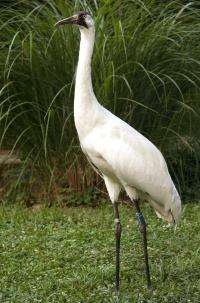
The Smithsonian's National Zoo has a new addition: Rocky, a male whooping crane (Grus americana). This is the first time the Zoo has exhibited this species in 88 years. Visitors can see Rocky on exhibit at the Zoo’s Bird House and learn about this endangered species, which were reduced to only an estimated 21 individuals in 1938 due to hunting and agricultural expansion. Their population, however, is now on the rise and scientists at the Smithsonian Conservation Biology Institute will also be looking to Rocky to help them determine the impact of genetic diversity on whooping crane sperm quality and fertility rate in captivity. Credit: Mehgan Murphy
After an 88-year-long hiatus North America's tallest bird, the statuesque whooping crane (Grus americana), is once again on exhibit at the Bird House at the Smithsonian's National Zoological Park. An 11-year-old male whooping crane named Rocky left Homosassa Springs State Park in Florida and is now on exhibit in the nation's capital. Whooping cranes are one of only two crane species native to the United States. There are only eight other zoos in the U.S. which exhibit these birds.
"It is an honor for the National Zoo to once again exhibit this magnificent species," said Dennis Kelly, director of the Smithsonian's National Zoological Park. "Although most people have heard of whooping cranes, very few have had the privilege of seeing one in person. We are thrilled to have Rocky here as an ambassador for his species."
Rocky is only the fourth whooping crane to call the National Zoo home. The Zoo's first crane, a wild-caught bird of unknown sex, arrived in 1897. Its last, a female, died in 1923.
By 1938, hunting and agricultural expansion had decimated wild whooping crane populations to an estimated 21 individuals. Zoos, research centers and nature preserves acted quickly to curtail the threat of extinction. Working together, they carefully matched individual birds that did not have mates in order to stabilize populations and achieve the greatest genetic diversity possiblea considerable challenge, given the population bottleneck.
The Smithsonian’s National Zoo has a new addition: Rocky, a male whooping crane (Grus americana). This is the first time the Zoo has exhibited this species in 88 years. Visitors can see Rocky on exhibit at the Zoo’s Bird House and learn about this endangered species, which were reduced to only an estimated 21 individuals in 1938 due to hunting and agricultural expansion. Their population, however, is now on the rise and scientists at the Smithsonian Conservation Biology Institute will also be looking to Rocky to help them determine the impact of genetic diversity on whooping crane sperm quality and fertility rate in captivity. Credit: Mehgan Murphy
Today, U.S. whooping crane populations are managed by the U.S. Fish and Wildlife Service. According to the 2010 census, 407 whooping cranes reside in breeding centers and protected nature reserves in the eastern and mid-western United States and Canada, while another 167 individuals are in human care. These numbers mean that their population trends are increasing, an encouraging sign that the species will thrive."Their remarkable population recovery and subsequent reintroduction is one of the greatest conservation stories in North America," said Ed Bronikowski, senior curator at the National Zoo. "Thanks to the continuing efforts of many, this species is not going extinct anytime soon."
Despite this progress, whooping cranes are still considered endangered by the International Union for Conservation of Nature. In breeding centers and zoos, whooping cranes can live upwards of 40 years old. In protected nature reserves, however, a whooping crane's lifespan is limited to about 30 years. Collisions with fences and power lines, illegal hunting, predators, disease and polluted waterways threaten these cranes.
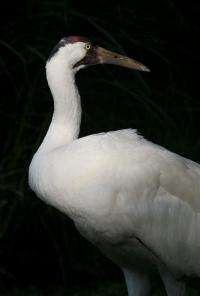
Visitors can see Rocky in the "Crane Run" exhibit outside of the Bird House. He is 5 feet tall and has a plume of white feathers, save for a patch of red and black feathers between his beak and the nape of his neck. He also has a 7-foot wingspan, which these cranes use to propel themselves 45 miles per hour during flight. Rocky will serve as an educational ambassador for his species, illustrating the behavior of whooping cranes to scientists, keepers and Zoo visitors. However, there is one trait visitors will not see Rocky perform: the loud "whoop" call these birds are named for.
"We don't know why Rocky is mute," says Sara Hallager, biologist at the Zoo's Bird House. "The reason behind his silence is a mystery known only to him."
The Zoo currently has no plans to breed Rocky, but his genes will not go to waste. He will participate in a study by the Zoo's Smithsonian Conservation Biology Institute that determines the impact of genetic diversity on whooping crane sperm quality and fertility rate in captivity.
Provided by
Smithsonian
-
From lemons to lemonade: Reaction uses carbon dioxide to make carbon-based semiconductor,
32 comments
-
Thioridazine kills cancer stem cells in human while avoiding toxic side-effects of conventional cancer treatments,
3 comments
-
SpaceX private rocket blasts off for space station (Update),
42 comments
-
Climate scientists say they have solved riddle of rising sea,
31 comments
-
SpaceX capsule has 'new car' smell, astronauts say (Update),
2 comments
-
What would stain as translucent on light-coloured fabric?
18 hours ago
-
How do I identify different bacteria on culture plates?
May 26, 2012
-
Why Do Dogs do Strange things...
May 25, 2012
-
What does exophillic and endophillic mean in terms of mosquito and their control?
May 24, 2012
-
Semen stains glows under black lights (uv light)?
May 23, 2012
-
Question on Human Chromosome 2
May 23, 2012
- More from Physics Forums - Biology
More news stories
Scientist: Evolution debate will soon be history
(AP) -- Richard Leakey predicts skepticism over evolution will soon be history. Not that the avowed atheist has any doubts himself.
17 hours ago |
3.3 / 5 (17) |
54
More plant species responding to global warming than previously thought
(Phys.org) -- Far more wild plant species may be responding to global warming than previous large-scale estimates have suggested.
May 22, 2012 |
4.6 / 5 (14) |
18
|
Thousands of shellfish found dead in Peru
Thousands of crustaceans were found dead off the coast of Lima following the mystery mass death of dolphins and pelicans, the Peruvian Navy said Friday.
May 26, 2012 |
4.8 / 5 (4) |
7
For monogamous sparrows, it doesn't pay to stray (but they do it anyway)
It's quite common for a female song sparrow to stray from her breeding partner and mate with the male next door, but a new study shows that sleeping around can be costly.
May 22, 2012 |
5 / 5 (2) |
7
|
Study uncovers secret to speedy burrowing by razor clams
(Phys.org) -- If you look at a razor burrowing clam sitting in a bucket, youd never guess that it could burrow itself down into the soil, much less do it with any speed. Razor clams look like fat straws, ...
Browser wars flare in mobile space
The browser wars are heating up again, but this time the fight is for dominance of the mobile Internet.
Nvidia trumpets Tegra 3 phone design wins for 2012
(Phys.org) -- Nvidias competitive war paint has a name, Tegra 3. On the heels of Nvidia announcements about lowering costs of its Tegra 3 processors and Nvidia-enabled tablets running Android Ice Cream ...
Dell tablet leak: 10.1-inch display, two-battery choice
(Phys.org) -- Headline after headline talks about vendors tablets in the wings as likely number-one contenders for the iPad. Such claims have justifiably been taken with a grain of salt, considering ...
Keep food safety in mind this memorial day weekend
(HealthDay) -- Picnics, parades and cookouts are as much a part of Memorial Day weekend as tributes to the United States' war veterans.
Social welfare cuts ultimately come with heavy price, researchers say
(Phys.org) -- Slashing government funding for Medicaid, food stamps and other programs that serve the poor while politically popular with some lawmakers and many conservatives may do more harm ...
Is a classical electrodynamics law incompatible with special relativity?
(Phys.org) -- The laws of classical electromagnetism that were developed in the 19th century are the same laws that scientists use today. They include Maxwell’s four equations along with the Lorentz la ...
