Monogamous queens help bees cooperate
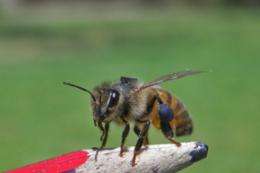
Credit: Mario Pahl
(PhysOrg.com) -- New research published today in Nature Communications online journal suggests that monogamy and close genetic relationships work together to enhance the cooperative social structure of insects such as bees, wasps and ants.
Known as haplodiploid animals because males develop from unfertilised eggs and have half the number of chromosomes that females have, the insect colonies are characterised as having a single queen and multiple drones.
Co-author of the paper Monogamy and haplodiploidy act in synergy to promote the evolution of eusociality Professor Hanna Kokko from the Research School of Biology at The Australian National University said the theoretical study looked at the logic of interacting genes in haplodiploids.
It is well known that ants, bees and wasps all form colonies where individuals help each other and form a collective, she said.
This paper is about a really old social evolution idea that has experienced a bit of a rollercoaster ride in popularity.
In the 1970s, Bill Hamilton suggested that the weird genetics of haplodiploid insects could favour cooperation in such systems because sisters are much more closely related to each other than they are in other organisms.
But this also means that they are less related to brothers so that would potentially make them less cooperative, and therefore people recently started to believe more in monogamy, where the queen mates only once, as a reason behind their social behavior.
We resurrected Hamiltons old argument by showing that both monogamy and haplodiploidy favour cooperative tendencies, but not because of the original reason.
Our research revealed that the two work together because the haplodiploid genetic system clumps cooperative genes together so that colonies benefit from having lots of like-minded individuals working together to achieve a common goal.
More information: The paper is available online: DOI:10.1038/ncomms1410
Provided by Australian National University
-
From lemons to lemonade: Reaction uses carbon dioxide to make carbon-based semiconductor,
32 comments
-
Thioridazine kills cancer stem cells in human while avoiding toxic side-effects of conventional cancer treatments,
3 comments
-
SpaceX private rocket blasts off for space station (Update),
42 comments
-
Climate scientists say they have solved riddle of rising sea,
31 comments
-
SpaceX capsule has 'new car' smell, astronauts say (Update),
2 comments
-
What would stain as translucent on light-coloured fabric?
18 hours ago
-
How do I identify different bacteria on culture plates?
May 26, 2012
-
Why Do Dogs do Strange things...
May 25, 2012
-
What does exophillic and endophillic mean in terms of mosquito and their control?
May 24, 2012
-
Semen stains glows under black lights (uv light)?
May 23, 2012
-
Question on Human Chromosome 2
May 23, 2012
- More from Physics Forums - Biology
More news stories
Scientist: Evolution debate will soon be history
(AP) -- Richard Leakey predicts skepticism over evolution will soon be history. Not that the avowed atheist has any doubts himself.
17 hours ago |
3.3 / 5 (17) |
54
More plant species responding to global warming than previously thought
(Phys.org) -- Far more wild plant species may be responding to global warming than previous large-scale estimates have suggested.
May 22, 2012 |
4.6 / 5 (14) |
18
|
Thousands of shellfish found dead in Peru
Thousands of crustaceans were found dead off the coast of Lima following the mystery mass death of dolphins and pelicans, the Peruvian Navy said Friday.
May 26, 2012 |
4.8 / 5 (4) |
7
For monogamous sparrows, it doesn't pay to stray (but they do it anyway)
It's quite common for a female song sparrow to stray from her breeding partner and mate with the male next door, but a new study shows that sleeping around can be costly.
May 22, 2012 |
5 / 5 (2) |
7
|
Study uncovers secret to speedy burrowing by razor clams
(Phys.org) -- If you look at a razor burrowing clam sitting in a bucket, youd never guess that it could burrow itself down into the soil, much less do it with any speed. Razor clams look like fat straws, ...
Browser wars flare in mobile space
The browser wars are heating up again, but this time the fight is for dominance of the mobile Internet.
Nvidia trumpets Tegra 3 phone design wins for 2012
(Phys.org) -- Nvidias competitive war paint has a name, Tegra 3. On the heels of Nvidia announcements about lowering costs of its Tegra 3 processors and Nvidia-enabled tablets running Android Ice Cream ...
Dell tablet leak: 10.1-inch display, two-battery choice
(Phys.org) -- Headline after headline talks about vendors tablets in the wings as likely number-one contenders for the iPad. Such claims have justifiably been taken with a grain of salt, considering ...
Keep food safety in mind this memorial day weekend
(HealthDay) -- Picnics, parades and cookouts are as much a part of Memorial Day weekend as tributes to the United States' war veterans.
Social welfare cuts ultimately come with heavy price, researchers say
(Phys.org) -- Slashing government funding for Medicaid, food stamps and other programs that serve the poor while politically popular with some lawmakers and many conservatives may do more harm ...
Is a classical electrodynamics law incompatible with special relativity?
(Phys.org) -- The laws of classical electromagnetism that were developed in the 19th century are the same laws that scientists use today. They include Maxwell’s four equations along with the Lorentz la ...