Major breakthrough on how viruses infect plants
Jul 14, 2011
Major breakthrough on how viruses infect plants
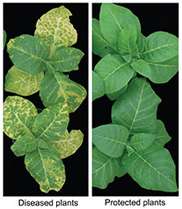
Tobacco plants affected by the virus and resistant to it. (Carl Davies CSIRO)

(PhysOrg.com) -- CSIRO plant scientists have shed light on a problem that has puzzled researchers since the first virus was discovered in 1892 – how exactly do they cause disease?

In a major breakthrough that helps us better understand how viruses cause diseases in – and potentially in animals and humans – Dr Ming-Bo Wang and Neil Smith of CSIRO Plant Industry have revealed a genetic mechanism that enables viral organisms to infect hosts and cause diseases.

“Cucumber Mosaic (CMV) is a common, destructive virus that affects a wide range of food crops and ornamental plants,” Dr Wang said.

“What we found was that CMV, accompanied by a special type of viral particle called a ‘satellite’, causes its distinctive yellowing symptoms in plants by slicing a gene that makes chlorophyll, the green pigment in leaves.  By preventing the production of chlorophyll, the virus causes the leaves to become partially or entirely yellowed which dramatically affects growth and productivity.” 

Importantly, Dr Wang and Mr Smith determined the exact gene affected by this virus – a gene called CHL1.

“Pinpointing this gene represents a major step forward in understanding exactly how some viruses cause disease symptoms in susceptible organisms,” Dr Wang said.

Until recently, scientists did not fully understand why viruses only affected a small range of host organisms.  This discovery shows that the accompanying satellite gene of CMV must directly match the host plant’s genes to cause the yellowing disease. 

When the viral satellite’s genes match the host plant’s genes, the satellite genes ‘lock’ onto and slice the host’s genes, preventing the host from forming green chlorophyll pigment.

“Think of it as like doing up a zipper on your jacket – two opposing but different sections have to come together for it to work,” Dr Wang said.

“So one half of the ‘zipper’ genes come from the virus and the other half of the genes from the host, and when they match up the virus causes disease.”

This finding means researchers can focus on finding in viruses that match known genetic sequences in plants, and this can help to reveal the cause of diseases by other viruses.

Knowing how CMV causes symptoms, Dr Wang and Mr Smith also experimented to see if they could block the viral disease in plants. They created specially altered plants with an extra copy of the chlorophyll-producing gene. This gene had been changed so that it no longer matched the viral gene, allowing the plants to produce the green chlorophyll pigment.

Remarkably, this small change in genetic makeup prevented the plants from becoming yellow and diseased but did not change any other aspects of the plants’ growth, habit or form.

Explore further: Engineered microbes grow in the dark

add to favorites email to friend print save as pdf

Related Stories

Key to controlling deadly viruses in bat community

Feb 15, 2011

CSIRO research into how bats can host some of the world’s deadliest viruses without suffering any ill-effects themselves will lead to improved strategies for controlling the spread of bat-borne diseases.

Invigorating plants

Jul 07, 2011

One of the key elements of the Green Revolution – when a series of  agricultural initiatives dramatically boosted crop productivity worldwide – was the harnessing of hybrid vigour. This phenomenon ...

Discovery could lead to better rice yields

Feb 10, 2009

(PhysOrg.com) -- Building on plant virus research started more than 20 years ago, a biologist at Washington University in St. Louis and his a colleague at the Donald Danforth Plant Science Center in St. Louis ...

All viruses 'can be DNA stowaways'

Nov 19, 2010

(PhysOrg.com) -- 'Fossil viruses' preserved inside the DNA of mammals and insects suggest that all viruses, including relatives of HIV and Ebola, could potentially be ‘stowaways’ transmitted from ...

The genetic secrets to jumping the species barrier

Feb 11, 2010

Scientists have pinpointed specific mutations that allow a common plant virus to infect new species, according to research published in the March issue of the Journal of General Virology. Understanding the genetics of the ...

Recommended for you

Engineered microbes grow in the dark

2 hours ago

Scientists at the University of California, Davis have engineered a strain of photosynthetic cyanobacteria to grow without the need for light. They report their findings today at the 113th General Meeting of the American ...

Turning up the heat on biofuels

May 16, 2013

(Phys.org) —The production of biofuels from lignocellulosic biomass would benefit on several levels if carried out at temperatures between 65 and 70 degrees Celsius. Researchers with the Energy Biosciences ...

Getting to the root of better crops

May 16, 2013

(Phys.org) —The more crop scientists know about how plant roots take up water and nutrients, the better able they will be to develop crop plants with roots that can cope with challenging soil and environmental ...

User comments : 1

Adjust slider to filter visible comments by rank

Display comments: newest first

DavidMcC
not rated yet Jul 15, 2011
So, if the "zipper" method works generally, maybe ERVs insinuate themselves into the host's DNA using a zipper at either end.

More news stories

Lovelorn frogs bag closest crooner

What lures a lady frog to her lover? Good looks, the sound of his voice, the size of his pad or none of the above? After weighing up their options, female strawberry poison frogs (Oophaga pumilio) bag th ...

Why we need to put the fish back into fisheries

Overfishing has reduced fish populations and biodiversity across much of the world's oceans. In response, fisheries are increasingly reliant on a handful of highly valuable shellfish. However, new research by the University ...

Engineered microbes grow in the dark

Scientists at the University of California, Davis have engineered a strain of photosynthetic cyanobacteria to grow without the need for light. They report their findings today at the 113th General Meeting of the American ...

Honeybees trained in Croatia to find land mines

(AP)—Mirjana Filipovic is still haunted by the land mine blast that killed her boyfriend and blew off her left leg while on a fishing trip nearly a decade ago. It happened in a field that was supposedly ...

Expectations high for next Xbox

It's almost time for a new Xbox. Eight years have passed since Microsoft unveiled the Xbox 360, double the amount of time between the original Xbox debut in 2001 and its high-definition successor's launch ...

US adviser on board of firm that sold anthrax drug

(AP)—Former Navy Secretary Richard J. Danzig, who has served as a bio-warfare adviser to the president, the Pentagon, and the Department of Homeland Security, urged the government to stockpile an anti-anthrax drug while ...