Kinetochores prefer the 'silent' DNA sections of the chromosome
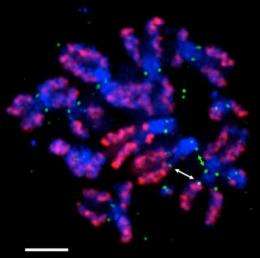
The protein complex responsible for the distribution of chromosomes during cell division is assembled in the transition regions between heterochromatin and euchromatin.
The centromere is a specialized region of the chromosome, on which a protein complex known as the kinetochore is assembled. During cell division, the kinetochore provides a point of attachment for molecules of the cytoskeleton, thereby mediating the segregation of chromosomes to the two opposing cell poles. Scientists from the Max Planck Institute of Immunobiology and Epigenetics and BIOSS in Freiburg have investigated the factors that play an essential role in the development of the kinetochore. According to their findings, both the organisation of the chromosomes and epigenetic marks determine the location where a kinetochore and, eventually, a centromere can form.
Centromeres are visible under the microscope as constrictions in the chromosomes. During cell division, the kinetochore, which is attached to the centromere, adheres to the microtubuli of the cytoskeleton and ensures that the chromosomes are divided equally between the two daughter cells. It was already known that cells of the brewer's yeast Saccharomyces cerevisiae, contain a very specific gene section of 125 base-pairs in length, which binds to the kinetochore complex and thereby enables the formation of a centromere.
However, other organisms do not appear to have a specific gene sequence which defines the location of the kinetochore formation. Instead, researchers suspect that the position of the centromere is regulated epigenetically with the help of the centromere-specific DNA packaging protein (histone) CENH3/CENP-A. Histone proteins, around which the thread-like DNA molecule is wrapped at regular intervals, influence the spatial arrangement of the DNA strand and, therefore also, the accessibility of genes and binding of other proteins, for example the kinetochore complex.
The Freiburg-based researchers have now succeeded in demonstrating that not only the centromere histone CENH3 but also other factors contribute to the formation of a functional kinetochore. Using a new research method, they induced the formation of the centromere-specific histone CENH3 in cells of the fruit fly Drosophila. Although the cells incorporated the protein into their chromosomes in many sites, the de novo assembly of ectopic kinetochores occurred not randomly but preferentially at the transition between gene-poor (heterochromatin) and gene-rich (euchromatin) sections, most often at the ends of the chromosomes, the telomeres.
It is possible that the transition regions between heterochromatin and euchromatin and the telomeres promote the formation of a kinetochore due to the absence of the typical heterochromatin and euchromatin proteins. In addition, very few genes are expressed and translated into proteins in these regions. Moreover, the chromatin turnover in these regions is very low, so that the kinetochore-specific histone can accumulate. "Therefore, in addition to the centromere-specific histones, the surroundings of the chromosome clearly play a crucial role in the formation of the kinetochore. Epigenetic histone marks thereby also influence where a kinetochore and, ultimately, a centromere can form," explains Patrick Heun from the Max Planck Institute of Immunobiology and Epigenetics.
More information: Olszak AM, van Essen D, Pereira AJ, Diehl S, Manke T, Maiato H, Saccani S, Heun P. Heterochromatin boundaries are hotspots for de novo kinetochore formation. Nat Cell Biol., 19 June 2011 doi:10.1038/ncb2272
Provided by Max-Planck-Gesellschaft


