Holes in fossil bones reveal dinosaur activity
July 8, 2011

Holes in fossil bones reveal dinosaur activity

Enlarge

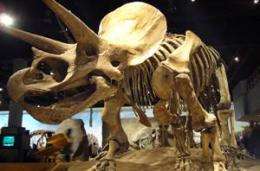
A dinosaur skeleton on display in Alberta, Canada. Photo by Cam Campbell.

(PhysOrg.com) -- New research from the University of Adelaide has added to the debate about whether dinosaurs were cold-blooded and sluggish or warm-blooded and active.

Professor Roger Seymour from the University's School of & Environmental Sciences has applied the latest theories of human and animal anatomy and physiology to provide insight into the lives of dinosaurs.  The results will be published this month in Proceedings B, the Proceedings of the Royal Society B (Biological Sciences), and can now be found online.

Human thigh bones have tiny - known as the 'nutrient foramen' - on the shaft that supply blood to living bone cells inside.  New research has shown that the size of those holes is related to the maximum rate that a person can be active during aerobic exercise. Professor Seymour has used this principle to evaluate the activity levels of dinosaurs.
Holes in fossil bones reveal dinosaur activity
Enlarge

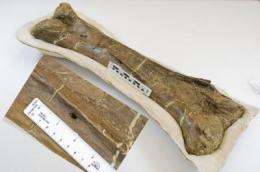
The femur of Centrosaurus apertus, a ceratopsian dinosaur, and (inset) the foramen. Credit: Photo by Dr Donald Henderson, Curator of Dinosaurs, Royal Tyrrell Museum, Alberta, Canada.

"Far from being lifeless, bone cells have a relatively high metabolic rate and they therefore require a large blood supply to deliver oxygen. On the inside of the bone, the blood supply comes usually from a single artery and vein that pass through a hole on the shaft - the nutrient foramen," he says.

Professor Seymour wondered whether the size of the nutrient foramen might indicate how much blood was necessary to keep the bones in good repair.  For example, highly active animals might cause more bone 'microfractures', requiring more frequent repairs by the and therefore a greater blood supply.

"My aim was to see whether we could use fossil bones of dinosaurs to indicate the level of bone metabolic rate and possibly extend it to the whole body's metabolic rate," he says. "One of the big controversies among paleobiologists is whether dinosaurs were cold-blooded and sluggish or warm-blooded and active.  Could the size of the foramen be a possible gauge for dinosaur ?"

Holes in fossil bones reveal dinosaur activity
Enlarge

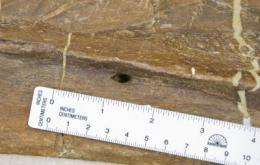
A hole in the femur of Centrosaurus apertus, a ceratopsian dinosaur. Credit: Photo by Dr Donald Henderson, Curator of Dinosaurs, Royal Tyrrell Museum, Alberta, Canada.

Comparisons were made with the sizes of the holes in living mammals and reptiles, and their metabolic rates.  Measuring mammals ranging from mice to elephants, and reptiles from lizards to crocodiles, one of Professor Seymour's Honours students, Sarah Smith, combed the collections of Australian museums, photographing and measuring hundreds of tiny holes in thigh bones.

"The results were unequivocal.  The sizes of the holes were related closely to the maximum metabolic rates during peak movement in mammals and reptiles," Professor Seymour says.  "The holes found in mammals were about 10 times larger than those in reptiles."

These holes were compared to those of fossil dinosaurs.  Dr. Don Henderson, Curator of Dinosaurs from the Royal Tyrrell Museum in Alberta, Canada, and Daniela Schwarz-Wings from the Museum für Naturkunde and Humboldt University Berlin, Germany, measured the holes in 10 species of dinosaur from five different groups, including bipedal and quadrupedal carnivores and herbivores, weighing 50kg to 20,000kg.

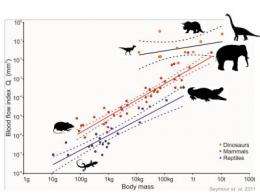
"On a relative comparison to eliminate the differences in body size, all of the dinosaurs had holes in their thigh bones larger than those of mammals," Professor Seymour says.
Holes in fossil bones reveal dinosaur activity
Enlarge

The y-axis is an index of the amount of blood flow through the foramen in relation to the body size of mammals (red), reptiles (blue) and dinosaurs (orange-red). Credit: Image courtesy of Professor Roger Seymour, School of Earth & Environmental Sciences, University of Adelaide.

"The dinosaurs appeared to be even more active than the mammals.  We certainly didn't expect to see that.  These results provide additional weight to theories that were warm-blooded and highly active creatures, rather than cold-blooded and sluggish."

Professor Seymour says following the results of this study, it's likely that a simple measurement of foramen size could be used to evaluate maximum activity levels in other vertebrate animal groups, both living and fossils.

Provided by University of Adelaide search and more info website

Filter


Move the slider to adjust rank threshold, so that you can hide some of the comments.


Display comments: newest first

PaulRC
Jul 08, 2011

Rank: not rated yet
makes me curious where birds would be on the chart.
Rank 5 /5 (3 votes)
Relevant PhysicsForums posts

More news stories

Social welfare cuts ultimately come with heavy price, researchers say

(Phys.org) -- Slashing government funding for Medicaid, food stamps and other programs that serve the poor – while politically popular with some lawmakers and many conservatives – may do more harm ...

Other Sciences / Social Sciences

created May 24, 2012 | popularity 4.3 / 5 (16) | comments 127

Ancient Bethlehem seal unearthed in Jerusalem

Israeli archaeologists have discovered a 2,700-year-old seal that bears the inscription "Bethlehem," the Israel Antiquities Authority announced Wednesday, in what experts believe to be the oldest artifact ...

Other Sciences / Archaeology & Fossils

created May 23, 2012 | popularity 3.5 / 5 (14) | comments 23

Oldest Jewish archaeological evidence on the Iberian Peninsula

German archaeologists of the Friedrich Schiller University Jena found one of the oldest archaeological evidence so far of Jewish Culture on the Iberian Peninsula at an excavation site in the south of Portugal, ...

Other Sciences / Archaeology & Fossils

created May 25, 2012 | popularity 4.3 / 5 (4) | comments 12

Dollars and sense: Why are some people morally against tax?

As the U.S. presidential election campaigns heat up, the economic debate is dominated by bailouts, austerity and, inevitably, taxation. Now a new study published in Symbolic Interaction asks why tax is such an important issue ...

Other Sciences / Social Sciences

created May 23, 2012 | popularity 3 / 5 (2) | comments 12

Oldest art even older

New dates from Geißenklösterle Cave in Southwest Germany document the early arrival of modern humans and early appearance of art and music.

Other Sciences / Archaeology & Fossils

created May 24, 2012 | popularity 4.3 / 5 (3) | comments 6


Nvidia trumpets Tegra 3 phone design wins for 2012

(Phys.org) -- Nvidia’s competitive war paint has a name, Tegra 3. On the heels of Nvidia announcements about lowering costs of its Tegra 3 processors and Nvidia-enabled tablets running Android Ice Cream ...

Browser wars flare in mobile space

The browser wars are heating up again, but this time the fight is for dominance of the mobile Internet.

Scientist: Evolution debate will soon be history

(AP) -- Richard Leakey predicts skepticism over evolution will soon be history. Not that the avowed atheist has any doubts himself.

Dell tablet leak: 10.1-inch display, two-battery choice

(Phys.org) -- Headline after headline talks about vendors’ tablets in the wings as likely number-one contenders for the iPad. Such claims have justifiably been taken with a grain of salt, considering ...

SpotterRF debuts Radar Backpack Kit (w/ Video)

(Phys.org) -- SpotterRF has announced a special radar backpack kit designed to enhance situational awareness for soldiers on the ground. The company says its special radar is designed for warfighters as part ...

SpaceX capsule has 'new car' smell, astronauts say (Update)

SpaceX's Dragon cargo vessel smells like a new car, said astronauts at the International Space Station after opening the hatches Saturday following the spacecraft's landmark mission to the orbiting lab.