Graphite + water = the future of energy storage
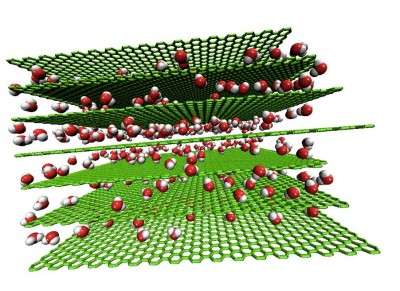
Graphene sheets. Credit: Gengping Jiang
A combination of two ordinary materials graphite and water could produce energy storage systems that perform on par with lithium ion batteries, but recharge in a matter of seconds and have an almost indefinite lifespan.
Dr. Dan Li, of the Monash University Department of Materials Engineering, and his research team have been working with a material called graphene, which could form the basis of the next generation of ultrafast energy storage systems.
Once we can properly manipulate this material, your iPhone, for example, could charge in a few seconds, or possibly faster. said Dr. Li.
Graphene is the result of breaking down graphite, a cheap, readily available material commonly used in pencils, into layers one atom thick. In this form, it has remarkable properties.
Graphene is strong, chemically stable, an excellent conductor of electricity and, importantly, has an extremely high surface area.
Dr. Li said these qualities make graphene highly suitable for energy storage applications.
The reason graphene isnt being used everywhere is that these very thin sheets, when stacked into a usable macrostructure, immediately bond together, reforming graphite. When graphene restacks, most of the surface area is lost and it doesnt behave like graphene anymore.
Now, Dr. Li and his team have discovered the key to maintaining the remarkable properties of separate graphene sheets: water. Keeping graphene moist in gel form provides repulsive forces between the sheets and prevents re-stacking, making it ready for real-world application.
The technique is very simple and can easily be scaled up. When we discovered it, we thought it was unbelievable. Were taking two basic, inexpensive materials water and graphite and making this new nanomaterial with amazing properties, said Dr. Li.
When used in energy devices, graphene gel significantly outperforms current carbon-based technology, both in terms of the amount of charge stored and how fast the charges can be delivered.
Dr. Li said the benefits of developing this new nanotechnology extend beyond consumer electronics.
High-speed, reliable and cost-effective energy storage systems are critical for the future viability of electricity from renewable resources. These systems are also the key to large-scale adoption of electrical vehicles.
Graphene gel is also showing promise for use in water purification membranes, biomedical devices and sensors.
Provided by
Monash University
-
From lemons to lemonade: Reaction uses carbon dioxide to make carbon-based semiconductor,
32 comments
-
Thioridazine kills cancer stem cells in human while avoiding toxic side-effects of conventional cancer treatments,
3 comments
-
SpaceX private rocket blasts off for space station (Update),
42 comments
-
Climate scientists say they have solved riddle of rising sea,
31 comments
-
SpaceX capsule has 'new car' smell, astronauts say (Update),
2 comments
-
microstructure of titanium
16 hours ago
-
Steam in My Espresso Machine
21 hours ago
-
Density question
May 24, 2012
-
Mass transport originating from a point source at a solid gas interface
May 22, 2012
-
Ammonia dispersion in Air
May 22, 2012
-
Multi Choice Help
May 21, 2012
- More from Physics Forums - Materials & Chemical Engineering
More news stories
In nanorod crystal growth, nanoparticles seen as artificial atoms
In the growth of crystals, do nanoparticles act as "artificial atoms" forming molecular-type building blocks that can assemble into complex structures? This is the contention of a major but controversial theory ...
May 24, 2012 |
4.8 / 5 (6) |
0
|
First direct observation of oriented attachment in nanocrystal growth
Berkeley Lab researchers have reported the first direct observation of nanoparticles undergoing oriented attachment, the critical step in biomineralization and the growth of nanocrystals. A better understanding ...
May 24, 2012 |
4.7 / 5 (3) |
0
|
Dopant gives graphene solar cells highest efficiency yet
(Phys.org) -- By taking advantage of graphenes favorable electrical and optical properties, and then adding an organic dopant, researchers have achieved the highest power conversion efficiency yet for ...
Synthetic nano-waste does not disappear
(Phys.org) -- Tiny particles of cerium oxide do not burn or change in the heat of a waste incineration plant. They remain intact on combustion residues or in the incineration system, as a new study by Swiss ...
Nanotechnology / Bio & Medicine
May 25, 2012 |
5 / 5 (2) |
1
|
'Metamaterials,' quantum dots show promise for new technologies
(Phys.org) -- Researchers are edging toward the creation of new optical technologies using "nanostructured metamaterials" capable of ultra-efficient transmission of light, with potential applications including ...
May 24, 2012 |
5 / 5 (7) |
1
|
Nvidia trumpets Tegra 3 phone design wins for 2012
(Phys.org) -- Nvidias competitive war paint has a name, Tegra 3. On the heels of Nvidia announcements about lowering costs of its Tegra 3 processors and Nvidia-enabled tablets running Android Ice Cream ...
Browser wars flare in mobile space
The browser wars are heating up again, but this time the fight is for dominance of the mobile Internet.
Scientist: Evolution debate will soon be history
(AP) -- Richard Leakey predicts skepticism over evolution will soon be history. Not that the avowed atheist has any doubts himself.
Dell tablet leak: 10.1-inch display, two-battery choice
(Phys.org) -- Headline after headline talks about vendors tablets in the wings as likely number-one contenders for the iPad. Such claims have justifiably been taken with a grain of salt, considering ...
SpotterRF debuts Radar Backpack Kit (w/ Video)
(Phys.org) -- SpotterRF has announced a special radar backpack kit designed to enhance situational awareness for soldiers on the ground. The company says its special radar is designed for warfighters as part ...
SpaceX capsule has 'new car' smell, astronauts say (Update)
SpaceX's Dragon cargo vessel smells like a new car, said astronauts at the International Space Station after opening the hatches Saturday following the spacecraft's landmark mission to the orbiting lab.
Jul 15, 2011
Rank: 2.6 / 5 (19)
Jul 15, 2011
Rank: 3.5 / 5 (11)
Jul 15, 2011
Rank: 5 / 5 (18)
Jul 15, 2011
Rank: 5 / 5 (6)
Jul 15, 2011
Rank: 5 / 5 (10)
But generally I agree: graphene seems to do everything except clean the coffepot (but I'm sure someone is working on that, too). I guess the excitement is akin to when integrated circuits got started or nuclear fission was discovered.
Jul 15, 2011
Rank: 1.2 / 5 (20)
Would be impressed if they could use Sea Water or Sewage.
Jul 15, 2011
Rank: 4.7 / 5 (14)
Word. Sea water would be much better...
Wait, what's this... graphene water desalinization?
:P
Jul 15, 2011
Rank: 4.6 / 5 (11)
Jul 15, 2011
Rank: 3.7 / 5 (3)
Jul 15, 2011
Rank: 4.4 / 5 (7)
The only constant is change.
SARCASM --> Everything there was to be discovered has been discovered and we know everything <-- END SARCASM
Of course there will be plenty more new discoveries from now on.
I compare electrical cars of today to the first mobile phones : big and not very practical. Look how well mobile phones turn to be. Future electrical cars will put to shame petrol cars.
Jul 15, 2011
Rank: 2.4 / 5 (13)
Jul 15, 2011
Rank: 2.4 / 5 (10)
Hopefully, graphene will not suffer a similar fate.
Jul 15, 2011
Rank: 1.3 / 5 (16)
Jul 15, 2011
Rank: 4.6 / 5 (10)
You're right no breakthroughs will ever happen ever we should just go kill ourselves because the world will never change. <---Sarcasm
I have seen plenty of improvements on energy storage in the past decade, you just have to know where to look. Also, just because you read about a breakthrough does not mean it is ready to be marketed on a consumer level (i.e. they just did the research now its up to other scientists and engineers to figure out a way this can be integrated with current technology).
Jul 15, 2011
Rank: 4.2 / 5 (5)
Energy companies are not dumb, they know just as well as we do that their source of income is absolutely finite.
They want to be at the lead of "the next big thing" in energy.
Just not until they've milked their cash-cow dry of course.
Jul 15, 2011
Rank: 4.5 / 5 (11)
I don't buy into the "evil oil-companies are going to keep all energy technologies from becoming viable" crap. Sure they will resist some, but from a business prospective if you don't adapt you die (they've been milking the oil business for a long time now). People want change, they have to respond to that or other companies will create a niche and claim the market (which some have). If anything oil-companies should buy into "green" technologies (some of them are actually) in order to 1)expand their interests and 2)protect their own image by investing into the green industry. By all means I'm not a pro-oil company guy, nor am I defending them, I just think they are getting more credit than what is due.
Jul 15, 2011
Rank: 4.6 / 5 (10)
Fresh water is a completely renewable resource and is extremely cheap. A slight improvement in irrigation methods would save thousands of times more fresh water than the tiny amount used in these devices. In fact, I bet dollars to donuts that you could easily get enough fresh water for one of these devices by mopping up the condensation off of your iced tea.
Jul 15, 2011
Rank: 4.3 / 5 (4)
All well and good but batteries are not an energy source. They only TRANSFER energy. You still have to have a real energy source or one discharge cycle and you are done. Even THAT cycle has to come from an external source, solar, grid, nuclear, wind, whatever.
Jul 15, 2011
Rank: 3 / 5 (2)
"Energy companies are not dumb, they know just as well as we do that their source of income is absolutely finite.
They want to be at the lead of "the next big thing" in energy.
Just not until they've milked their cash-cow dry of course."
Sure i can buy into that, however, i don't see them making enough of an effort, i mean, why don't they dig for lithium and set up factories, they of all else have the all the wealth in the world to do so, they don't have to claim to be the owners, they could be an "undecover" sponsor for such a project, and also regarding the cash cow, there's enough oil left for about 100 years or so right, so obviously me and my buddies won't benefit from the nice breakthroughs being discussed now anytime soon now will we. :(
Jul 15, 2011
Rank: 5 / 5 (1)
Jul 15, 2011
Rank: 3 / 5 (2)
Jul 15, 2011
Rank: 5 / 5 (6)
Jul 15, 2011
Rank: 1.8 / 5 (6)
@Corban: Since we are carbon-based lifeforms, we've been in the Carbon Age for quite a long time.
As for the entrenched industries vs. innovation debate: have you ever talked to these guys? They still think the environmental movement is a liberal, Commie plot to stop them from doing whatever they want to do to make more bucks than the next guy, at whatever cost to humanity... Oh wait, I guess they're right!
Jul 15, 2011
Rank: 3.8 / 5 (4)
Jul 15, 2011
Rank: not rated yet
The fallacy of your statement, other than your noble and concerned intent; is that when you remove the need for all the other things in current storage cycle systems that contain hydrogen and oxygen, the amount of 'fresh water' in the battery is likely vastly exceeded when talking about all systems across the board. Further, using a salt component in the water would reduce efficiency by a substantial degree due to heat.
Jul 15, 2011
Rank: 1.5 / 5 (2)
Except that NOW the word is absolutely OUT THERE;barring a full on nuclear conflagration and this tech is so simple that mechanically inclined people WILL be making storage devices on their own.Obviously, those people won't be able to make nearly as good a system as industry can, but I'd be willing to bet a trillion dollars(approx amount of $ spent by US on battery development per yr)that someone will be investigating processes and components specifically to make a battery from this discovery.I'm confident to that degree, because I'm already thinking about it.
Jul 15, 2011
Rank: 5 / 5 (1)
Great question, as well as on the other end, heat. We will need a good insulation component that resists both and that doesn't leak power. I think we'll be looking at a layered housing of different elements as well as a magnetic component. Unlike our current batteries, the housings for this type will be more toxic than the material inside. Monash University just became a very big place. Awesome work, Dr Li and team.
Jul 15, 2011
Rank: 3 / 5 (2)
rather than just freezing what about evaporation of the water. If this occurs then the graphene sheets will just end up bonding to form graphite.
Jul 15, 2011
Rank: 0.5 / 5 (26)
Jul 15, 2011
Rank: 1 / 5 (1)
Yes it will, and very likely no matter what happens with the debt ceiling and cuts they are arguing about now; but I imagine that the university knows how big this discovery is, and will protect their development at any cost until they can secure their initial process and design patent applications, some of which they have already, or this would never have been put out for public consumption.
Jul 15, 2011
Rank: 5 / 5 (2)
Jul 15, 2011
Rank: 3.6 / 5 (5)
research? One more... If the taxpayer funds the research, why isn't there a "cut of the action" given back to the taxpayers?
Jul 16, 2011
Rank: 0.3 / 5 (26)
Obvious isn't it?
Jul 16, 2011
Rank: 5 / 5 (2)
Not really. universities do their research with grant money or the money allotted to them by the government. Oftentimes the money comes from companies who wish to have some research done cheaply (graduates and PhD students cost next to nothing compared to a full time researcher at a company).
As such any research results are not property of the university anyhow.
(And most universities aren't interested in actually going into business with any of the results that could be construed to be theirs. Universities are for teaching and research - not kiddie stuff like selling baubles to the aborigines....that's what companies are for)
Jul 16, 2011
Rank: 1.3 / 5 (3)
The really sad part of energy research - our top research agencies like DARPA are busy investing $B in dead end, human food competitive tech like biofuel/algae oil research dependent on peak petro and peak phosphate fertilizers (all at scale biofuels are dependent) - clueless to their mass balance negativity and lack of sustainability.
Jul 16, 2011
Rank: not rated yet
Jul 16, 2011
Rank: not rated yet
That problem can be detoured quite simply. MIT, amongst others, have successfully grown MWCNTs on graphene surfaces. MWCNTs have a far greater surface than the graphene sheets themselves. It should be possible to design a graphene sandwich comprised of x graphene sheets with MWCNTs between the sheets. Such a sandwich could accomodate a lot of stacked sheets before reaching a thickness of, say 4 or 5 micro meters.
A capacitor with such an architecture could have both electrodes of the same material; a mind bogging capacity and no freezing problem. The electrons could move 3-D and not only within the sheets (2-D).
Jul 16, 2011
Rank: 3.8 / 5 (4)
The article doesn't describe how such a battery would work. I doubt it would work like a traditional battery, by ions moving across a potential through a medium (water). My best guess is that the battery this article doesn't describe would work like a capacitor. Remember that pure water doesn't conduct electricity (at low voltages); in batteries, water's used as a medium for the movement of ions. If this is true, the capacitance of the 'battery/capacitor' would increase with freezing (allowing a greater charge to be stored) and decrease with the water turning to a gas.
Another thought: phase states are a bulk material property. A single water molecule can't be considered a solid/liquid/gas. So, if the graphene sheets are too close to another to prevent the water molecules from forming their 3D crystalline structure... I really have no idea how that would affect the device.
Jul 17, 2011
Rank: 1 / 5 (1)
Jul 17, 2011
Rank: 2.5 / 5 (2)
Jul 17, 2011
Rank: 4.7 / 5 (3)
So you are correct, they know that change is inevitable and some, if not all are embracing that change by taking stakes in it whilst continuing to milk the oil cow for all they can get out of it.
Jul 17, 2011
Rank: not rated yet
http://pubget.com...21479302
The silly PhysOrg news even don't allow me to find more details about the stuff - it's the brainwashing in its full glory.
Jul 18, 2011
Rank: not rated yet
Jul 18, 2011
Rank: 4 / 5 (1)
That's science for you. Theory first. Then engineering.
If you don't like it then don't try to read science(journalism)-articles.
Lots of scientific groups specialize in doing simulations and then publish their data. Others may take it up and try it out (or not). The field (or basicaly an field) has grown too complex for one group to do everything from inception to simulation to development to testing to optimization to marketing.
Jul 18, 2011
Rank: 5 / 5 (1)
GO GRAPHENE!!!!
Jul 18, 2011
Rank: 4.5 / 5 (2)
Jul 18, 2011
Rank: not rated yet
Jul 18, 2011
Rank: not rated yet
Yes,I know,but doing an experiment(in this case,producing a proof of concept device) to validate a hypothesis is part of science too.
Jul 18, 2011
Rank: 5 / 5 (2)
You and I live in a different reality. When I was young, modern battery technology was lead-acid. It has progressed through various types of nickel technologies until now we have lithium ion batteries. I remember reading about lithium-ion when they were very new (and had a disturbing tendency to blow up spontaneously). So give the normal cycle of development some time before rejecting it.
Jul 18, 2011
Rank: not rated yet
Jul 19, 2011
Rank: not rated yet
That might be the next publication.
It's just standard procedure to publish what you find every step of the way (heck, if it gets me a free plane ticket to go to conferences all over the world why wouldn't I publish my latest findings?).
In the academic world it's "publish or perish". Unfortunately some jobs (e.g. becoming a professor with tenure) is dependent on having a minimum amount of 'points'. Points are given dependent on where you managed to publish your stuff. Some conferences give you very little (or no) points while renowned journals or even a book will get you more. This will sometimes lead to stuff being republished with only marginal improvements. (But usually peer review selects only those submissions with significant improvement)
Jul 21, 2011
Rank: 5 / 5 (1)
Jul 21, 2011
Rank: not rated yet
To everyone echoing the above sentiment, or saying an energy company doesn't care about this stuff, you're not thinking things through.
Depending on how the whole carbon-to-renewables thing pans out, the two fields (generation and storage) will very likely become hand-in-hand concerns for the utility giants.
As the power companies transition to more and more renewables they are most definitely going to have to figure out better storage to optimize their operations. Perhaps not via graphene (who knows it's potential?), but whether it's super capacitors or whatever, energy storage is going to be synonymous with generation to a utility company as renewables grow.
Jul 21, 2011
Rank: 4 / 5 (2)
No it won't. Monash is based in Australia and US Government direct funding doesn't apply. Twit...
Jul 21, 2011
Rank: not rated yet
Jul 21, 2011
Rank: 0.7 / 5 (48)
I just thought of something...
So graphite has NEUTRONS... hmm...
I wonder if there is some sort of... forgive me for inventing a term, Neutron Repulsion going on in these batteries? Definitely something to think about.
Frank Herbert
Author of Dune
Former Sci-Fi Principle
Jul 22, 2011
Rank: not rated yet
This isn't ... "troll baiting" ... is it?
Aug 21, 2011
Rank: not rated yet
Aug 21, 2011
Rank: not rated yet
The discharge rate would depend on the load,so an electric motor running a car at a steady speed would present a high impedance (equivalent to higher resistance) to current flow compared with the same car under heavy acceleration,which would be seen by the power source as a low impedance (equivalent to low resistance),which would drain the energy storage device/capacitor/battery at a faster clip.
Aug 21, 2011
Rank: not rated yet
That is one of the beauties of electronics science. One can construct 'gated' control systems that allow less outflow of current than inflow, with assistance of voltage regulation and the additional supply of energy from regenerative breaking to help lessen the speed of discharge. Additionally, the capacitance can also be set up as an energy buffer between batteries and components.
There already is a car with battery technology that will be able to be recharged in ten minutes at 220VAC. (At least, that is the claim). That is the Shelby Aero EV. Too bad the car is going to be priced somewhere between 500,000 and 650,000 dollars US. I'd have pre-ordered one but I cannot see paying more for a car than for a house. Perhaps a similar technology will actually be adopted with other designs that will be cheaper.