Graphene's 'quantum leap' takes electronics a step closer
July 24, 2011

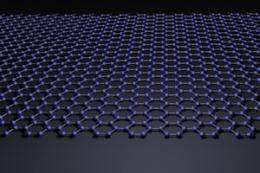
Graphene

Enlarge

(PhysOrg.com) -- Writing in the journal Nature Physics, the academics, who discovered the world's thinnest material at The University of Manchester in 2004, have revealed more about its electronic properties.

Research institutes and universities around the world are already looking at ways to build devices such as touch-screens, ultrafast and .

Now the research from the creators of the material promises to accelerate that research, and potentially open up countless more electronic opportunities.

The researchers, from the universities of Manchester, Madrid and Moscow, have studied in detail the effect of interactions between electrons on the electronic properties of graphene.

They use extremely high-quality graphene devices which are prepared by suspending sheets of graphene in a .

This way most of the unwanted scattering mechanisms for electrons in graphene could be eliminated, thus enhancing the effect of electron-on-electron interaction.

This is the first effect of its kind where the interactions between electrons in graphene could be clearly seen.

The reason for such unique electronic properties is that electrons in this material are very different from those in any other metals. They mimic massless relativistic particles – such as photons.

Due to such properties graphene is sometimes called 'CERN on a desk' – referencing the Large Hadron Collider in Switzerland. This is just one of the reasons why the electronic properties are particularly exciting and often bring surprises.

Professor Geim and Professor Novoselov's pioneering work won them the Nobel Prize for Physics in 2010 for "groundbreaking experiments regarding the two-dimensional material graphene".

The pair, who have worked together for more than a decade since Professor Novoselov was Professor Geim's PHD student, used to devote every Friday evening to 'out of the box' experiments not directly linked to their main research topics.

One Friday, they used Scotch tape to peel away layers of carbon from a piece of graphite, and were left with a single atom thick, two dimensional film of carbon – graphene.

Graphene is a novel two-dimensional material which can be seen as a monolayer of carbon atoms arranged in a hexagonal lattice.
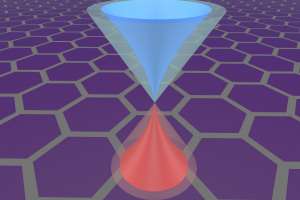
Graphene's 'quantum leap' takes electronics a step closer
It possesses a number of unique properties, such as extremely high electron and thermal conductivities due to very high velocities of and high quality of the crystals, as well as mechanical strength.

Professor Novoselov said: "Although the exciting physics which we have found in this particular experiment may have an immediate implementation in practical electronic devices, the further understanding of the of this material will bring us a step closer to the development of electronics."

Professor Geim added: "The progress have been possible due to quantum leap in improvement of the sample quality which could be produced at The University of Manchester."

More information: "Dirac cones reshaped by interaction effects in suspended graphene", by D. C. Elias, R. V. Gorbachev, A. S. Mayorov, S. V. Morozov, A. A. Zhukov, P. Blake, L. A. Ponomarenko, I. V. Grigorieva, K. S. Novoselov, F. Guinea and A. K. Geim, Nature Physics.

Provided by University of Manchester search and more info website

4.8 /5 (18 votes)  

Filter


Move the slider to adjust rank threshold, so that you can hide some of the comments.


Display comments: newest first

Vendicar_Decarian
Jul 24, 2011

Rank: 2.2 / 5 (5)
Man words...

0 content.
nicknick
Jul 25, 2011

Rank: not rated yet
>> They use extremely high-quality graphene devices which are
>> prepared by suspending sheets of graphene in a vacuum.

>> This way most of the unwanted scattering mechanisms for
>> electrons in graphene could be eliminated, thus enhancing
>> the effect of electron-on-electron interaction.

Very interesting for the quantum physicists, but it does not look practical for the semiconductor engineer.
Rank 4.8 /5 (18 votes)
Relevant PhysicsForums posts
  • microstructure of titanium
    created16 hours ago
  • Steam in My Espresso Machine
    created21 hours ago
  • Density question
    createdMay 24, 2012
  • Mass transport originating from a point source at a solid gas interface
    createdMay 22, 2012
  • Ammonia dispersion in Air
    createdMay 22, 2012
  • Multi Choice Help
    createdMay 21, 2012
  • More from Physics Forums - Materials & Chemical Engineering

More news stories

In nanorod crystal growth, nanoparticles seen as artificial atoms

In the growth of crystals, do nanoparticles act as "artificial atoms" forming molecular-type building blocks that can assemble into complex structures? This is the contention of a major but controversial theory ...

Nanotechnology / Nanophysics

created May 24, 2012 | popularity 4.8 / 5 (6) | comments 0 | with audio podcast

First direct observation of oriented attachment in nanocrystal growth

Berkeley Lab researchers have reported the first direct observation of nanoparticles undergoing oriented attachment, the critical step in biomineralization and the growth of nanocrystals. A better understanding ...

Nanotechnology / Nanophysics

created May 24, 2012 | popularity 4.7 / 5 (3) | comments 0 | with audio podcast

Dopant gives graphene solar cells highest efficiency yet

(Phys.org) -- By taking advantage of graphene’s favorable electrical and optical properties, and then adding an organic dopant, researchers have achieved the highest power conversion efficiency yet for ...

Nanotechnology / Nanophysics

created May 21, 2012 | popularity 5 / 5 (10) | comments 14 | with audio podcast feature

Synthetic nano-waste does not disappear

(Phys.org) -- Tiny particles of cerium oxide do not burn or change in the heat of a waste incineration plant. They remain intact on combustion residues or in the incineration system, as a new study by Swiss ...

Nanotechnology / Bio & Medicine

created May 25, 2012 | popularity 5 / 5 (2) | comments 1 | with audio podcast

'Metamaterials,' quantum dots show promise for new technologies

(Phys.org) -- Researchers are edging toward the creation of new optical technologies using "nanostructured metamaterials" capable of ultra-efficient transmission of light, with potential applications including ...

Nanotechnology / Nanophysics

created May 24, 2012 | popularity 5 / 5 (7) | comments 1 | with audio podcast


Nvidia trumpets Tegra 3 phone design wins for 2012

(Phys.org) -- Nvidia’s competitive war paint has a name, Tegra 3. On the heels of Nvidia announcements about lowering costs of its Tegra 3 processors and Nvidia-enabled tablets running Android Ice Cream ...

Browser wars flare in mobile space

The browser wars are heating up again, but this time the fight is for dominance of the mobile Internet.

Scientist: Evolution debate will soon be history

(AP) -- Richard Leakey predicts skepticism over evolution will soon be history. Not that the avowed atheist has any doubts himself.

Dell tablet leak: 10.1-inch display, two-battery choice

(Phys.org) -- Headline after headline talks about vendors’ tablets in the wings as likely number-one contenders for the iPad. Such claims have justifiably been taken with a grain of salt, considering ...

SpotterRF debuts Radar Backpack Kit (w/ Video)

(Phys.org) -- SpotterRF has announced a special radar backpack kit designed to enhance situational awareness for soldiers on the ground. The company says its special radar is designed for warfighters as part ...

SpaceX capsule has 'new car' smell, astronauts say (Update)

SpaceX's Dragon cargo vessel smells like a new car, said astronauts at the International Space Station after opening the hatches Saturday following the spacecraft's landmark mission to the orbiting lab.