The full moon indicates impending danger from lion attack
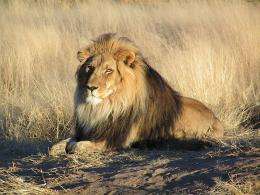
Be sure to check the sky if you ever set out for a nighttime stroll in southeastern Tanzania. If the moon is full, continue. But if the sky is dark, turn back – or you may be a lion's dinner.
A new study led by Craig Packer, an international lion expert based at the University of Minnesota's College of Biological Sciences, shows that while moonlight limits lions' success at hunting their four-legged prey, the last day of a full moon signals the beginning of a foraging opportunity for bipeds. After that day, the moon will not appear until well after dark, but in rural areas where lions rely on humans as food, hungry lions catch up on missed meals after a week of brightly lit nights.
The finding, published in the July 20 issue of PLoS One emerged from a study of nearly 500 lion attacks on Tanzanian villagers between 1988 and 2009. More than two-thirds of the attacks were fatal and victims were eaten. The vast majority of victims were attacked between dusk and 10 p.m., when humans are most active, on nights when the waning moon provided relatively little light. (In Tanzania, dusk is short and nights are 12 hours long, even during the summer.)
Packer's research group, which included Alexandra Swanson and Hadas Kushnir, graduate students in the Department of Ecology, Evolution and Behavior, as well as Dennis Ikanda, of the Tanzanian Wildlife Research Institute, used measurements of belly size recorded at regular intervals since 1978 in the Serengeti and Ngorongoro Crater, data on lunar cycles (available from the US naval oceanography website) and records of lion attacks in southeastern Tanzania kept by government authorities since 1988.
Overall, lions are more successful at hunting when the cover of darkness allows them to surprise their prey. In wildlife reserves like the Serengeti, lions feed best during moonless nights, but their prey are available all night long. Human prey, on the other hand, are only accessible in the evening. The group's analysis of the data also showed that the incidence of lion attacks on humans drops during the rainy season, when the moon is more likely to be obscured by clouds.
A look at attack rates aligned with phases of the moon shows a clear pattern. The rate of human attacks during the first half of the lunar cycle (when there is lots of moonlight on most evenings) is one-third the rate during the second half (when there is little or no moonlight). Lions are hungriest just after the full moon because the abundance of light just before and during the full moon limits their ability to hunt successfully.
| Days: | 0-4 | 5-9 | 10-14 | 15-19 | 20-24 | 25-29 |
| Attacks: | 44 | 28 | 18 | 63 | 61 | 56 |
"So people start out at moderate danger during days 0-4, when the moon is only a sliver and sets shortly after sunset," Packer explains. "Danger then declines as the moon gets brighter each evening – with very few attacks in the nights just before the full moon. Then WHAM, danger spikes as those hungry lions can now operate in darkness for the rest of the lunar cycle. The post-full-moon spike is restricted to relatively few hours of full darkness before the largish moon rises later in the evening."
Humans have always lived in close proximity to large nocturnal carnivores. Lions were once the most widely distributed mammal in the world. And lions, tigers, jaguars and leopards still co-exist with humans in Africa, Asia and tropical America. Homo sapiens painted lions on cave walls 36,000 years ago.
This may help explain why the moon has been woven into folklore and mythology, the paper states. While a full moon provides some a respite from attacks, it also indicates that nocturnal predators will be more active in the following days.
It's well known that lions are nocturnal predators, relying on the cover of darkness to successfully attack and kill their prey. This study helps confirm the long-held belief that nocturnal predators played a key role in human evolution, creating fear of the dark and driving the need for nighttime shelter as well as control of fire.
Lion attacks on humans in Africa increased during the 1990s as civilization encroached on lion territory. But Packer reports that attacks on humans throughout Tanzania have dropped off over the past three years because villagers have killed the big cats to protect themselves and their livestock.
"We may be the last research team to ever collect enough data to publish this sort of analysis," Packer says. "Big cats are disappearing fast all over the world, but their evolutionary impact on our psychology will likely persist forever."
More information: Paper www.plosone.org/article/info%3Adoi%2F10.1371%2Fjournal.pone.0022285
Provided by University of Minnesota


