Foreseer of future resources
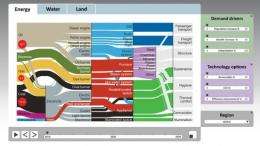
Understanding how energy can be used efficiently is key to reducing carbon emissions and mitigating future fuel and food shortages. But energy use is only part of the story. The link between resources and final services – such as food, warmth, shelter and transport – is only really complete if water and land use is also factored in.
Almost a year ago, nine experts from seven different departments across the University set out to do precisely this. They reasoned that to understand the uncertainties ahead it is vitally important not only to integrate models of energy, water and land use but also to create a visualisation tool that could be widely used, by industry, policy-makers, researchers and others, to understand the consequences of how decisions today might play out in decades to come.
Foreseer
The Foreseer Project is funded through BP’s Energy Sustainability Challenge, which is supporting projects in 12 leading research universities worldwide to explore some of the key issues that could shape future energy supply and demand.
At the heart of the Cambridge project is the use of the Sankey diagram – a remarkably intuitive visual interpretation of the quantity of resources and how they are consumed.
Although Sankey diagrams have been in use for over a century for mapping energy flow, they have had limitations, as Dr. Julian Allwood, who leads the Foreseer Project, explained: “Past diagrams were based on economic data and stopped short of tracing the length of each energy chain from fuels all the way to consumers, halting instead at sectors. They gave you an idea of who to blame for energy use but they didn’t provide a basis for what you could change.”
By demonstrating two years ago that it was indeed possible to create a global snapshot of energy flow from fuel to final service, Dr. Allwood and colleague Dr. Jonathan Cullen realised that it might also be feasible to turn this into a tool with forecasting potential.
“We could then ask ‘what if’ questions such as what if car engines were to become twice as efficient?” Dr. Allwood explained. “But to be truly predictive, mapping energy flow alone is not enough. An increase in biofuel, for instance, has implications for land and water use, as well as fertiliser use, which itself is an energy-demanding product. Energy, land and water are interlinked.”
Good decisions
The key innovation of the Foreseer Project is integration. Access to the data, physical models and expertise were already in existence in departments across the University; Foreseer has brought them together for the first time. “It has been a fascinating experience for each of the Project members to expand from thinking about the variables that each of us are familiar with to thinking about how they couple with other resources on a massive scale. The Project has really got under everybody’s skin.”
The team has had to start from first principles to understand how to build a map for land and water use. The first stage, recently completed, focused on California, USA, and Beijing, China, and the goal now is to expand this to other regions and then worldwide.
“Ultimately we want to be able to ask global questions such as: what are the resource implications of rapid economic development and urbanisation in developing countries, and the expansion of mega-cities? How will changes in climate, population and technology affect services such as food provision? Making good decisions now, including energy investment decisions, requires physically based predictions of future needs and pressures.”
Provided by University of Cambridge


