New exploration shows parts of North Atlantic seabed were once above sea level
July 12, 2011 by Bob Yirka
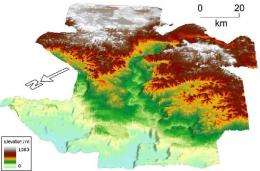
Image (c) R A Hartley et al./Nature Geoscience (2011) doi:10.1038/ngeo1191
(PhysOrg.com) -- Using data obtained from oil searching contractors, researchers have discovered that parts of what is now the ocean floor off the northern coast of Scotland, were at one time raised up enough by thermal expansion beneath to have jutted at least 1 kilometer above the sea. Nicky White, senior researcher from the University of Cambridge and his team explain what theyve found in their paper published in Nature Geoscience.
Extending for 3,861 square miles (10,000 square km) just north east of the Orkney-Shetland Islands, and about 1.2 miles (almost 2 kilometers) beneath the surface, the undersea terrain appears to have once existed above sea level, forming an island. By examining data from echo-sounding technology employed by contractors working for oil companies, maps of the ocean floor were able to be made. The maps constructed are 3-D in nature, and thus are able to show not just the ocean floor, but what lies beneath; hence its use in looking for oil. In looking at the maps, the researchers were able to see that beneath the layers of silt and other assorted debris, was a lost land of sorts, one that had been pushed up by the Icelandic Plume, or expansion of the mantle due to the hot magma below.
The images constructed were sharp enough to allow the researchers to identify ancient rivers and mountain peaks and even some fossils, all from some 56 million years ago.
The images also suggest that the ocean floor rose in three distinct stages of about 200-400 m each, creating the island which they believe lasted for about a million years, before once again disappearing beneath the cold waters of the North Atlantic Sea. White describes the seascape as appearing for all the world like that of a modern landscape.
The echo-technology used by the contractors involved releasing highly pressurized air beneath the surface of the sea, which produced sound waves capable of passing through the ocean floor sediment. When the sound waves eventually bounced back, they were captured by microphones dragged behind a boat and fed into a computer to produce the 3-D images.
The initial research team followed up on the 3-D imagery by taking core samples, some of which contained pollen and coal, suggesting land-dwelling life once existed there. The Cambridge team also found fossils indicating there was also a marine environment at one time.
The research team thinks that the now sunken landscape is part of a much bigger region that at one time merged with modern Scotland and may have reached all the way to Norway.
More information: Transient convective uplift of an ancient buried landscape, Nature Geoscience (2011) doi:10.1038/ngeo1191
Abstract
Sedimentary basins in the North Atlantic Ocean preserve a record of intermittent uplift during Cenozoic times. These variations in elevation are thought to result from temperature changes within the underlying Icelandic mantle plume. When parts of the European continental shelf were episodically lifted above sea level, new landscapes were carved by erosion, but these landscapes then subsided and were buried beneath marine sediments. Here, we use three-dimensional seismic data to reconstruct one of these ancient landscapes that formed off the northwest coast of Europe during the PalaeoceneEocene Thermal Maximum. We identify a drainage network within the landscape and, by modelling the profiles of individual rivers within this network, we reconstruct the history of surface uplift. We show that the landscape was lifted above sea level in a series of three discrete steps of 200400 m each. After about 1 million years of subaerial exposure, this landscape was reburied. We use the magnitude and duration of uplift to constrain the temperature and velocity of a mantle-plume anomaly that drove landscape formation. We conclude that pulses of hot, chemically depleted, mantle material spread out radially beneath the lithospheric plate at velocities of ~35 cm yr−1.
© 2010 PhysOrg.com
-
From lemons to lemonade: Reaction uses carbon dioxide to make carbon-based semiconductor,
32 comments
-
Thioridazine kills cancer stem cells in human while avoiding toxic side-effects of conventional cancer treatments,
3 comments
-
SpaceX private rocket blasts off for space station (Update),
42 comments
-
Climate scientists say they have solved riddle of rising sea,
31 comments
-
SpaceX capsule has 'new car' smell, astronauts say (Update),
2 comments
-
Hypothetical desert earth
11 hours ago
-
More human population = greater mass?
May 25, 2012
-
Conversion from aircraft bearing to normal degrees
May 23, 2012
-
Interpretation/Analysis of the Lab results(HEPA filter)
May 22, 2012
-
Has anyone here attended the The Urbino Summer School in Paleoclimatology?
May 22, 2012
-
Earthquakes: Mag 6 N. Italy and Mag 5.6 W. Bulgaria
May 21, 2012
- More from Physics Forums - Earth
More news stories
Sophisticated simulations predict future warming
The chances of our planet being hit by a global warming of 3 degrees Celsius by 2050 is as likely as it being hit by an increase of 1.4 degrees, new research shows. Presented in the journal Nature Geoscience, the British study ...
Space & Earth / Earth Sciences
May 22, 2012 |
4.4 / 5 (9) |
51
Kyoto Protocol architect 'frustrated' by climate dialogue
UN climate talks are going nowhere, as politicians dither or bicker while the pace of warming dangerously speeds up, one of the architects of the Kyoto Protocol told AFP.
May 23, 2012 |
3.7 / 5 (7) |
39
Dragon arrives at space station in historic 1st (Update 2)
The privately bankrolled Dragon capsule made a historic arrival at the International Space Station on Friday, triumphantly captured by astronauts wielding a giant robot arm.
Space & Earth / Space Exploration
May 25, 2012 |
5 / 5 (10) |
19
Aliens don't want to eat us, says former SETI director
Alien life probably isnt interested in having us for dinner, enslaving us or laying eggs in our bellies, according to a recent statement by former SETI director Jill Tarter.
Space & Earth / Space Exploration
May 25, 2012 |
4.4 / 5 (13) |
37
What's the big deal about private space launches?
(AP) -- The first private spaceship is headed to the International Space Station. Some questions and answers about the cargo mission by Space Exploration Technologies, known as SpaceX:
Space & Earth / Space Exploration
May 22, 2012 |
5 / 5 (6) |
32
Nvidia trumpets Tegra 3 phone design wins for 2012
(Phys.org) -- Nvidias competitive war paint has a name, Tegra 3. On the heels of Nvidia announcements about lowering costs of its Tegra 3 processors and Nvidia-enabled tablets running Android Ice Cream ...
Browser wars flare in mobile space
The browser wars are heating up again, but this time the fight is for dominance of the mobile Internet.
Scientist: Evolution debate will soon be history
(AP) -- Richard Leakey predicts skepticism over evolution will soon be history. Not that the avowed atheist has any doubts himself.
Dell tablet leak: 10.1-inch display, two-battery choice
(Phys.org) -- Headline after headline talks about vendors tablets in the wings as likely number-one contenders for the iPad. Such claims have justifiably been taken with a grain of salt, considering ...
Keep food safety in mind this memorial day weekend
(HealthDay) -- Picnics, parades and cookouts are as much a part of Memorial Day weekend as tributes to the United States' war veterans.
Social welfare cuts ultimately come with heavy price, researchers say
(Phys.org) -- Slashing government funding for Medicaid, food stamps and other programs that serve the poor while politically popular with some lawmakers and many conservatives may do more harm ...
Jul 12, 2011
Rank: 1 / 5 (1)
http://en.wikiped...ki/Thule
Jul 12, 2011
Rank: 1 / 5 (1)
Jul 12, 2011
Rank: 1 / 5 (1)
http://museum.gov...lobe.htm
Jul 12, 2011
Rank: 1 / 5 (1)
Jul 12, 2011
Rank: 4.5 / 5 (2)
The Kerguelen sea-floor plateau in the Eastern Indian Ocean(created by a magma flood event) was also once above sea level, and was about the size of Great Britain.
Hmm...somebody heat up the rock underneath the Faraday seamount, and you will get an island conveniently right between North America and Britain. Perfect stopover for aircraft :-)