Europe drought leading to more property damage: study
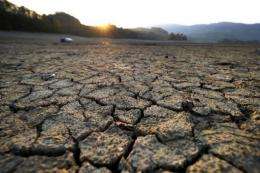
Cracked mud is pictured at sunrise in the dried shores of Lake Gruyere affected by continous drought near the western Switzerland village of Avry-devant-Pont. Increasing occurrences of drought have led to a jump in European insurance claims for damage to homes owing to subsiding soil, a study by reinsurer Swiss Re and the Swiss Federal Institute of Technology said.
Increasing occurrences of drought have led to a jump in European insurance claims for damage to homes owing to subsiding soil, a study by reinsurer Swiss Re and the Swiss Federal Institute of Technology said on Monday.
With temperatures set to rise in coming years and less regular rainfall amid climate change, future potential losses from soil movements are expected to increase in some areas by over 50 percent for the period 2021 to 2040 compared to today, said the study.
"A long and intense dry spell can lower the ground so much that it creates fissures in the earth and tears apart the foundations of houses, bridges, industrial sites and other structures," explained the research.
"In the worst case, shifting soil can cause whole buildings to collapse," it said.
Large swathes of France, Britain, Germany as well as northern Spain are already now showing jumps of more than 50 percent in potential claims compared to the period 1951 to 1970.
"In France alone, economic losses from soil subsidence have risen by over 50 percent since 1990, amounting to an average of 340 million euros ($494 million) a year," said the study.
"Climate change will further increase the frequency and intensity of drought-induced soil subsidence -- and with it the risk of future damage to properties.
"Large parts of Europe will experience more sporadic rainfall and drier soils, and as a result face far greater losses from shifting soil," it warned.
(c) 2011 AFP
-
From lemons to lemonade: Reaction uses carbon dioxide to make carbon-based semiconductor,
32 comments
-
Thioridazine kills cancer stem cells in human while avoiding toxic side-effects of conventional cancer treatments,
3 comments
-
SpaceX private rocket blasts off for space station (Update),
42 comments
-
Climate scientists say they have solved riddle of rising sea,
31 comments
-
SpaceX capsule has 'new car' smell, astronauts say (Update),
2 comments
-
Hypothetical desert earth
11 hours ago
-
More human population = greater mass?
May 25, 2012
-
Conversion from aircraft bearing to normal degrees
May 23, 2012
-
Interpretation/Analysis of the Lab results(HEPA filter)
May 22, 2012
-
Has anyone here attended the The Urbino Summer School in Paleoclimatology?
May 22, 2012
-
Earthquakes: Mag 6 N. Italy and Mag 5.6 W. Bulgaria
May 21, 2012
- More from Physics Forums - Earth
More news stories
Sophisticated simulations predict future warming
The chances of our planet being hit by a global warming of 3 degrees Celsius by 2050 is as likely as it being hit by an increase of 1.4 degrees, new research shows. Presented in the journal Nature Geoscience, the British study ...
Space & Earth / Earth Sciences
May 22, 2012 |
4.4 / 5 (9) |
51
Kyoto Protocol architect 'frustrated' by climate dialogue
UN climate talks are going nowhere, as politicians dither or bicker while the pace of warming dangerously speeds up, one of the architects of the Kyoto Protocol told AFP.
May 23, 2012 |
3.7 / 5 (7) |
39
Dragon arrives at space station in historic 1st (Update 2)
The privately bankrolled Dragon capsule made a historic arrival at the International Space Station on Friday, triumphantly captured by astronauts wielding a giant robot arm.
Space & Earth / Space Exploration
May 25, 2012 |
5 / 5 (10) |
19
Aliens don't want to eat us, says former SETI director
Alien life probably isnt interested in having us for dinner, enslaving us or laying eggs in our bellies, according to a recent statement by former SETI director Jill Tarter.
Space & Earth / Space Exploration
May 25, 2012 |
4.4 / 5 (13) |
37
What's the big deal about private space launches?
(AP) -- The first private spaceship is headed to the International Space Station. Some questions and answers about the cargo mission by Space Exploration Technologies, known as SpaceX:
Space & Earth / Space Exploration
May 22, 2012 |
5 / 5 (6) |
32
Nvidia trumpets Tegra 3 phone design wins for 2012
(Phys.org) -- Nvidias competitive war paint has a name, Tegra 3. On the heels of Nvidia announcements about lowering costs of its Tegra 3 processors and Nvidia-enabled tablets running Android Ice Cream ...
Browser wars flare in mobile space
The browser wars are heating up again, but this time the fight is for dominance of the mobile Internet.
Scientist: Evolution debate will soon be history
(AP) -- Richard Leakey predicts skepticism over evolution will soon be history. Not that the avowed atheist has any doubts himself.
Dell tablet leak: 10.1-inch display, two-battery choice
(Phys.org) -- Headline after headline talks about vendors tablets in the wings as likely number-one contenders for the iPad. Such claims have justifiably been taken with a grain of salt, considering ...
Keep food safety in mind this memorial day weekend
(HealthDay) -- Picnics, parades and cookouts are as much a part of Memorial Day weekend as tributes to the United States' war veterans.
Social welfare cuts ultimately come with heavy price, researchers say
(Phys.org) -- Slashing government funding for Medicaid, food stamps and other programs that serve the poor while politically popular with some lawmakers and many conservatives may do more harm ...
Jul 04, 2011
Rank: not rated yet
When your subsoil becomes mud, your house gets wobbly. When your subsoil becomes extremely dry, same problem.
However, there is one difference. The melting point of water is known.
The effects of soil shrinkage due to evaporation of water from it is not. And it isn't going to be simple either. Different soil types hold more or less water. And in either case, diffent materials are more or less sticky.
How about some data on this one?
Jul 04, 2011
Rank: not rated yet
Yep.
Don't build on mud.
Jul 05, 2011
Rank: not rated yet
That doesn't leave very much else in the way of surface to build on...it's all mud, just different types.
Where I live my house foundations are set on clay, when it dries out we end up with very wide cracks all over the gardens.
I'm not saying their evidence about the droughts is incorrect as it obviously isn't, especially here in parts of the UK, but their quote of a 50% rise in potential claims as compared to the 1951 - 1970 period is quite possibly because just about everyone with a property nowadays has them insured whereas back in the 50's/60's/70's it was more unusual to have property insurance unless you were wealthy.
They need to include a comparison of the number of properties insured to give a more accurate figure.