A novel enzymatic catalyst for biodiesel production
July 4, 2011

A novel enzymatic catalyst for biodiesel production

Enlarge

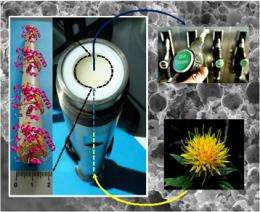
Diagram showing the enzyme biocatalytic reactor and its unidirectional continuous flow operation that uses enzymatic catalysis to turn triesters into biodiesel. © CNRS

Continuous production of biodiesel can now be envisaged thanks to a novel catalyst developed by a French team at CNRS's Centre de Recherches Paul Pascal (CRPP). The results, which have been patented, have just been published in the journal Energy & Environmental Science.

Biofuel production provides an alternative to fossil fuels. Biodiesels, for instance, are processed products based on oils from oleaginous plants such as oilseed rape, palm, sunflower and soybeans. They result from a chemical reaction, catalyzed in either an acidic or preferably a basic medium, between a vegetable oil (90%) and an alcohol (10%). This reaction, known as transesterification, converts the mixture into a methyl ester (the main constituent of biodiesel) and glycerol. A saponification side reaction (methyl ester conversion into the corresponding acid salt) reduces methyl ester yield. To increase the yield, it was therefore necessary to develop alternative catalysts.

For this type of reaction, certain enzymatic catalysts such as those belonging to the family of lipases (triglyceride hydrolases) are particularly efficient and selective. However, their high cost and low conformational stability restrict their industrial use, unless they can be irreversibly confined in porous matrices, allowing good accessibility and enhanced mass transport. This has now been achieved by the team led by Professor Renal Backov.

In an initial study, they had already demonstrated the possibility of efficient catalysis, by developing modified silica-based cellular matrices that make it possible to confine lipases in order to obtain exceptional yields for hydrolysis, esterification and transesterification reactions. Their work had also shown that unpurified enzymes could be used in the matrices. The fact that they were unpurified was a first step to significantly reducing the cost of biocatalysts. However, the methodology did not allow continuous production. This obstacle has now been overcome.

Researchers have developed a new method that generates the cellular hybrid biocatalyst in situ inside a chromotography column. This novel approach makes it possible to carry out continuous, unidirectional flow synthesis over long periods, since catalytic activity and ethyl ester production are maintained at high, practically steady levels during a two-month period of time. These results are amongst the best ever obtained in this field.

Research is continuing into solvent-free conversion of triesters, aimed at minimizing waste production and curbing the use of solvents and metals in chemical transformation processes. This work, which meets current energy and environmental requirements, shows how much chemists are working in the public interest, and confirms the importance of integrative chemistry.

More information: References:

-- “Enzyme-Based Biohybrid Foams Designed for Continuous Flow Heterogeneous Catalysis and Biodiesel Production”, N.Brun, A.Babeau-Garcia, M.-F.Achard, C.Sanchez, F.Durand, L.Guillaume, M.Birot, H.Deleuze and R.Backov - Energy & Environmental Science, 2011 DOI:10.1039/C1EE01295A

-- Catalyseur enzymatique hétérogène, procédé de préparation et utilisation pour la catalyse enzymatique en flux continu. N.Brun, H.Deleuze, C.Sanchez and R.Backov. French patent 2010. File number FR10-56099.

Provided by CNRS search and more info website

Filter


Move the slider to adjust rank threshold, so that you can hide some of the comments.


Display comments: newest first

gmurphy
Jul 04, 2011

Rank: not rated yet
I know this is offtopic but the "rape" in oilseed rape comes from the latin word "rapum", meaning turnip. http://en.wikiped...History, thank you wikipedia :)
Trim
Jul 04, 2011

Rank: 4 / 5 (1)
So unlike the Vikings the Romans only turniped and pillaged?
aroc91
Jul 04, 2011

Rank: 5 / 5 (1)
I know this is offtopic but the "rape" in oilseed rape comes from the latin word "rapum", meaning turnip. http://en.wikiped...History, thank you wikipedia :)


I'm pretty sure you mean rapeseed oil.
Telekinetic
Jul 04, 2011

Rank: not rated yet
Now the whole world will smell like french fries.
stripeless_zebra
Jul 04, 2011

Rank: not rated yet
As always it works great in a lab but won't be commercialized.
In the meantime our civilization is already past the Peak Oil and waiting for the energy disaster to happen. Cheap mass production of biofuels is decades away if ever possible.
Sebas
Jul 04, 2011

Rank: not rated yet
There are millions of inventions that won't be commercialized. That's not because there are evil oil corporations that are hindering it; It's all about economics. If this can be scaled up and compete with the oil industry, of course it will be commercialized (and if it's a profitable idea then why shouldn't for example an oil company invest in it?)

I just read the article and it's quite awesome that they could covalently immobilize the enzymes onto a porous membrane and still keep a quite high yield. But the problem is that after 2 months the yield drops to about 50% and this is still quite an issue if it would like to compete and have any impact in the huge diesel market.
Although this may be difficult to scale up (because you would need enormous amounts of enzymes which would need enormous amounts of micro-organisms), it might find its way to private homes or companies who produce vegetable oils.
stripeless_zebra
Jul 04, 2011

Rank: not rated yet
... it might find its way to private homes or companies who produce vegetable oils.


...and that's what Mr. Obama calls "The end to oil dependency" :)
Rank 5 /5 (1 vote)
Relevant PhysicsForums posts
  • Gibbs Free Energy Change/Entropy
    created4 hours ago
  • What's the rule to covalent character
    created5 hours ago
  • Schwartz reagent-- NMR/MS/IR
    created23 hours ago
  • High school chemistry EEI
    createdMay 25, 2012
  • oxidation of I- by KMnO4
    createdMay 25, 2012
  • Inversion temp
    createdMay 25, 2012
  • More from Physics Forums - Chemistry

More news stories

New CO2-removing catalyst can take the heat

(Phys.org) -- The current method of removing the greenhouse gas carbon dioxide (CO2) from the flues of coal-fired power plants uses so much energy that no one bothers to use it. So says Roger Aines, principal ...

Chemistry / Materials Science

created May 24, 2012 | popularity 5 / 5 (7) | comments 7 | with audio podcast

High-speed method to aid search for solar energy storage catalysts

Eons ago, nature solved the problem of converting solar energy to fuels by inventing the process of photosynthesis.

Chemistry / Materials Science

created May 25, 2012 | popularity 5 / 5 (3) | comments 4 | with audio podcast

Researchers demonstrate possible primitive mechanism of chemical info self-replication

(Phys.org) -- When scientists think about the replication of information in chemistry, they usually have in mind something akin to what happens in living organisms when DNA gets copied: a double-stranded molecule ...

Chemistry / Materials Science

created May 25, 2012 | popularity 5 / 5 (4) | comments 2 | with audio podcast

Building a better solar panel -- one molecule at a time

(Phys.org) -- One of the fundamental building blocks in modern chemistry, an organometallic chemical compound called ferrocene, has never been structurally defined - until now.

Chemistry / Materials Science

created May 25, 2012 | popularity 5 / 5 (3) | comments 0 | with audio podcast

Discarded data may hold the key to a sharper view of molecules

(Phys.org) -- There's nothing like a new pair of eyeglasses to bring fine details into sharp relief. For scientists who study the large molecules of life from proteins to DNA, the equivalent of new lenses have come in the ...

Chemistry / Biochemistry

created May 24, 2012 | popularity 4.7 / 5 (3) | comments 0 | with audio podcast


Nvidia trumpets Tegra 3 phone design wins for 2012

(Phys.org) -- Nvidia’s competitive war paint has a name, Tegra 3. On the heels of Nvidia announcements about lowering costs of its Tegra 3 processors and Nvidia-enabled tablets running Android Ice Cream ...

Browser wars flare in mobile space

The browser wars are heating up again, but this time the fight is for dominance of the mobile Internet.

Scientist: Evolution debate will soon be history

(AP) -- Richard Leakey predicts skepticism over evolution will soon be history. Not that the avowed atheist has any doubts himself.

Dell tablet leak: 10.1-inch display, two-battery choice

(Phys.org) -- Headline after headline talks about vendors’ tablets in the wings as likely number-one contenders for the iPad. Such claims have justifiably been taken with a grain of salt, considering ...

Keep food safety in mind this memorial day weekend

(HealthDay) -- Picnics, parades and cookouts are as much a part of Memorial Day weekend as tributes to the United States' war veterans.

Social welfare cuts ultimately come with heavy price, researchers say

(Phys.org) -- Slashing government funding for Medicaid, food stamps and other programs that serve the poor – while politically popular with some lawmakers and many conservatives – may do more harm ...