Enceladus rains water onto Saturn
July 26, 2011

Enceladus rains water onto Saturn

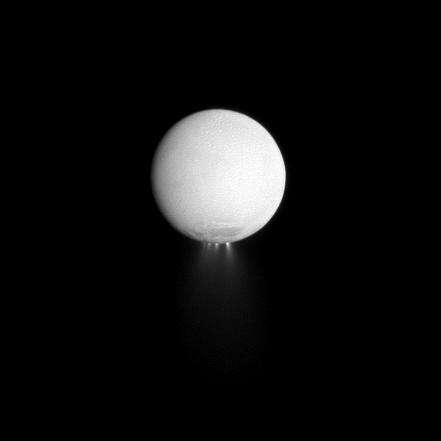
At least four distinct plumes of water ice spew out from the south polar region of Saturn's moon Enceladus. Light reflected off Saturn is illuminating the moon while the sun, almost directly behind Enceladus, is backlighting the plumes. This view looks toward the Saturn-facing side of Enceladus (504 kilometers across). North is up. The image was taken in visible light with the Cassini spacecraft narrow-angle camera on Dec. 25, 2009. The view was obtained at a distance of approximately 617,000 kilometers from Enceladus and at a Sun-Enceladus-spacecraft, or phase, angle of 174 degrees. Image scale is 4 kilometers per pixel. The Cassini-Huygens mission is a cooperative project of NASA, the European Space Agency and the Italian Space Agency. Credits: NASA/JPL/Space Science Institute

(PhysOrg.com) -- ESA's Herschel space observatory has shown that water expelled from the moon Enceladus forms a giant torus of water vapour around Saturn. The discovery solves a 14-year mystery by identifying the source of the water in Saturn’s upper atmosphere.

Herschel’s latest results mean that Enceladus is the only moon in the Solar System known to influence the chemical composition of its parent planet.

Enceladus expels around 250 kg of vapour every second, through a collection of jets from the south polar region known as the Tiger Stripes because of their distinctive surface markings.

These crucial observations reveal that the water creates a doughnut-shaped torus of vapour surrounding the ringed planet.

The total width of the torus is more than 10 times the radius of Saturn, yet it is only about one Saturn radius thick. Enceladus orbits the planet at a distance of about four Saturn radii, replenishing the torus with its jets of water.  

Despite its enormous size, it has escaped detection until now because water vapour is transparent to visible light but not at the infrared wavelengths was designed to see.

Enceladus rains water onto Saturn
Enlarge

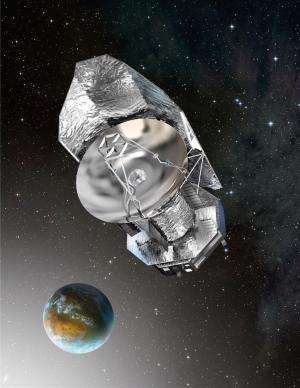
Herschel, the largest infrared space telescope, is stationed at the second Lagrange point of the Sun-Earth system. Its 3.5-metre diameter collects long-wavelength infrared radiation from some of the coolest and most distant objects in the Universe. Herschel covers a wide range of wavelengths, from far-infrared to sub-millimetre. The longest of these wavelengths have not been covered before. The satellite was launched on 14 May 2009 with ESA's Planck microwave observatory, on board an Ariane 5 from Europe's Spaceport in Kourou, French Guiana. Credits: ESA - D. Ducros, 2009

Saturn's is known to contain traces of gaseous water in its deeper layers. A particular enigma has been the presence of water in its upper atmosphere.

First reported in 1997 by teams using ESA’s Infrared Space Observatory, the source of this water was unknown until now. Computer models of these latest Herschel observations show that about 3-5% of the water expelled by Enceladus ends up falling into Saturn.

“There is no analogy to this behaviour on Earth,” says Paul Hartogh, Max-Planck-Institut für Sonnensystemforschung, Katlenburg-Lindau, Germany, who led the collaboration on the analysis of these results.
 
“No significant quantities of water enter our atmosphere from space. This is unique to Saturn.”

Although most of the water from Enceladus is lost into space, freezes on the rings or perhaps falls onto Saturn’s other moons, the small fraction that does fall into the planet is sufficient to explain the water observed in its upper atmosphere.

It is also responsible for the production of additional oxygen-bearing compounds, such as carbon dioxide.

Ultimately, water in Saturn's upper atmosphere is transported to lower levels, where it will condense but the amounts are so tiny that the resulting clouds are not observable.

“Herschel has proved its worth again. These are observations that only Herschel can make,” says Göran Pilbratt, ESA Herschel Project Scientist.

“ESA’s Infrared found the in ’s atmosphere. Then NASA/ESA’s Cassini/Huygens mission found the jets of Enceladus. Now Herschel has shown how to fit all these observations together.”

Provided by European Space Agency search and more info website

4.8 /5 (16 votes)  

Rank 4.8 /5 (16 votes)
Relevant PhysicsForums posts
  • revamping general concept and cosmological principle
    createdMay 25, 2012
  • Transiting Exoplanet Light Curve
    createdMay 25, 2012
  • Math behind Theoretical Physics
    createdMay 24, 2012
  • Do we know whats at the center of galaxies yet?
    createdMay 23, 2012
  • Structure of the Milky Way?
    createdMay 20, 2012
  • What would it take to terraform Pluto and Charon?
    createdMay 19, 2012
  • More from Physics Forums - General Astronomy

More news stories

Sophisticated simulations predict future warming

The chances of our planet being hit by a global warming of 3 degrees Celsius by 2050 is as likely as it being hit by an increase of 1.4 degrees, new research shows. Presented in the journal Nature Geoscience, the British study ...

Space & Earth / Earth Sciences

created May 22, 2012 | popularity 4.4 / 5 (9) | comments 51

Kyoto Protocol architect 'frustrated' by climate dialogue

UN climate talks are going nowhere, as politicians dither or bicker while the pace of warming dangerously speeds up, one of the architects of the Kyoto Protocol told AFP.

Space & Earth / Environment

created May 23, 2012 | popularity 3.7 / 5 (7) | comments 39

Dragon arrives at space station in historic 1st (Update 2)

The privately bankrolled Dragon capsule made a historic arrival at the International Space Station on Friday, triumphantly captured by astronauts wielding a giant robot arm.

Space & Earth / Space Exploration

created May 25, 2012 | popularity 5 / 5 (10) | comments 19

Aliens don't want to eat us, says former SETI director

Alien life probably isn’t interested in having us for dinner, enslaving us or laying eggs in our bellies, according to a recent statement by former SETI director Jill Tarter.

Space & Earth / Space Exploration

created May 25, 2012 | popularity 4.4 / 5 (13) | comments 37

What's the big deal about private space launches?

(AP) -- The first private spaceship is headed to the International Space Station. Some questions and answers about the cargo mission by Space Exploration Technologies, known as SpaceX:

Space & Earth / Space Exploration

created May 22, 2012 | popularity 5 / 5 (6) | comments 32


Nvidia trumpets Tegra 3 phone design wins for 2012

(Phys.org) -- Nvidia’s competitive war paint has a name, Tegra 3. On the heels of Nvidia announcements about lowering costs of its Tegra 3 processors and Nvidia-enabled tablets running Android Ice Cream ...

Browser wars flare in mobile space

The browser wars are heating up again, but this time the fight is for dominance of the mobile Internet.

Scientist: Evolution debate will soon be history

(AP) -- Richard Leakey predicts skepticism over evolution will soon be history. Not that the avowed atheist has any doubts himself.

Dell tablet leak: 10.1-inch display, two-battery choice

(Phys.org) -- Headline after headline talks about vendors’ tablets in the wings as likely number-one contenders for the iPad. Such claims have justifiably been taken with a grain of salt, considering ...

Keep food safety in mind this memorial day weekend

(HealthDay) -- Picnics, parades and cookouts are as much a part of Memorial Day weekend as tributes to the United States' war veterans.

Social welfare cuts ultimately come with heavy price, researchers say

(Phys.org) -- Slashing government funding for Medicaid, food stamps and other programs that serve the poor – while politically popular with some lawmakers and many conservatives – may do more harm ...