Embracing superficial imperfections
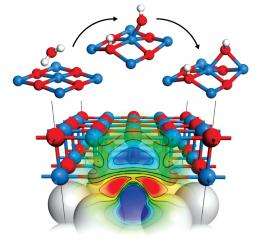
Figure 1: Defects inside an ultrathin magnesium oxide film (red and blue spheres, bottom) accumulate electronic charges (red and blue contour map) and enhance the catalytic dissociation of water molecules (top). Credit: 2011 Yousoo Kim
Chemists normally work rigorously to exclude impurities from their reactions. This is especially true for scanning tunneling microscopy (STM) experiments that can produce atomic-scale images of surfaces. Using STM to investigate processes such as catalysis usually requires pristine substratesany flaws or foreign particles in the surface can critically interfere with the test study. Preconceptions about interface defects and catalysis are about to change, however, thanks to recently published research led by Yousoo Kim and Maki Kawai at the RIKEN Advanced Science Institute in Wako, Japan.
Through a series of high-level computer simulations, the researchers found that the catalytic splitting of water molecules occurs faster on an ultrathin insulating film containing misplaced atoms than on a non-defective surface. Because water splitting reactions are one of the easiest ways to generate hydrogen fuel, this finding could be a boon to future fleets of hybrid vehicles.
Recently, Kim, Kawai, and colleagues discovered that depositing insulating magnesium oxide (MgO) onto a silver (Ag) substrate enabled extraordinary control over water dissociation reactions. By injecting electrons into the MgO/Ag surface with an STM tip, they were able to excite absorbed water molecules and cause them to sever hydrogen and hydroxide ions. Optimizing the MgO film thickness was a key part of this approach; only ultrathin layers could direct water splitting owing to its enhanced electronic interaction strength.
This relationship between insulator thickness and chemical reactivity suggested to the researchers that the oxidemetal interface plays a crucial role in directing catalytic reactions. Engineering specific flaws into the ultrathin interface could be one way to heighten the electronic control over the water-splitting process. However, since artificially manipulating oxide atoms is a difficult experimental procedure, they used density functional theory simulations, based on quantum mechanics, to analyze the role of structural imperfections in MgO.
Surprisingly, the researchers found that three different types of defectsoxygen and magnesium impurities, as well as an oxygen vacancyimproved water adsorption and substantially lowered dissociation energy barriers compared to an ideal MgO film. Further analysis revealed that the oxide defects accumulate charges injected into the substrate (Fig. 1), creating an electronic environment that speeds up the catalytic water splitting. In the presence of these defects, the films chemical reactivity can be greatly enhanced, says Kim.
The next goal for the researchers is to find systematic techniques to control interface imperfections on these novel catalytic filmsan objective best achieved by the teams unique combined experimentaltheoretical approach, notes Kim.
More information:
1. Jung, J., et al. Activation of ultrathin oxide films for chemical reaction by interface defects. Journal of the American Chemical Society 133, 61426145 (2011).
2. Shin, H.-J., et al. State-selective dissociation of a single water molecule on an ultrathin MgO film. Nature Materials 9, 442447 (2010).
3. Jung, J., et al. Controlling water dissociation on an ultrathin MgO film by tuning film thickness. Physical Review B 82, 085413 (2010).
Provided by
RIKEN
-
From lemons to lemonade: Reaction uses carbon dioxide to make carbon-based semiconductor,
32 comments
-
Thioridazine kills cancer stem cells in human while avoiding toxic side-effects of conventional cancer treatments,
3 comments
-
SpaceX private rocket blasts off for space station (Update),
42 comments
-
Climate scientists say they have solved riddle of rising sea,
31 comments
-
SpaceX capsule has 'new car' smell, astronauts say (Update),
2 comments
-
Gibbs Free Energy Change/Entropy
4 hours ago
-
What's the rule to covalent character
5 hours ago
-
Schwartz reagent-- NMR/MS/IR
23 hours ago
-
High school chemistry EEI
May 25, 2012
-
oxidation of I- by KMnO4
May 25, 2012
-
Inversion temp
May 25, 2012
- More from Physics Forums - Chemistry
More news stories
New CO2-removing catalyst can take the heat
(Phys.org) -- The current method of removing the greenhouse gas carbon dioxide (CO2) from the flues of coal-fired power plants uses so much energy that no one bothers to use it. So says Roger Aines, principal ...
May 24, 2012 |
5 / 5 (7) |
7
|
High-speed method to aid search for solar energy storage catalysts
Eons ago, nature solved the problem of converting solar energy to fuels by inventing the process of photosynthesis.
May 25, 2012 |
5 / 5 (3) |
4
|
Researchers demonstrate possible primitive mechanism of chemical info self-replication
(Phys.org) -- When scientists think about the replication of information in chemistry, they usually have in mind something akin to what happens in living organisms when DNA gets copied: a double-stranded molecule ...
May 25, 2012 |
5 / 5 (4) |
2
|
Building a better solar panel -- one molecule at a time
(Phys.org) -- One of the fundamental building blocks in modern chemistry, an organometallic chemical compound called ferrocene, has never been structurally defined - until now.
May 25, 2012 |
5 / 5 (3) |
0
|
Discarded data may hold the key to a sharper view of molecules
(Phys.org) -- There's nothing like a new pair of eyeglasses to bring fine details into sharp relief. For scientists who study the large molecules of life from proteins to DNA, the equivalent of new lenses have come in the ...
May 24, 2012 |
4.7 / 5 (3) |
0
|
Nvidia trumpets Tegra 3 phone design wins for 2012
(Phys.org) -- Nvidias competitive war paint has a name, Tegra 3. On the heels of Nvidia announcements about lowering costs of its Tegra 3 processors and Nvidia-enabled tablets running Android Ice Cream ...
Browser wars flare in mobile space
The browser wars are heating up again, but this time the fight is for dominance of the mobile Internet.
Scientist: Evolution debate will soon be history
(AP) -- Richard Leakey predicts skepticism over evolution will soon be history. Not that the avowed atheist has any doubts himself.
Dell tablet leak: 10.1-inch display, two-battery choice
(Phys.org) -- Headline after headline talks about vendors tablets in the wings as likely number-one contenders for the iPad. Such claims have justifiably been taken with a grain of salt, considering ...
Keep food safety in mind this memorial day weekend
(HealthDay) -- Picnics, parades and cookouts are as much a part of Memorial Day weekend as tributes to the United States' war veterans.
Social welfare cuts ultimately come with heavy price, researchers say
(Phys.org) -- Slashing government funding for Medicaid, food stamps and other programs that serve the poor while politically popular with some lawmakers and many conservatives may do more harm ...