Dynamic Eye partners with UB to develop 'smart' sunglasses that block blinding glare
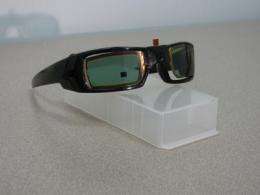
The days of being blinded by glare from the sun, despite the $300 sunglasses straddling your face, may soon be over.
Chris Mullin, PhD, a formerly local inventor and entrepreneur, has teamed up with the University at Buffalo to develop sunglasses that detect bright spots of light and darken specific parts of the lens to protect sunglasses wearers from blinding glare.
Although the sunglasses are not yet ready for the consumer market, they are garnering significant attention: these "smart" shades were named in June one of Popular Science's top 10 inventions of 2011.
And the U.S. Air Force is funding new research focused on creating eyewear for fighter pilots and soldiers. The technology may also have potential applications in the automotive, recreational and health care sectors.
"Our products let users see more in glare situations than ever before, because they reduce direct glare 10 to 100 times more than any other sunglasses," says Mullin, adding, "when there is no glare, it's just a pair of sunglasses."
Mullin is the founder and CEO of Dynamic Eye (http://www.dyneye.com/), a company he created in 2003, and has since worked with UB electrical-engineering professor Albert Titus, PhD, on producing state-of-the-art sunglasses that combine sensors and miniaturized electronics to identify and block bright glare.
Dynamic Eye relocated to Pittsburgh, Pa., in 2008.
Together, Mullin and Titus improved the speed at which the sensor was able to detect glare, at one point taking a prototype of the sunglasses to Buffalo's Delaware Park and testing them out on random park goers.
"Dr. Titus and I built a significant amount of 'brains' into our patented glare sensor," says Mullin, an expert in optics, electronics and plastics. "Our microcontroller does not need to work very hard to perceive and fight glare."
The glasses' lenses are actually liquid crystal display (LCD) screens, capable of creating dark spots that specifically target glaring light.
A pinhole camera in the bridge of the glasses takes a picture of the frame's line of vision. The camera itself analyzes the image and scans it for glare that exceeds a certain threshold.
The camera then alerts an adjacent microcontroller, which directs the LCD to send extra pixels of shade to that portion of the lens, displaying a four- to six-millimeter gray square in front of the eye.
The square moves with the wearer to block the source of glare at any angle but still allows the surroundings to remain visible. If the sun moves, then so does the LCD spot.
This whole process takes about 50 milliseconds.
Mullin says he couldn't have advanced this technology without UB's help. He first needed to secure a patent for the technology used to create the glasses. In 2003, he began working with UB's Office of Science, Technology Transfer and Economic Outreach (STOR), which acquired the patent Mullin needed from Lockheed Martin and licensed it to Dynamic Eye.
Mullin was then put in touch with Titus by UB's Center for Industrial Effectiveness (TCIE), which partners local businesses with UB engineering brainpower from any of seven departments from UB's School of Engineering and Applied Sciences: Biomedical Engineering; Chemical and Biological Engineering; Civil, Structural and Environmental Engineering; Computer Science and Engineering; Electrical Engineering; Industrial and Systems Engineering; and Mechanical and Aerospace Engineering.
"What Chris was working on is exactly what I do," explains Titus, who is also co-chair of UB's Department of Biomedical Engineering.
UB staff not only secured the patent for Mullin and connected him with Titus, but also helped to fund their research. TCIE is the regional administrator of the Strategic Partnership for Industrial Resurgence (SPIR) -- a New York State program that supplies grants to technically advanced companies employing fewer than 500 people.
TCIE helped Mullin secure $36,393 in funding through SPIR grants -- accounting for 42 percent of all research costs done while working with TCIE. The collaboration between Mullen and Titus resulted in a new patent application that was also licensed by STOR to Dynamic Eye.
Glasses for glaucoma patients with sensitivity to light would certainly benefit from Mullin's technology, as would a car's rearview mirrors and windshield, to avoid being blinded by either bright headlights at night or the sun.
"A few circuits, a little battery power and you can really fight the sun," says Mullin.
Provided by University at Buffalo


