DNA cages 'can survive inside living cells'
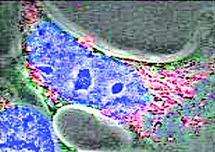
Human embryonic kidney cells were used to test the DNA cages
(PhysOrg.com) -- Scientists at Oxford University have shown for the first time that molecular cages made from DNA can enter and survive inside living cells.
The work, a collaboration between physicists and molecular neuroscientists at Oxford, shows that artificial DNA cages that could be used to carry cargoes of drugs can enter living cells, potentially leading to new methods of drug delivery.
A report of the research is published online in the journal ACS Nano.
The cages developed by the researchers are made from four short strands of synthetic DNA. These strands are designed so that they naturally assemble themselves into a tetrahedron (a pyramid with four triangular faces) around 7 nanometres tall.
The Oxford researchers have previously shown that it is possible to assemble these cages around protein molecules, so that the protein is trapped inside, and that DNA cages can be programmed to open when they encounter specific trigger molecules that are found inside cells.
In the new experiment they introduced fluorescently-labelled DNA tetrahedrons into human kidney cells grown in the laboratory. They then examined the cells under the microscope and found that the cages remained substantially intact, surviving attack by cellular enzymes, for at least 48 hours. This is a crucial advance: to be useful as a drug delivery vehicle, a DNA cage must enter cells efficiently and survive until it can release its cargo where and when it is needed.
At the moment we are only testing our ability to create and control cages made of DNA, said Professor Andrew Turberfield of Oxford Universitys Department of Physics, who led the work. However, these results are an important first step towards proving that DNA cages could be used to deliver cargoes, such as drugs, inside living cells.
Professor Turberfield said: Previous studies have shown that the size of particles is an important factor in whether or not they can easily enter cells, with particles with a radius less than 50 nanometres proving much more successful at gaining entry than larger particles. At 7 nanometres across our DNA tetrahedrons are compact enough to easily enter cells but still large enough to carry a useful cargo. More work is now needed to understand exactly how these DNA cages manage to find their way inside living cells.
Provided by
Oxford University
-
From lemons to lemonade: Reaction uses carbon dioxide to make carbon-based semiconductor,
32 comments
-
Thioridazine kills cancer stem cells in human while avoiding toxic side-effects of conventional cancer treatments,
3 comments
-
SpaceX private rocket blasts off for space station (Update),
42 comments
-
Climate scientists say they have solved riddle of rising sea,
31 comments
-
SpaceX capsule has 'new car' smell, astronauts say (Update),
2 comments
-
What would stain as translucent on light-coloured fabric?
16 hours ago
-
How do I identify different bacteria on culture plates?
May 26, 2012
-
Why Do Dogs do Strange things...
May 25, 2012
-
What does exophillic and endophillic mean in terms of mosquito and their control?
May 24, 2012
-
Semen stains glows under black lights (uv light)?
May 23, 2012
-
Question on Human Chromosome 2
May 23, 2012
- More from Physics Forums - Biology
More news stories
In nanorod crystal growth, nanoparticles seen as artificial atoms
In the growth of crystals, do nanoparticles act as "artificial atoms" forming molecular-type building blocks that can assemble into complex structures? This is the contention of a major but controversial theory ...
May 24, 2012 |
4.8 / 5 (6) |
0
|
First direct observation of oriented attachment in nanocrystal growth
Berkeley Lab researchers have reported the first direct observation of nanoparticles undergoing oriented attachment, the critical step in biomineralization and the growth of nanocrystals. A better understanding ...
May 24, 2012 |
4.7 / 5 (3) |
0
|
Dopant gives graphene solar cells highest efficiency yet
(Phys.org) -- By taking advantage of graphenes favorable electrical and optical properties, and then adding an organic dopant, researchers have achieved the highest power conversion efficiency yet for ...
Synthetic nano-waste does not disappear
(Phys.org) -- Tiny particles of cerium oxide do not burn or change in the heat of a waste incineration plant. They remain intact on combustion residues or in the incineration system, as a new study by Swiss ...
Nanotechnology / Bio & Medicine
May 25, 2012 |
5 / 5 (2) |
1
|
'Metamaterials,' quantum dots show promise for new technologies
(Phys.org) -- Researchers are edging toward the creation of new optical technologies using "nanostructured metamaterials" capable of ultra-efficient transmission of light, with potential applications including ...
May 24, 2012 |
5 / 5 (7) |
1
|
Nvidia trumpets Tegra 3 phone design wins for 2012
(Phys.org) -- Nvidias competitive war paint has a name, Tegra 3. On the heels of Nvidia announcements about lowering costs of its Tegra 3 processors and Nvidia-enabled tablets running Android Ice Cream ...
Browser wars flare in mobile space
The browser wars are heating up again, but this time the fight is for dominance of the mobile Internet.
Scientist: Evolution debate will soon be history
(AP) -- Richard Leakey predicts skepticism over evolution will soon be history. Not that the avowed atheist has any doubts himself.
Dell tablet leak: 10.1-inch display, two-battery choice
(Phys.org) -- Headline after headline talks about vendors tablets in the wings as likely number-one contenders for the iPad. Such claims have justifiably been taken with a grain of salt, considering ...
Keep food safety in mind this memorial day weekend
(HealthDay) -- Picnics, parades and cookouts are as much a part of Memorial Day weekend as tributes to the United States' war veterans.
Social welfare cuts ultimately come with heavy price, researchers say
(Phys.org) -- Slashing government funding for Medicaid, food stamps and other programs that serve the poor while politically popular with some lawmakers and many conservatives may do more harm ...