Discovery of a new magnetic order
July 31, 2011

Atomic-scale Magnetic Lattice of Skyrmions

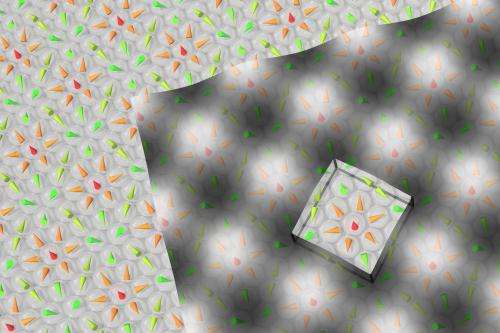
Physicists at Forschungszentrum Juelich and the universities of Kiel and Hamburg are the first to discover stable magnetic skyrmions on a surface as opposed to in bulk materials. The tiny cycloidal spirals, made up of just 15 atoms with their spins, form a regular lattice. The diagram shows simulations of magnetic measurements with the aid of spin-polarized scanning tunneling microscopy in black and white. The orange, red and green arrows show the upward or downward orientation of the spins. The cube-shaped "peephole" designates a single skyrmion. Credit: University of Hamburg

Physicists at Forschungszentrum Jülich and the universities of Kiel and Hamburg are the first to discover a regular lattice of stable magnetic skyrmions – radial spiral structures made up of atomic-scale spins – on a surface instead of in bulk materials. Such tiny formations could one day form the basis of a new generation of smaller and more efficient data storage units in the field of information technology.

The scientists discovered the spirals, each made up of just 15 atoms, in a one-atomic-layer of iron on iridium. They present their results in the current issue of the scientific journal Nature Physics.

The existence of magnetic skyrmions was already predicted over 20 years ago, but was first proven experimentally in 2009; a group of research scientists from the Technische Universität München (TUM) had identified lattices of magnetic vortices in manganese silicon in a weak magnetic field. Unlike these structures, the ones now discovered by at Jülich, Kiel and Hamburg exist without an external magnetic field and are located on the surface of the materials examined, instead of inside them. Their diameter amounts to just a few atoms, making them at least one order of magnitude smaller than the skyrmions which have been identified to date.

"The magnetically-stable entities that we have discovered behave like particles and arrange themselves like atoms in a two-dimensional lattice", explains Prof. Stefan Blügel, Director at the Peter Grünberg Institute and the Institute for Advanced Simulation in Jülich. "This discovery is for us a dream come true". Already in 2007, the same scientific team had discovered a new type of magnetic order in a thin manganese film on tungsten and demonstrated the critical significance of the so-called Dzyaloshinskii-Moriya interaction for the formation of its wave-like structure. The same interaction is also necessary for the formation of the spiral-shaped skyrmions.

The scientists did not discover the skyrmion lattice at first attempt. Originally, they wanted to prepare a one-atomic layer of chromium on iridium, in order to investigate the presumed existence of a different magnetic state. As the experiments were unsuccessful, they then tried with other metals. Using spin-polarized scanning tunnelling microscopy in studies of iron on iridium at the University of Hamburg, the researchers noticed regular magnetic patterns that were not consistent with the crystalline structure of the metal surface. "We were sure straightaway that we had discovered skyrmions", says Blügel. Intricate calculations undertaken by the Jülich supercomputers subsequently proved him right.

The result is a model describing the formation of the spin alignment through a complex interplay of three interactions: the chiral Dzyaloshinskii-Moriya interaction, the conventional interaction between spins plus a non-linear interaction involving four spins. The model should help, in the future, to selectively influence magnetic structures on surfaces. "We are now planning to investigate the effect of electricity on skyrmions; how do the electron spins of an electric current "ride" the spirals, how do they influence resistance and how are the spirals affected?", says Blügel.

More information: "Spontaneous atomic-scale magnetic skyrmion lattice in two dimensions," Nature Physics, published online: 31.07.2011; DOI: 10.1038/NPHYS2045

Provided by Helmholtz Association of German Research Centres search and more info website

4.4 /5 (17 votes)  

Filter


Move the slider to adjust rank threshold, so that you can hide some of the comments.


Display comments: newest first

Caliban
Jul 31, 2011

Rank: 5 / 5 (4)
I wonder how much pressure would be required to collapse these vortices? And could this principle be used to manufacture, for instance, zero-friction bearings? Passive mag-lev?
lqtoai
Jul 31, 2011

Rank: 5 / 5 (3)
I like your comment, Caliban. But I guess that for practical issues, this discovery has very very long way to go. The same problem happens to graphene, because when these few-layer materials are in contact with other materials, their properties will be influenced significantly. Therefore, to sell the recipe of this newly discovered magnetic order to manufacturers, I guess more researches are required, for example about the reproducibility, or the life time of this magnetic state.
Caliban
Jul 31, 2011

Rank: not rated yet
Yeah Iqtoai,

That's essentially what I was asking. Even at that- just imagine what a difference this would make in the service lifetime of small electronic applications, like disk drives and cooling fans, for instance.

If ways could be found to adapt these principles for more heavy-duty purposes -well, the sky's the limit.

antialias_physorg
Aug 01, 2011

Rank: 5 / 5 (1)
And could this principle be used to manufacture, for instance, zero-friction bearings? Passive mag-lev?

Unlikely as the effect is a surface effect and therefore the field strengths are exceedingly small. The cumulative magnetic field over a macro (or even micro) scopic area seems to be zero.

This does not seem to be an applicable for bulk/strong magnetic materials but for very localized fields (like we need for magnetic data storage).
Imagine a sheet, one atom thick, which could be used as a solid state storage solution. Now imagine stacks and stacks of these. The information density could be enormous if we can find an elegant way to read/write fom these.
dutchman
Aug 01, 2011

Rank: not rated yet
In order for this to be useful in data storage, one has to be able to change the state of the location. I wonder if that is even theoretically possible. I did not see anything in the article that would hint at such a possibility.
jselin
Aug 01, 2011

Rank: not rated yet
I wonder if these have mobility at room temperature or if the order was formed at the higher temperatures seen during the monolayer deposition. If its possible to write data to it the "annealing" temperature will have to be high enough above room temperature to preserve it.
Rank 4.4 /5 (17 votes)
Relevant PhysicsForums posts
  • [Drift velocity] Factors affecting velocity
    created1 hour ago
  • does cold gasoline have less energy
    created2 hours ago
  • distribution of molecules throughout the atmosphere
    created4 hours ago
  • The Global Positioning System !
    created5 hours ago
  • A Question relating Power
    created6 hours ago
  • Writing a book so im learning about things, i have some general questions please read
    created8 hours ago
  • More from Physics Forums - General Physics

More news stories

Is a classical electrodynamics law incompatible with special relativity?

(Phys.org) -- The laws of classical electromagnetism that were developed in the 19th century are the same laws that scientists use today. They include Maxwell’s four equations along with the Lorentz la ...

Physics / General Physics

created May 24, 2012 | popularity 4.7 / 5 (16) | comments 42 | with audio podcast feature

Landmark calculation clears the way to answering how matter is formed

(Phys.org) -- An international collaboration of scientists, including Thomas Blum, associate professor of physics, is reporting in landmark detail the decay process of a subatomic particle called a kaon – ...

Physics / General Physics

created May 25, 2012 | popularity 4.2 / 5 (21) | comments 47 | with audio podcast

Lying in wait for WIMPs: Researchers seek to dramatically increase sensitivity of Large Underground Xenon detector

Although it's invisible, dark matter accounts for at least 80 percent of the matter in the universe. No one knows what it is, but most scientists would bet on weakly interacting massive particles, or WIMPs.

Physics / General Physics

created May 23, 2012 | popularity 4 / 5 (7) | comments 15 | with audio podcast

Hawaii lab turns laser-powered bubbles into microrobots

(Phys.org) -- A team of scientists from the University of Hawaii are working on microrobots created from bubbles of air in a saline solution. The bubbles take on their title of “robots” as a laser ...

Physics / General Physics

created May 23, 2012 | popularity 5 / 5 (4) | comments 2 | with audio podcast weblog

Sound increases the efficiency of boiling

Scientists at the Georgia Institute of Technology achieved a 17-percent increase in boiling efficiency by using an acoustic field to enhance heat transfer. The acoustic field does this by efficiently removing vapor bubbles ...

Physics / Soft Matter

created May 24, 2012 | popularity 5 / 5 (2) | comments 2


Nvidia trumpets Tegra 3 phone design wins for 2012

(Phys.org) -- Nvidia’s competitive war paint has a name, Tegra 3. On the heels of Nvidia announcements about lowering costs of its Tegra 3 processors and Nvidia-enabled tablets running Android Ice Cream ...

Browser wars flare in mobile space

The browser wars are heating up again, but this time the fight is for dominance of the mobile Internet.

Scientist: Evolution debate will soon be history

(AP) -- Richard Leakey predicts skepticism over evolution will soon be history. Not that the avowed atheist has any doubts himself.

Dell tablet leak: 10.1-inch display, two-battery choice

(Phys.org) -- Headline after headline talks about vendors’ tablets in the wings as likely number-one contenders for the iPad. Such claims have justifiably been taken with a grain of salt, considering ...

Keep food safety in mind this memorial day weekend

(HealthDay) -- Picnics, parades and cookouts are as much a part of Memorial Day weekend as tributes to the United States' war veterans.

Social welfare cuts ultimately come with heavy price, researchers say

(Phys.org) -- Slashing government funding for Medicaid, food stamps and other programs that serve the poor – while politically popular with some lawmakers and many conservatives – may do more harm ...