Diesel cars gain traction slowly in US market
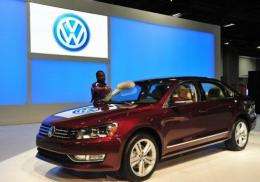
After many fits and starts, diesel cars are gaining traction in the US market, fueled largely by German carmakers including Volkswagen, which opened a plant in May in Tennessee.
Diesel auto sales in the United States revved higher this year thanks to some temporary factors, including a shortage of hybrid cars because of disruptions from the Japanese earthquake disaster.
US consumers bought an estimated 9,000 diesel cars in May, up 34 percent from a year earlier, according to the research firm Baum & Associates.
Some analysts say the long-term view is getting better as well for diesel, whose image has been tarnished by concerns about smelly cars and poor availability of diesel fuel outside the truck sector.
Diesels have been available in the US for decades, but the market pales compared to Europe where they make up around half the auto fleet.
Alan Baum of Baum & Associates said that outside the large pickup truck segment, around one percent of US cars are diesels, and that total diesel market share is expected to be around 4.5 percent this year.
By 2015, Baum expects diesel to grow to 6.0 to 6.5 percent, "with all of the growth in the smaller vehicles, meaning the one percent will grow to 2.5 or 3.0 percent."
The research firm JD Power & Associates sees the US diesel market share at 3.1 percent in 2011, and growing steadily to 7.4 percent by 2017.
Jeremy Anwyl, chief executive at the consultancy Edmunds.com, said prospects appear to be improving for diesel cars, which are cleaner and more efficient than in the past.
"The success has surprised even the manufacturers, because for many years diesel has been lagging," Anwyl said.
"If you drive these vehicles you'd never know you were driving a diesel. They drive like regular vehicles."
Anwyl said consumers looking for better fuel efficiency are giving another look to diesels -- which typically get 20 to 30 percent better fuel economy than gasoline cars -- because of a tight supply of hybrids like the Toyota Prius.
"If you're looking for a Prius there aren't any around," he said. "The tight supply means prices have shot up and that makes alternatives more appealing."
Still, he said diesels "are not cheap" and do better in the luxury segment where the cost difference is not as noticeable.
German carmaker Volkswagen is betting on diesel gaining in the US with its new plant opened in May in Tennessee, where around one in four cars produced is a diesel.
The Mexican-made VW Jetta compact is the biggest-selling US diesel car with around 5,000 sold in May, according to Baum. Other diesels are sold by Mercedes and BMW, along with a handful of large trucks from US makers.
US Transportation Secretary Ray LaHood said the improved fuel economy of diesel cars is a way to wean the US off imported petroleum.
"If one-third of all vehicles in the USA were already clean diesel vehicles today, we would be saving 1.4 million barrels of oil every day," LaHood said at the VW plant opening.
"That is equivalent to the amount of oil we currently import from Saudi Arabia."
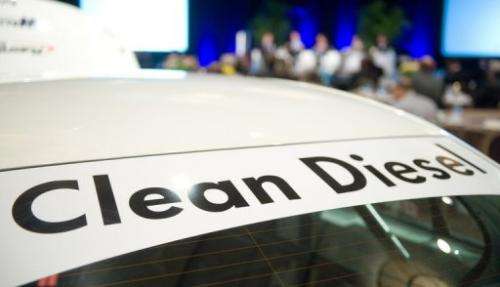
Although efforts to introduce more diesels to the US have sputtered in the past, some things are different now, said Allen Schaeffer, executive director of the Diesel Technology Forum, a nonprofit group backed by industry.
"For those seeing the products, we are seeing a very strong take rate for diesel cars," he said.
Schaeffer said diesels can now meet US emissions standards, even in states like California with more stringent regulations, thanks to technology improvement and new low-sulfur diesel fuel. In past years, some diesels could not be sold in California and a few other states.
One factor holding back diesel car sales is the cost of fuel. While it had been cheaper than gasoline in the past, it is now more costly, due to higher federal and state taxes and a smaller market for refiners.
Schaeffer said the cost differential is bad energy policy and discourages diesel car sales.
"In no case should we tax a more energy-efficient fuel in a way that creates a disincentive," he said.
Jesse Toprak at the consultancy TrueCar.com said many Americans still need convincing.
"Most consumers still have the perception that diesels are grandpa's old loud smoky car," he said.
With diesel cars around 10 percent more expensive than comparable gasoline cars, Toprak said there is "some reluctance by automakers" on introducing new models.
Still, he expects a 40 percent jump in US diesel sales this year, albeit from a very low base. But it remains unclear whether automakers will push diesels or look at more advanced technologies like fuel cells.
Baum said growth in diesel will depend on a number of variables including overall fuel costs, taxes and emissions standards.
Because European regulations emphasize carbon emissions over other pollutants, some diesel models in Europe, notably made by General Motors and Ford, cannot be easily adapted for the US.
Baum said he sees pressure to harmonize US and European standards in a way that allows more of the European diesel engines to be used in the American market.
"If this is done I would expect to see significant increases in diesel because GM and Ford have strong diesel programs in Europe," he said.
(c) 2011 AFP


