Researchers decipher protein structure of key molecule in DNA transcription system
Jul 03, 2011
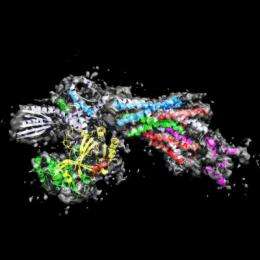
Scientists have deciphered the structure of an essential part of Mediator, a complex molecular machine that plays a vital role in regulating the transcription of DNA. Credit: Indiana University School of Medicine

Scientists have deciphered the structure of an essential part of Mediator, a complex molecular machine that plays a vital role in regulating the transcription of DNA.

The research adds an important link to discoveries that have enabled scientists to gain a deeper understanding of how cells translate into the proteins and processes of life. The findings, published in the July 3 advance online issue of the journal Nature, were reported by a research team led by Yuichiro Takagi, Ph.D., assistant professor of biochemistry and molecular biology at Indiana University School of Medicine.

The fundamental operations of all are controlled by the genetic information – the genes –stored in each cell's , a long double-stranded chain. Information copied from sections of the DNA – through a process called transcription – leads to synthesis of messenger RNA, eventually enabling the production of proteins necessary for cellular function. Transcription is undertaken by the enzyme called RNA polymerase II.

As cellular operations proceed, signals are sent to the DNA asking that some genes be activated and others be shut down. The Mediator transcription regulator accepts and interprets those instructions, telling RNA polymerase II where and when to begin the transcription process.

Mediator is a gigantic molecular machine composed of 25 proteins organized into three modules known as the head, the middle, and the tail. Using X-ray crystallography, the Takagi team was able to describe in detail the structure of the Mediator Head module, the most important for interactions with RNA polymerase II.

"It's turned out to be extremely novel, revealing how a molecular machine is built from multiple proteins," said Takagi.

"As a molecular machine, the Mediator head module needs to have elements of both stability and flexibility in order to accommodate numerous interactions. A portion of the head we named the neck domain provides the stability by arranging the five proteins in a polymer-like structure," he said.

"We call it the alpha helical bundle," said Dr. Takagi. "People have seen structures of alpha helical bundles before but not coming from five different proteins."

"This is a completely noble structure," he said.

One immediate benefit of the research will be to provide detailed mapping of previously known mutations that affect the regulation of the transcription process, he said.

The ability to solve such complex structures will be important because multi-protein complexes such as Mediator will most likely become a new generation of drug targets for treatment of disease, he said.

Previously, the structure of RNA polymerase II was determined by Roger Kornberg of Stanford University, with whom Dr. Takagi worked prior to coming to IU School of Medicine. Kornberg received the Nobel Prize in 2006 for his discoveries. The researchers who described the structure of the ribosome, the production machine, were awarded the Nobel Prize in 2009. The structure of the entire Mediator has yet to be described, and thus remains the one of grand challenges in structure biology. Dr. Takagi's work on the Mediator head module structure represents a major step towards a structure determination of the entire .

Explore further: RNA capable of catalyzing electron transfer on early earth with iron's help, study says

Provided by Indiana University School of Medicine

5 /5 (2 votes)

Related Stories

How RNA polymerase II gets the go-ahead for gene transcription

Oct 09, 2009

All cells perform certain basic functions. Each must selectively transcribe parts of the DNA that makes up its genome into RNAs that specify the structure of proteins. The set of proteins synthesized by a cell in turn determines ...

Evolution with a restricted number of genes

Dec 14, 2007

The development of higher forms of life would appear to have been influenced by RNA polymerase II. This enzyme transcribes the information coded by genes from DNA into messenger-RNA (mRNA), which in turn is the basis for ...

Recommended for you

Attacking MRSA with metals from antibacterial clays

May 17, 2013

In the race to protect society from infectious microbes, the bugs are outrunning us. The need for new therapeutic agents is acute, given the emergence of novel pathogens as well as old foes bearing heightened antibiotic resistance.

Keeping fruit, vegetables and cut flowers fresh longer

May 15, 2013

New technology offers the promise of reducing billions of dollars of losses that occur each year from the silent, invisible killer of fruits, vegetables and cut flowers—a gas whose effects are familiar to everyone who has ...

Why don't beetles freeze in the winter?

May 14, 2013

For 37 years, Queen's University Biochemistry professor Peter Davies has been unraveling the mystery of why some organisms including insects and fish don't freeze in the winter. His research into insect antifreeze protein ...

The molecular basis of strawberry aroma

May 13, 2013

You know that summer is here when juicy red strawberries start to appear on the shelves. In Germany, this seasonal fruit has never been more popular: on average 3.5 kilos per head were consumed in 2012—a ...

A new dimension for 3-D protein structures

May 13, 2013

(Phys.org) —3D structures of biological molecules like proteins directly affect the way they behave in our bodies. EPFL scientists have developed a new infrared-UV laser method to more accurately determine ...

User comments : 3

Adjust slider to filter visible comments by rank

Display comments: newest first

kevinrtrs
1 / 5 (3) Jul 04, 2011
We call it the alpha helical bundle, said Dr. Takagi. People have seen structures of alpha helical bundles before but not coming from five different proteins.
This is a completely noble structure, he said.

Not sure what "noble" means in this context. Did he perhaps mean to say "novel"?
In any case, this surely points to more problems for evolutionary thought. How did this particular stucture develop in a step-wise fashion whilst providing the services that it's supposed to deliver?
Simply not possible since the functions it performs are vital to the continued existence of the cell itself. Another conundrum for evolutionists to unravel. I predict with 100% certainty that hand-waving is in the offing.
aroc91
5 / 5 (1) Jul 04, 2011
In any case, this surely points to more problems for evolutionary thought.


No it doesn't.

You sure like to use terms like "surely" a lot, when in reality, you have no idea what you're talking about.
barakn
5 / 5 (1) Jul 04, 2011
I predict with 100% certainty that hand-waving is in the offing.

Since your post already introduced the hand-waving, that doesn't count as a prediction.

More news stories

Attacking MRSA with metals from antibacterial clays

In the race to protect society from infectious microbes, the bugs are outrunning us. The need for new therapeutic agents is acute, given the emergence of novel pathogens as well as old foes bearing heightened antibiotic resistance.

Beautiful 'flowers' self-assemble in a beaker

By simply manipulating chemical gradients in a beaker of fluid, materials scientists at Harvard have found that they can control the growth behavior of crystals to create precisely tailored structures—such ...

Honeybees trained in Croatia to find land mines

(AP)—Mirjana Filipovic is still haunted by the land mine blast that killed her boyfriend and blew off her left leg while on a fishing trip nearly a decade ago. It happened in a field that was supposedly ...

Mice, gerbils perish in Russia space flight

A number of mice and eight gerbils sent into space in a Russian capsule destined to find out how well organisms can withstand extended flights perished during their journey, scientists said Sunday as the ...