Cosmic bullseye: Auriga's wheel
July 25, 2011 By Jon Voisey
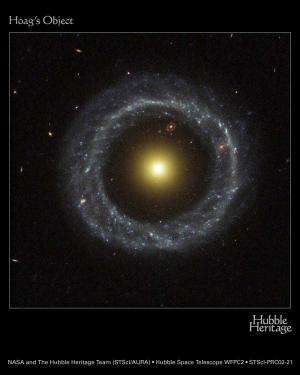
Hoag's Object Credit: HST
One of the strangest types of galaxies are those known as ring galaxies. Examples of these include Hoags Object (shown above), the Cartwheel Galaxy, and AM 0644-741. These unusual shapes are cause by a galactic collision in which a smaller galaxy plunges nearly straight through the center of a larger galaxy. The gravitational disturbance caused a wave of star formation to ripple out from the center. In most cases, the intruder galaxy is long gone, but a serendipitous discovery as part of a larger survey recently turned up another of these objects, this time with the collisional partner still making its getaway.
Prior to this discovery, astronomers recognized only 127 ring galaxies, most of which are in the relatively nearby universe (< 1 billion lightyears). The lifetime of the ring structure is generally short lived and will dissipate once the density wave leaves the galaxy but while it persists, such galaxies give astronomers a wonderful chance to study the star formation the process triggers. In particular, it helps astronomers understand stellar evolution since the age of the stars becomes linked to the radius from the center; the newest stars are the furthest out where the ring is currently condensing new ones from the interstellar medium, and older ones lie towards the center where the density wave began.
The new ring galaxy was discovered by astronomers from the Max Planck Institute for Astronomy in Germany as part of a study to explore the Milky Ways thick disk. The discovery images were taken in 2007 using the recently damaged Subaru telescope.
When the team noticed the rare galaxy in their image they tentatively dubbed it Aurigas Wheel, they turned to the Gemini North telescope to obtain spectroscopy for the object. The redshift of these objects would allow astronomers to explore their distance and confirm that they were likely interacting and not simply a chance alignment. When the data was analyzed, the galaxies were found to lie together at a distance of nearly 1.5 billion lightyears making this a new record holder for furthest ring galaxy for which spectroscopic data has been obtained.
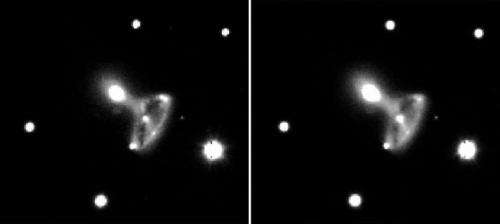
Auriga's Wheel as seen in the g (left) and r (right) filters from Subaru. Credit: Blair Conn et al.
But aside from the temporary place in the record books, the pair is interesting in other ways. Modeling of the interaction as well as the spectroscopic data allowed the team to estimate the propagation of the ring to be at ~200 km/sec which would make it 50 million years since the collision occurred. The image also clearly shows the galaxy that plunged through the center of the more massive, disk galaxy and a distinct trail of gas and dust connects the two. Additionally, both galaxies appear to have Active Galactic Nuclei, which is rare for ring galaxies. However, it is not clear whether the activity was a result of the collision or a property of the individual galaxies prior to the interaction.Source: Universe Today
-
From lemons to lemonade: Reaction uses carbon dioxide to make carbon-based semiconductor,
32 comments
-
Thioridazine kills cancer stem cells in human while avoiding toxic side-effects of conventional cancer treatments,
3 comments
-
SpaceX private rocket blasts off for space station (Update),
42 comments
-
Climate scientists say they have solved riddle of rising sea,
31 comments
-
SpaceX capsule has 'new car' smell, astronauts say (Update),
2 comments
-
revamping general concept and cosmological principle
May 25, 2012
-
Transiting Exoplanet Light Curve
May 25, 2012
-
Math behind Theoretical Physics
May 24, 2012
-
Do we know whats at the center of galaxies yet?
May 23, 2012
-
Structure of the Milky Way?
May 20, 2012
-
What would it take to terraform Pluto and Charon?
May 19, 2012
- More from Physics Forums - General Astronomy
More news stories
Sophisticated simulations predict future warming
The chances of our planet being hit by a global warming of 3 degrees Celsius by 2050 is as likely as it being hit by an increase of 1.4 degrees, new research shows. Presented in the journal Nature Geoscience, the British study ...
Space & Earth / Earth Sciences
May 22, 2012 |
4.4 / 5 (9) |
51
Kyoto Protocol architect 'frustrated' by climate dialogue
UN climate talks are going nowhere, as politicians dither or bicker while the pace of warming dangerously speeds up, one of the architects of the Kyoto Protocol told AFP.
May 23, 2012 |
3.7 / 5 (7) |
39
Dragon arrives at space station in historic 1st (Update 2)
The privately bankrolled Dragon capsule made a historic arrival at the International Space Station on Friday, triumphantly captured by astronauts wielding a giant robot arm.
Space & Earth / Space Exploration
May 25, 2012 |
5 / 5 (10) |
19
Aliens don't want to eat us, says former SETI director
Alien life probably isnt interested in having us for dinner, enslaving us or laying eggs in our bellies, according to a recent statement by former SETI director Jill Tarter.
Space & Earth / Space Exploration
May 25, 2012 |
4.4 / 5 (13) |
37
What's the big deal about private space launches?
(AP) -- The first private spaceship is headed to the International Space Station. Some questions and answers about the cargo mission by Space Exploration Technologies, known as SpaceX:
Space & Earth / Space Exploration
May 22, 2012 |
5 / 5 (6) |
32
Nvidia trumpets Tegra 3 phone design wins for 2012
(Phys.org) -- Nvidias competitive war paint has a name, Tegra 3. On the heels of Nvidia announcements about lowering costs of its Tegra 3 processors and Nvidia-enabled tablets running Android Ice Cream ...
Browser wars flare in mobile space
The browser wars are heating up again, but this time the fight is for dominance of the mobile Internet.
Scientist: Evolution debate will soon be history
(AP) -- Richard Leakey predicts skepticism over evolution will soon be history. Not that the avowed atheist has any doubts himself.
Dell tablet leak: 10.1-inch display, two-battery choice
(Phys.org) -- Headline after headline talks about vendors tablets in the wings as likely number-one contenders for the iPad. Such claims have justifiably been taken with a grain of salt, considering ...
Keep food safety in mind this memorial day weekend
(HealthDay) -- Picnics, parades and cookouts are as much a part of Memorial Day weekend as tributes to the United States' war veterans.
Social welfare cuts ultimately come with heavy price, researchers say
(Phys.org) -- Slashing government funding for Medicaid, food stamps and other programs that serve the poor while politically popular with some lawmakers and many conservatives may do more harm ...

Jul 25, 2011
Rank: 1 / 5 (2)
If it were a result of galactic collisions, we would see a far more crowded space in the intergalactic voids. Just not logical. Thus, I conclude LaViolette's model fits this observation more accurately than the collision model.
I once posted more detail on this process in this example.
http://www.physor...ars.html
Jul 25, 2011
Rank: 5 / 5 (1)
"No. Admittedly, this is not my field. I am simply an aerospace engineer with an interest in cosmology."
you also say "Has science lost credibilty? Or has the mainstream been influenced by DoD counter-intelligence, aimed at keeping classified physics classified" and make up conspiracy theories about modern science.
Jul 25, 2011
Rank: not rated yet
i mistyped a word. i meant field above, didnt notice till it was too late to change.