A closer look at cells
July 27, 2011 By Sarah Perrin
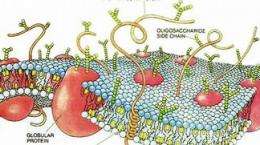
Drawing of a cell membrane. Credit: Dana Woods / Scientific American
Many substances and nutrients are exchanged across the cell membrane. EPFL scientists have developed a method to observe these exchanges, by taking a highly accurate count of the number of proteins found there. Their research has just been published in the Journal Plos One.
Proteins on the cell surface play an essential role in the survival of the cell. They govern the exchanges between the interior and the exterior. Now, EPFL scientists have found a way to observe them in action. They have developed a method based on fluorescence microscopy that gives them a very precise image of the composition of the membrane and the exchanges taking place there. Their results are published July 26 in an article in Plos One, an online journal specializing in science and medicine, as well as in a June 12, 2011 letter to the journal Nature Methods.
It is important to study the membrane because it is an exchange platform between the cell and its environment, explains Aleksandra Radenovic, Professor in the Laboratory of Nanoscale Biology and one of the studys authors.
Permeable to some molecules but closed off to others, the membrane controls the movement of substances and nutrients between the interior and the exterior of the cell. The proteins in the membrane play critical roles in the cell, particularly in energy transfer, gene expression and nutrient transport.
Using the method they developed, the scientists can now count these proteins very accurately. In so doing, they obtain valuable information on their interactions and their evolution. It allows them to know more about how a cell reacts to the administration of a drug or exposure to an external agent (such as a pollutant), and why a given cell behaves differently from another cell. Eventually, this technique could thus help us develop more effective drugs, Radenovic says.
Capturing light
This research is based on very high resolution data provided by a special fluorescence microscopy technique called Photo Activated Localization Microscopy (PALM). Developed just under five years ago, this technology has revolutionized molecular imaging. It works on the principle of capturing light that is emitted either naturally or upon combination with a fluorescent substance (fluorochrome) - by certain bodies at the nanometer scale.
Once the biological sample is placed under the microscope, the scientist illuminates the molecules with a series of successive flashes. The assemblage of images then forms a very high resolution image, which allows the scientists to pinpoint the location of proteins at extremely small scales.
The Laboratory of Nanoscale Biology is continuing its investigations, in order to refine the use of this technology and the quantification of elements present in the membrane in the most reliable manner possible. In particular, they are working on a photoactivatable protein called mEos2. The voyage into the infinitely small universe of the cell has just begun
More information: Quantitative Photo Activated Loalization Microscopy : unraveling the effects of photoblinking», by Aleksandra Radenovic, et al. Plos One doi:10.1371/journal.pone.0022678
"Identification of clustering artifacts in photoactivated localization microscopy", Nature Methods doi:10.1038/nmeth.1627
Provided by Ecole Polytechnique Federale de Lausanne
-
From lemons to lemonade: Reaction uses carbon dioxide to make carbon-based semiconductor,
32 comments
-
Thioridazine kills cancer stem cells in human while avoiding toxic side-effects of conventional cancer treatments,
3 comments
-
SpaceX private rocket blasts off for space station (Update),
42 comments
-
Climate scientists say they have solved riddle of rising sea,
31 comments
-
SpaceX capsule has 'new car' smell, astronauts say (Update),
2 comments
-
What would stain as translucent on light-coloured fabric?
15 hours ago
-
How do I identify different bacteria on culture plates?
May 26, 2012
-
Why Do Dogs do Strange things...
May 25, 2012
-
What does exophillic and endophillic mean in terms of mosquito and their control?
May 24, 2012
-
Semen stains glows under black lights (uv light)?
May 23, 2012
-
Question on Human Chromosome 2
May 23, 2012
- More from Physics Forums - Biology
More news stories
Scientist: Evolution debate will soon be history
(AP) -- Richard Leakey predicts skepticism over evolution will soon be history. Not that the avowed atheist has any doubts himself.
14 hours ago |
3.5 / 5 (14) |
33
More plant species responding to global warming than previously thought
(Phys.org) -- Far more wild plant species may be responding to global warming than previous large-scale estimates have suggested.
May 22, 2012 |
4.6 / 5 (14) |
18
|
Thousands of shellfish found dead in Peru
Thousands of crustaceans were found dead off the coast of Lima following the mystery mass death of dolphins and pelicans, the Peruvian Navy said Friday.
May 26, 2012 |
4.8 / 5 (4) |
7
For monogamous sparrows, it doesn't pay to stray (but they do it anyway)
It's quite common for a female song sparrow to stray from her breeding partner and mate with the male next door, but a new study shows that sleeping around can be costly.
May 22, 2012 |
5 / 5 (1) |
7
|
Study uncovers secret to speedy burrowing by razor clams
(Phys.org) -- If you look at a razor burrowing clam sitting in a bucket, youd never guess that it could burrow itself down into the soil, much less do it with any speed. Razor clams look like fat straws, ...
Nvidia trumpets Tegra 3 phone design wins for 2012
(Phys.org) -- Nvidias competitive war paint has a name, Tegra 3. On the heels of Nvidia announcements about lowering costs of its Tegra 3 processors and Nvidia-enabled tablets running Android Ice Cream ...
Browser wars flare in mobile space
The browser wars are heating up again, but this time the fight is for dominance of the mobile Internet.
Dell tablet leak: 10.1-inch display, two-battery choice
(Phys.org) -- Headline after headline talks about vendors tablets in the wings as likely number-one contenders for the iPad. Such claims have justifiably been taken with a grain of salt, considering ...
Keep food safety in mind this memorial day weekend
(HealthDay) -- Picnics, parades and cookouts are as much a part of Memorial Day weekend as tributes to the United States' war veterans.
Family history of Alzheimer's affects functional connectivity
(HealthDay) -- Cognitively normal individuals with a family history of late-onset Alzheimer's disease (AD) may display lower resting state functional connectivity in the default mode network (DMN) of the brain, ...
Social welfare cuts ultimately come with heavy price, researchers say
(Phys.org) -- Slashing government funding for Medicaid, food stamps and other programs that serve the poor while politically popular with some lawmakers and many conservatives may do more harm ...