'Cling-film' solar cells could lead to advance in renewable energy
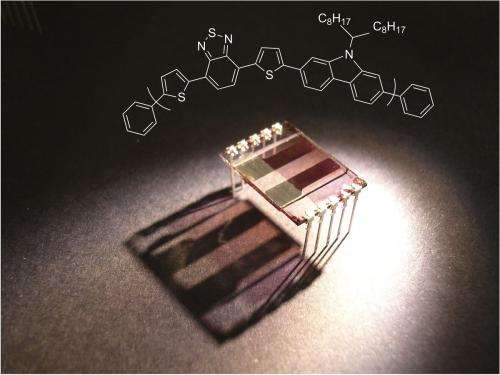
A polymer solar cell ready for testing; the metal connections allow us to measure different areas of the film and measure the device efficiency amongst other parameters. Credit: Andrew Parnell
(PhysOrg.com) -- A scientific advance in renewable energy which promises a revolution in the ease and cost of using solar cells, has been announced today. A new study shows that even when using very simple and inexpensive manufacturing methods - where flexible layers of material are deposited over large areas like cling-film - efficient solar cell structures can be made.
The study, published in the journal Advanced Energy Materials, paves the way for new solar cell manufacturing techniques and the promise of developments in renewable solar energy. Scientists from the Universities of Sheffield and Cambridge used the ISIS Neutron Source and Diamond Light Source at STFC Rutherford Appleton Laboratory in Oxfordshire to carry out the research.
Plastic (polymer) solar cells are much cheaper to produce than conventional silicon solar cells and have the potential to be produced in large quantities. The study showed that when complex mixtures of molecules in solution are spread onto a surface, like varnishing a table-top, the different molecules separate to the top and bottom of the layer in a way that maximises the efficiency of the resulting solar cell.
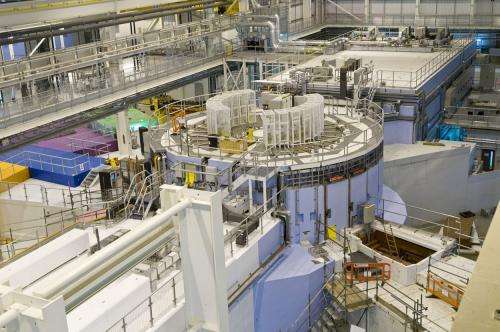
ISIS' Target Station 2 at STFC Rutherford Appleton Laboratory in Oxfordshire. Credit: STFC
Dr Andrew Parnell of the University of Sheffield said, "Our results give important insights into how ultra-cheap solar energy panels for domestic and industrial use can be manufactured on a large scale. Rather than using complex and expensive fabrication methods to create a specific semiconductor nanostructure, high volume printing could be used to produce nanoscale (60 nanometers) films of solar cells that are over a thousand times thinner than the width of a human hair. These films could then be used to make cost-effective, light and easily transportable plastic solar cell devices such as solar panels."Dr Robert Dalgliesh, one of the ISIS scientists involved in the work, said, "This work clearly illustrates the importance of the combined use of neutron and X-ray scattering sources such as ISIS and Diamond in solving modern challenges for society. Using neutron beams at ISIS and Diamond's bright X-rays, we were able to probe the internal structure and properties of the solar cell materials non-destructively. By studying the layers in the materials which convert sunlight into electricity, we are learning how different processing steps change the overall efficiency and affect the overall polymer solar cell performance."
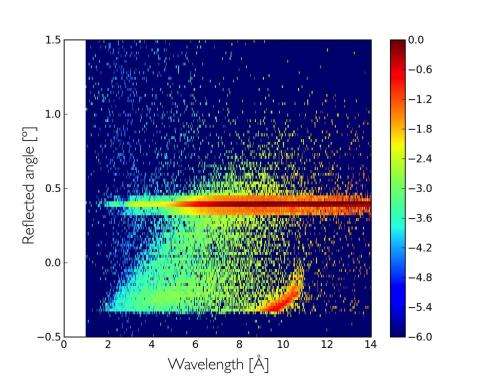
This image shows how neutrons are scattered from one of the solar cell layers. Modelling this information helps us understand the composition and structure within the layer. The intense horizontal line is the mirror-like reflection (specular reflectivity) from the solar cell. The data was taken on the instrument Offspec at ISIS' Target Station 2. Credit: STFC
"Over the next fifty years society is going to need to supply the growing energy demands of the world's population without using fossil fuels, and the only renewable energy source that can do this is the Sun", said Professor Richard Jones of the University of Sheffield. "In a couple of hours enough energy from sunlight falls on the Earth to satisfy the energy needs of the Earth for a whole year, but we need to be able to harness this on a much bigger scale than we can do now. Cheap and efficient polymer solar cells that can cover huge areas could help move us into a new age of renewable energy."Solar cells
Photovoltaics are semiconductor devices that are used to generate low-cost renewable energy - most commonly as solar panels. When sunlight hits a photovoltaic cell, it is absorbed and its energy is converted into an electrical current. Most photovoltaic devices are made with silicon; however, devices can also be made from plastic (organic photovoltaic devices).
Plastic films can be deposited from solution by low-cost, roll to roll printing techniques resulting in significant overall savings in energy and cost. This is where the film is put on a roll and goes through a series of processes similar to the way newspapers are printed and taken off a roll at the end. There are currently products using this type of technology. To increase usage further, however, the technology needs to be more efficient. Polymer solar cells are currently 7-8% efficient.The next step is to develop cells which are 10% efficient or more for commercial viability.
The materials used in the research carried out by the collaboration are called PCDTBT (poly [N-9′-heptadecanyl-2,7-carbazole-alt-5,5-(4′,7′-di- 2-thienyl- 2′,1′,3′-benzothiadiazole): PCBM ([6,6]- phenyl-C61-butyric acid methylester), a material based on Nobel-prize-winning (Chemistry 1996) work of Professor Richard Smalley and Professor Harry Kroto (amongst others) on the C60 Buckminsterfullerene or buckyball form of carbon.Bright X-rays using instruments at Diamond Light Source were used to study the crystallinity of the material; neutrons at ISIS were used to examine the material's composition profile.
More information: The research is published in Advanced Energy Materials, volume 1, issue 4 July 2011. The paper is also available to view online.
Provided by
Science and Technology Facilities Council
-
From lemons to lemonade: Reaction uses carbon dioxide to make carbon-based semiconductor,
32 comments
-
Thioridazine kills cancer stem cells in human while avoiding toxic side-effects of conventional cancer treatments,
3 comments
-
SpaceX private rocket blasts off for space station (Update),
42 comments
-
Climate scientists say they have solved riddle of rising sea,
31 comments
-
SpaceX capsule has 'new car' smell, astronauts say (Update),
2 comments
-
microstructure of titanium
17 hours ago
-
Steam in My Espresso Machine
22 hours ago
-
Density question
May 24, 2012
-
Mass transport originating from a point source at a solid gas interface
May 22, 2012
-
Ammonia dispersion in Air
May 22, 2012
-
Multi Choice Help
May 21, 2012
- More from Physics Forums - Materials & Chemical Engineering
More news stories
In nanorod crystal growth, nanoparticles seen as artificial atoms
In the growth of crystals, do nanoparticles act as "artificial atoms" forming molecular-type building blocks that can assemble into complex structures? This is the contention of a major but controversial theory ...
May 24, 2012 |
4.8 / 5 (6) |
0
|
First direct observation of oriented attachment in nanocrystal growth
Berkeley Lab researchers have reported the first direct observation of nanoparticles undergoing oriented attachment, the critical step in biomineralization and the growth of nanocrystals. A better understanding ...
May 24, 2012 |
4.7 / 5 (3) |
0
|
Dopant gives graphene solar cells highest efficiency yet
(Phys.org) -- By taking advantage of graphenes favorable electrical and optical properties, and then adding an organic dopant, researchers have achieved the highest power conversion efficiency yet for ...
Synthetic nano-waste does not disappear
(Phys.org) -- Tiny particles of cerium oxide do not burn or change in the heat of a waste incineration plant. They remain intact on combustion residues or in the incineration system, as a new study by Swiss ...
Nanotechnology / Bio & Medicine
May 25, 2012 |
5 / 5 (2) |
1
|
'Metamaterials,' quantum dots show promise for new technologies
(Phys.org) -- Researchers are edging toward the creation of new optical technologies using "nanostructured metamaterials" capable of ultra-efficient transmission of light, with potential applications including ...
May 24, 2012 |
5 / 5 (7) |
1
|
Nvidia trumpets Tegra 3 phone design wins for 2012
(Phys.org) -- Nvidias competitive war paint has a name, Tegra 3. On the heels of Nvidia announcements about lowering costs of its Tegra 3 processors and Nvidia-enabled tablets running Android Ice Cream ...
Browser wars flare in mobile space
The browser wars are heating up again, but this time the fight is for dominance of the mobile Internet.
Scientist: Evolution debate will soon be history
(AP) -- Richard Leakey predicts skepticism over evolution will soon be history. Not that the avowed atheist has any doubts himself.
Dell tablet leak: 10.1-inch display, two-battery choice
(Phys.org) -- Headline after headline talks about vendors tablets in the wings as likely number-one contenders for the iPad. Such claims have justifiably been taken with a grain of salt, considering ...
Keep food safety in mind this memorial day weekend
(HealthDay) -- Picnics, parades and cookouts are as much a part of Memorial Day weekend as tributes to the United States' war veterans.
Family history of Alzheimer's affects functional connectivity
(HealthDay) -- Cognitively normal individuals with a family history of late-onset Alzheimer's disease (AD) may display lower resting state functional connectivity in the default mode network (DMN) of the brain, ...


Jul 04, 2011
Rank: not rated yet
Jul 04, 2011
Rank: not rated yet
Jul 04, 2011
Rank: 2.3 / 5 (3)
Jul 04, 2011
Rank: not rated yet
http://www.physor...193.html
Jul 04, 2011
Rank: 5 / 5 (1)
Jul 04, 2011
Rank: 1 / 5 (1)
I agree, the sensationalist headlines are frustrating. When you see "could lead to" in the title, ignore it. It's a curiosity, nothing more. There will be no product, don't hold your breath. If I were a betting man, I'd say the odds are against this or any other single technology coming to market. Something might eventually but based on what I've seen, it's not going to be any time soon.
Jul 05, 2011
Rank: 5 / 5 (2)
Say it with me: "This is a site that reports on scientific findings not a site that reports on released products"
The time between something being researched and the same thing hitting store shelves is measured in years (oftentimes decades).
Investors need to be found, market viability needs to be explored, factories have to be built, distribution networks established, people hired and trained, the product has to be optimized, ...
Stuff like that just doesn't happen over night.
To be fair (and speaking from experience): Researchers are mostly not really interested in marketing their findings. That's just not interesting. What would be the point? A lot of time spent doing non-research work? Would you do something that eally isn't fun if you had the choice?
Jul 05, 2011
Rank: 5 / 5 (1)
Although I am not a scientist Physorg is one of my favorite sites, precisely because it reports on the cutting edge of scientific research. This is the kind of news that needs to be reported to other scientists and to more business-minded people who can do the "not interesting" work of bringing the science to market.
Jul 11, 2011
Rank: not rated yet
Perhaps that's because conventional solar cells have also improved?
Jul 11, 2011
Rank: not rated yet
Jul 11, 2011
Rank: not rated yet
And when they reach 10%, they will try for 12. Of course it's a moving target.