Climate will damage reefs at 'different rates'
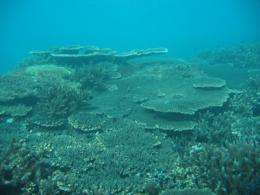
(PhysOrg.com) -- Climate change and acidifying ocean water are likely to have a highly variable impact on the world's coral reefs in space, time and diversity, according to an international team of coral scientists, including UQ researchers.
The picture that is emerging from studies of past coral extinctions and present impacts on today's reef systems is complex and subtle.
It will demand much more sophisticated management to preserve reefs intact, the team of scientists said in a paper in the international journal Science.
“New research confirms that coral reefs…. are indeed threatened by climate change, but that some current projections of global-scale collapse of reefs within the next few decades probably overestimate the rapidity and uniformity of the decline,” the researchers said.
“A considered view of all the most recent evidence suggests that some coral reef systems will decline more rapidly – especially those subject to other human pressures such as overfishing," said lead author Professor John Pandolfi of the ARC Centre of Excellence for Coral Reef Studies and The University of Queensland..
"However, others may change in composition, but manage to persist for longer.”
The paper, “Projecting coral reef futures under global warming and ocean acidification” by John M. Pandolfi, Sean R. Connolly, Dustin J. Marshall and Anne L. Cohen appears in the latest issue of the journal Science.
“Coral reefs occupy a small part of the world's oceans, yet harbor a hugely disproportionate amount of its biodiversity,” the researchers said.
“More than 450 million people from 109 countries live close to coral reefs, which provide important sources of ecosystem goods and services for these communities.
“But reefs have suffered degradation from human over-exploitation and pollution over centuries to millennia, degradation that has accelerated in the last 50 years.
"Global warming and ocean acidification are now compounding these threats.”
However reefs are naturally highly diverse and resilient, and are likely to respond to the changed conditions in different ways and at varying rates.
The research paper says that past extinction crises in coral reef ecosystems appeared to coincide with episodes of rapid global warming and ocean acidification.
"This has led some to predict rapid, dramatic, global-scale losses of coral reefs.
“Widespread degradation of reefs is already underway," said another of the study authors, Professor Sean Connolly of the ARC Center of Excellence for Coral Reef Studies and James Cook University.
"However, rates of future decline will be highly variable, because coral reefs are naturally highly diverse with some species able to cope with change more than others.
Moreover, changes in ocean and climate conditions will be different in different regions, and the partnership between corals and their symbiotic algae has variable capacity to adapt to changing conditions.”
The researchers said that evolution and genetic change in both creatures could make them more tolerant of major changes in ocean temperature and chemistry – but, paradoxically, it could also accelerate the decline of reef species.
However, human management was necessary to improve the corals' chances.
Actions that improved coral diversity would tend to make reefs more resilient.
The researchers also noted that large populations of reef species, not already stressed by overfishing or coastal runoff, were likely to be better able to adapt to the challenges of climate change.
“This makes the overall picture extraordinarily complex," Professor Pandolfi said.
"We do not yet have a model that explains the full spectrum of reef responses everywhere."
The researchers highlighted some critical knowledge gaps, including the effects of climate change on interactions between species, and the potential rates of adaptation of reef species to warmer and more acidic conditions.
“Our ability to continue to improve our projections of climate change effects on coral reefs depends especially on advances in our understanding of these areas,” Professor Connolly said.
“We think it would be best if the world prepares itself for a range of possible impacts and responses on reefs, and manages them accordingly, if we are to give our corals their best possible chance of survival through what we know from geological history is bound to be a very stressful era of environmental change.”
The researchers said that the best and most achievable thing people could do for coral reefs to deal with climate change was to seek to manage them well.
“However, slowing rates of climate change, and reducing the strong selection imposed by human impacts such as fishing and coastal development will remain critical to the long-term persistence of coral reef ecosystems,” they said.
Provided by University of Queensland


