China sub makes first dive to below 5,000m

July 26, 2011 by Dan Martin
The sun rises behind clouds over the Pacific Ocean. A Chinese submersible conducted the country's deepest manned dive Tuesday in the latest technical milestone for China, which theoretically puts most of the ocean floor's vast resources within its reach.
A Chinese submersible conducted the country's deepest manned dive Tuesday in the latest technological milestone for China, which theoretically puts most of the ocean floor's vast resources within its reach.
The Jiaolong undersea craft -- named after a mythical sea dragon -- reached 5,057 metres (16,591 feet) below sea level in a test dive in the northeastern Pacific, the State Oceanic Administration (SOA) said.
Though less than half as deep as a record dive by the US Navy in 1960, the achievement highlights China's push to catch up with advanced nations in space, sea, and polar exploration, and points to its fast-growing technical capabilities.
This campaign has been exemplified by a space programme that in 2003 made China just the third nation to conduct manned space flight.
The Jiaolong -- designed for a maximum depth of 7,000 metres -- carried three people to 4,027 metres down in a test on Thursday.
It conducted the test dive to break the 5,000-metre mark early on Tuesday morning in international waters, the SOA said.
Afterwards, the submersible's three-man crew appeared on the deck of the mission's main ship triumphantly holding a Chinese flag in images broadcast on state television.
The test's success indicated that the submersible was capable of reaching more than 70 percent of the planet's seabed, the SOA said.
China has pushed hard in recent years to obtain oil, minerals and other resources needed to fuel its growth, and has said its submersible programme is aimed at scientific research and the peaceful exploration and use of natural resources.
Scientists say the oceans' floors contain rich deposits of potentially valuable minerals, but the extreme depths pose technical difficulties in harvesting them on a wide scale.
But it may not take China long to begin reaching these riches, Jian Zhimin, director of the State Key Laboratory of Marine Geology at Shanghai's Tongji University, told AFP.
"I don't think it will be a very long time before China can perform deep-sea ocean-floor mining," he said, noting that many of the most valuable oceanic mineral resources are located around the Jiaolong's maximum designed depth of 7,000 metres.
The SOA said the submersible would attempt a 7,000-metre dive in 2012.
The US Navy reached the bottom of the Mariana Trench -- the deepest point in the world's oceans at 11,000 metres -- in 1960.
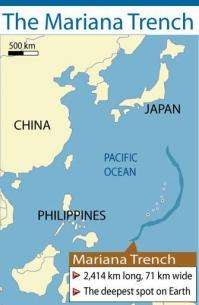
Graphic on the Mariana Trench. A Chinese submersible has conducted the country's deepest manned dive in the latest technological milestone for China, which theoretically puts most of the ocean floor's vast resources within its reach.
But China's appetite for resources, rapid military expansion and increasing assertiveness over maritime territorial claims have caused concern.During a Jiaolong dive to the bottom of the disputed South China Sea last year, it planted a Chinese flag in the seabed in what some saw as a provocative act.
The South China Sea, believed to be rich in oil and gas, is claimed in whole or in part by China and several other nations.
Some concerns also have been raised that deep-sea vessels could have military applications such as tapping into or severing communications cables.
China's successful dive comes after Japanese media earlier this year said Japan planned to step up its search for undersea mineral reserves, setting up a potential race for seabed resources.
Japanese researchers earlier this month said they had detected vast reserves of rare earths -- substances used in many high-tech electronics -- on the Pacific seabed.
Chinese state news agency Xinhua quoted the submersible's chief designer Xu Qinan as touting its "state-of-the-art" systems but noting that some components had been imported from abroad, such as the high-definition video and transmission equipment.
(c) 2011 AFP
-
From lemons to lemonade: Reaction uses carbon dioxide to make carbon-based semiconductor,
32 comments
-
Thioridazine kills cancer stem cells in human while avoiding toxic side-effects of conventional cancer treatments,
3 comments
-
SpaceX private rocket blasts off for space station (Update),
42 comments
-
Climate scientists say they have solved riddle of rising sea,
31 comments
-
SpaceX capsule has 'new car' smell, astronauts say (Update),
2 comments
-
Hypothetical desert earth
10 hours ago
-
More human population = greater mass?
May 25, 2012
-
Conversion from aircraft bearing to normal degrees
May 23, 2012
-
Interpretation/Analysis of the Lab results(HEPA filter)
May 22, 2012
-
Has anyone here attended the The Urbino Summer School in Paleoclimatology?
May 22, 2012
-
Earthquakes: Mag 6 N. Italy and Mag 5.6 W. Bulgaria
May 21, 2012
- More from Physics Forums - Earth
More news stories
Sophisticated simulations predict future warming
The chances of our planet being hit by a global warming of 3 degrees Celsius by 2050 is as likely as it being hit by an increase of 1.4 degrees, new research shows. Presented in the journal Nature Geoscience, the British study ...
Space & Earth / Earth Sciences
May 22, 2012 |
4.4 / 5 (9) |
51
Dragon arrives at space station in historic 1st (Update 2)
The privately bankrolled Dragon capsule made a historic arrival at the International Space Station on Friday, triumphantly captured by astronauts wielding a giant robot arm.
Space & Earth / Space Exploration
May 25, 2012 |
5 / 5 (10) |
19
Kyoto Protocol architect 'frustrated' by climate dialogue
UN climate talks are going nowhere, as politicians dither or bicker while the pace of warming dangerously speeds up, one of the architects of the Kyoto Protocol told AFP.
May 23, 2012 |
3.7 / 5 (7) |
39
Aliens don't want to eat us, says former SETI director
Alien life probably isnt interested in having us for dinner, enslaving us or laying eggs in our bellies, according to a recent statement by former SETI director Jill Tarter.
Space & Earth / Space Exploration
May 25, 2012 |
4.4 / 5 (13) |
37
What's the big deal about private space launches?
(AP) -- The first private spaceship is headed to the International Space Station. Some questions and answers about the cargo mission by Space Exploration Technologies, known as SpaceX:
Space & Earth / Space Exploration
May 22, 2012 |
5 / 5 (6) |
32
Nvidia trumpets Tegra 3 phone design wins for 2012
(Phys.org) -- Nvidias competitive war paint has a name, Tegra 3. On the heels of Nvidia announcements about lowering costs of its Tegra 3 processors and Nvidia-enabled tablets running Android Ice Cream ...
Browser wars flare in mobile space
The browser wars are heating up again, but this time the fight is for dominance of the mobile Internet.
Scientist: Evolution debate will soon be history
(AP) -- Richard Leakey predicts skepticism over evolution will soon be history. Not that the avowed atheist has any doubts himself.
Dell tablet leak: 10.1-inch display, two-battery choice
(Phys.org) -- Headline after headline talks about vendors tablets in the wings as likely number-one contenders for the iPad. Such claims have justifiably been taken with a grain of salt, considering ...
Keep food safety in mind this memorial day weekend
(HealthDay) -- Picnics, parades and cookouts are as much a part of Memorial Day weekend as tributes to the United States' war veterans.
Family history of Alzheimer's affects functional connectivity
(HealthDay) -- Cognitively normal individuals with a family history of late-onset Alzheimer's disease (AD) may display lower resting state functional connectivity in the default mode network (DMN) of the brain, ...
